
[Paper Review] Automated Deep Learning: Neural Architecture Search Is Not the End
This paper presents a comprehensive evaluation of automated deep learning (AutoDL), arguing that while neural architecture search (NAS) is prominent, it is not the sole focus of AutoDL. The authors introduce ten criteria—novelty, solution quality, efficiency, stability, interpretability, reproducibility, engineering quality, scalability, generalizability, and eco-friendliness—to assess AutoDL research across the full deep learning lifecycle, advocating for broader, more holistic progress beyond NAS.
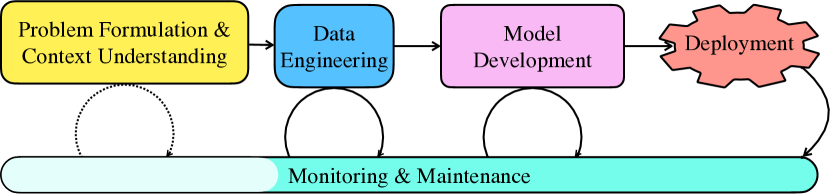
Deep learning (DL) has proven to be a highly effective approach for developing models in diverse contexts, including visual perception, speech recognition, and machine translation. However, the end-to-end process for applying DL is not trivial. It requires grappling with problem formulation and context understanding, data engineering, model development, deployment, continuous monitoring and maintenance, and so on. Moreover, each of these steps typically relies heavily on humans, in terms of both knowledge and interactions, which impedes the further advancement and democratization of DL. Consequently, in response to these issues, a new field has emerged over the last few years: automated deep learning (AutoDL). This endeavor seeks to minimize the need for human involvement and is best known for its achievements in neural architecture search (NAS), a topic that has been the focus of several surveys. That stated, NAS is not the be-all and end-all of AutoDL. Accordingly, this review adopts an overarching perspective, examining research efforts into automation across the entirety of an archetypal DL workflow. In so doing, this work also proposes a comprehensive set of ten criteria by which to assess existing work in both individual publications and broader research areas. These criteria are: novelty, solution quality, efficiency, stability, interpretability, reproducibility, engineering quality, scalability, generalizability, and eco-friendliness. Thus, ultimately, this review provides an evaluative overview of AutoDL in the early 2020s, identifying where future opportunities for progress may exist.
Motivation & Objective
- To move beyond the narrow focus on neural architecture search (NAS) and examine automation across the entire deep learning lifecycle.
- To identify key gaps in current AutoDL research, particularly in areas like automated data engineering, deployment, and model maintenance.
- To propose a standardized evaluation framework using ten criteria to improve rigor, reproducibility, and impact in AutoDL research.
- To challenge the research community to prioritize usability, autonomy, and long-term sustainability over short-term performance gains.
- To foster a more holistic and sustainable evolution of AutoDL by addressing human and systemic biases in research focus.
Proposed method
- Conduct a systematic review of AutoDL research across the full deep learning workflow, including problem formulation, data engineering, model development, hyperparameter optimization, deployment, and maintenance.
- Propose a comprehensive set of ten evaluation criteria—novelty, solution quality, efficiency, stability, interpretability, reproducibility, engineering quality, scalability, generalizability, and eco-friendliness—for assessing AutoDL methods.
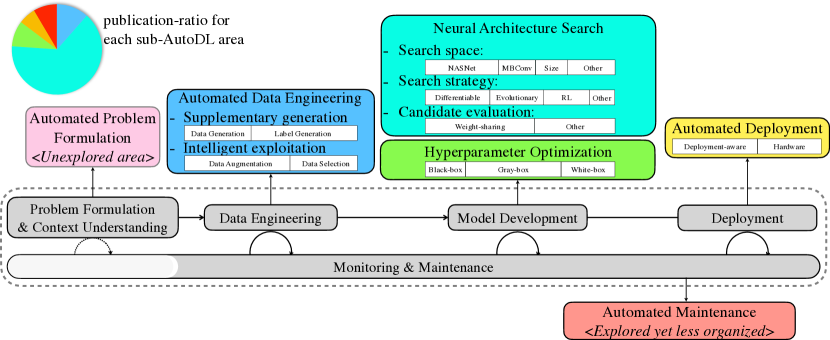
- Categorize existing approaches in key AutoDL subfields: NAS (black-box, gray-box, white-box), hyperparameter optimization (HPO), automated data engineering, hardware search, deployment-aware automation, and model maintenance (e.g., continual learning).
- Analyze the maturity and research density of each subfield, identifying underexplored areas such as automated data engineering and persistent model adaptation.
- Use the proposed criteria to evaluate and critique existing work, emphasizing the need for transparency, reproducibility, and long-term sustainability.
- Advocate for a shift in research culture toward broader, more responsible automation that considers real-world constraints and long-term system viability.
Experimental results
Research questions
- RQ1What are the key limitations of focusing exclusively on neural architecture search (NAS) in automated deep learning (AutoDL) research?
- RQ2How can the quality and impact of AutoDL research be objectively assessed beyond model accuracy and performance on benchmarks?
- RQ3Which stages of the deep learning lifecycle remain under-investigated in AutoDL, and why?
- RQ4To what extent do current AutoDL methods prioritize efficiency, reproducibility, and sustainability over performance alone?
- RQ5How can the research community adopt a more holistic and responsible approach to AutoDL development and evaluation?
Key findings
- Neural architecture search (NAS), while influential, is not the end goal of automated deep learning (AutoDL), and over-reliance on it limits broader progress.
- Many AutoDL subfields—such as automated data engineering, hardware search, and model maintenance—remain under-researched despite their critical role in real-world deployment.
- The proposed ten evaluation criteria (e.g., interpretability, reproducibility, eco-friendliness) provide a robust framework for assessing AutoDL research beyond performance metrics.
- White-box hyperparameter optimization (HPO) shows strong efficiency potential but lacks rigorous reproducibility studies, raising concerns about its long-term validity.
- Deployment-aware AutoDL is more advanced than hardware search due to the non-standardization of hardware, yet both areas are critical for real-world scalability.
- The field of AutoDL is hindered by human factors such as short-term focus, lack of reproducibility, and neglect of sustainability and engineering quality, which impede end-to-end automation.
Read this paper
Open the full text in the Nubint reader and ask about any passage as you read.
Read this paper on NubintThis review was generated by AI from the original paper. Please check the paper before citing it.