
[Paper Review] Automated title and abstract screening for scoping reviews using the GPT-4 Large Language Model
This paper introduces GPTscreenR, an R package that uses GPT-4 with chain-of-thought prompting to automate title and abstract screening in scoping reviews. It achieves 71% sensitivity, 89% specificity, and 84% accuracy—comparable to zero-shot methods but with improved error control, offering a user-friendly tool to reduce human workload in systematic literature screening.
Scoping reviews, a type of literature review, require intensive human effort to screen large numbers of scholarly sources for their relevance to the review objectives. This manuscript introduces GPTscreenR, a package for the R statistical programming language that uses the GPT-4 Large Language Model (LLM) to automatically screen sources. The package makes use of the chain-of-thought technique with the goal of maximising performance on complex screening tasks. In validation against consensus human reviewer decisions, GPTscreenR performed similarly to an alternative zero-shot technique, with a sensitivity of 71%, specificity of 89%, and overall accuracy of 84%. Neither method achieved perfect accuracy nor human levels of intraobserver agreement. GPTscreenR demonstrates the potential for LLMs to support scholarly work and provides a user-friendly software framework that can be integrated into existing review processes.
Motivation & Objective
- To reduce the intensive human effort required for screening large numbers of sources in scoping reviews.
- To develop a user-friendly, open-source R package that integrates GPT-4 into existing review workflows.
- To evaluate the performance of chain-of-thought prompting with GPT-4 for title and abstract screening in comparison to zero-shot prompting.
- To assess the reliability and transparency of LLM-based screening relative to human reviewer consensus.
- To provide a framework for integrating LLMs into scholarly review processes while maintaining auditability through reasoning traces.
Proposed method
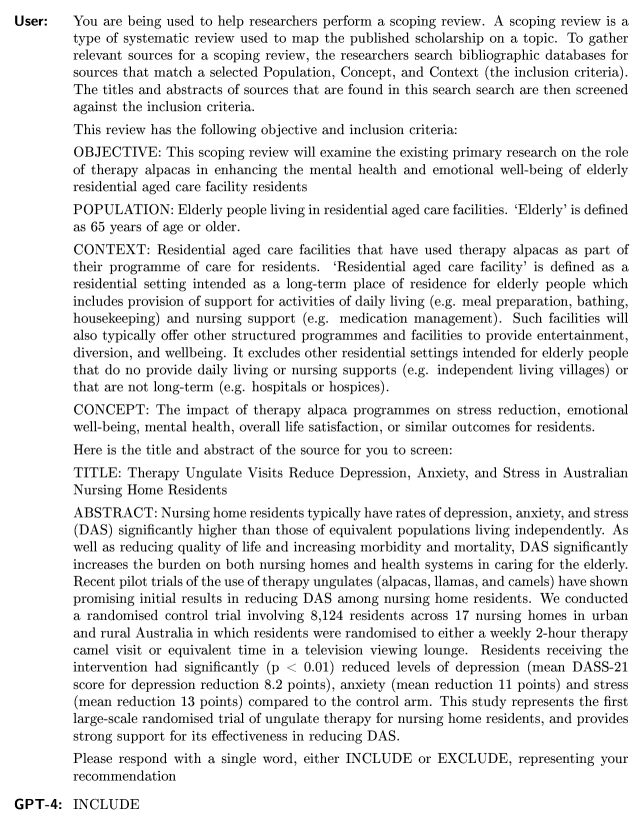
- The GPTscreenR package implements a chain-of-thought prompting strategy, breaking down screening decisions into intermediate reasoning steps.
- Each source is processed via a prompt that instructs GPT-4 to evaluate relevance based on inclusion and exclusion criteria, step-by-step.
- The model generates a reasoning transcript before outputting a final decision to include or exclude a source.
- Performance is evaluated by comparing GPT-4 decisions against consensus human reviewer judgments across multiple scoping reviews.
- The approach uses the OpenAI API with GPT-4, charging per token, and is implemented as an open-source R package under the MIT license.
- The method supports transparency by allowing reviewers to inspect the reasoning chain behind each LLM decision.

Experimental results
Research questions
- RQ1Can chain-of-thought prompting with GPT-4 improve the reliability and transparency of automated screening in scoping reviews compared to zero-shot prompting?
- RQ2How does the performance of GPTscreenR compare to human reviewer consensus in terms of sensitivity, specificity, and overall accuracy?
- RQ3To what extent does the chain-of-thought approach reduce type I errors (false positives) compared to zero-shot methods?
- RQ4What are the practical limitations of using GPT-4 for screening, including cost, time, and data quality dependencies?
- RQ5Can the reasoning traces generated by GPT-4 support human reviewers in resolving disagreements or improving decision consistency?
Key findings
- GPTscreenR achieved a sensitivity of 71%, specificity of 89%, and overall accuracy of 84% when compared to human consensus decisions.
- The chain-of-thought method showed higher specificity (89%) than the zero-shot method (84%) but lower sensitivity (71% vs. 78%), indicating a trade-off favoring reduced false positives.
- Performance was limited by data quality issues in the validation reviews, including missing or malformed abstracts and inconsistent screening records.
- The chain-of-thought approach enabled reviewers to inspect the reasoning behind each LLM decision, enhancing transparency and auditability.
- Despite comparable performance to zero-shot methods, GPTscreenR did not reach the level of inter-human reviewer agreement, indicating room for improvement.
- The method incurred higher token usage and cost than zero-shot prompting due to longer reasoning sequences, affecting scalability for large-scale screening tasks.
Read this paper
Open the full text in the Nubint reader and ask about any passage as you read.
Read this paper on NubintThis review was generated by AI from the original paper. Please check the paper before citing it.