
[Paper Review] Automatic acoustic detection of birds through deep learning: the first Bird Audio Detection challenge
The paper reports a public data challenge showing deep learning can achieve high general-purpose bird detection in unseen acoustic conditions, with top AUC around 88% and strong generalisation across diverse datasets.
Assessing the presence and abundance of birds is important for monitoring specific species as well as overall ecosystem health. Many birds are most readily detected by their sounds, and thus passive acoustic monitoring is highly appropriate. Yet acoustic monitoring is often held back by practical limitations such as the need for manual configuration, reliance on example sound libraries, low accuracy, low robustness, and limited ability to generalise to novel acoustic conditions. Here we report outcomes from a collaborative data challenge showing that with modern machine learning including deep learning, general-purpose acoustic bird detection can achieve very high retrieval rates in remote monitoring data --- with no manual recalibration, and no pre-training of the detector for the target species or the acoustic conditions in the target environment. Multiple methods were able to attain performance of around 88% AUC (area under the ROC curve), much higher performance than previous general-purpose methods. We present new acoustic monitoring datasets, summarise the machine learning techniques proposed by challenge teams, conduct detailed performance evaluation, and discuss how such approaches to detection can be integrated into remote monitoring projects.
Motivation & Objective
- Motivate robust, general-purpose bird detection in remote acoustic monitoring without species-specific tuning or environment-specific calibration.
- Create diverse annotated datasets from remote monitoring and crowdsourced sources to test generalisation.
- Benchmark baseline and deep-learning methods against a common, agnostic detection task evaluated with AUC.
- Analyze detector calibration and error types to inform deployment in real-world monitoring grids.
Proposed method
- Assemble multi-source datasets (Chernobyl CEZ, Warblr crowdsourced, freefield1010, PolandNFC) and annotate ten-second clips for bird-present/absent labels.
- Define a generic detection task: label each 10-second clip as bird present or absent, enabling precise time localization within ±10 seconds.
- Provide development data to participants and private testing data to prevent overfitting, plus a separate dataset for generalisation testing.
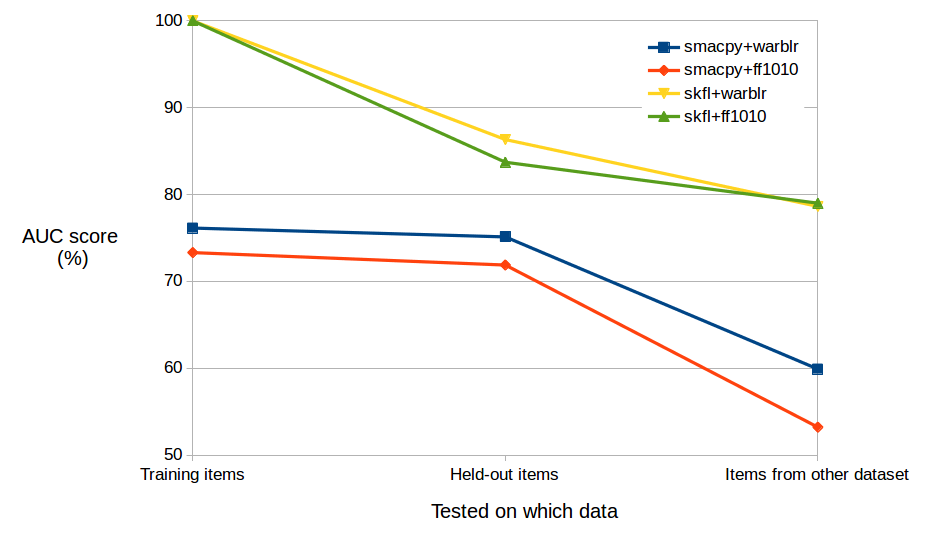
- Baseline classifiers: smacpy (MFCCs with Gaussian mixture models) and skfl (unsupervised feature learning on Mel spectrograms with a random forest).
- Participants employed deep learning approaches (often CNNs) with spectrogram (mel) inputs and data augmentation; outputs were probabilistic scores used to compute AUC.
- Evaluation focused on generalisation across unseen conditions and sites, plus calibration analysis via calibration plots.
Experimental results
Research questions
- RQ1Can general-purpose, species-agnostic detectors achieve high bird-detection performance without environment-specific tuning?
- RQ2How well do detection methods generalise to unseen acoustic environments and data sources?
- RQ3What are the calibration properties of deep-learning based detectors, and how do they vary across sites (e.g., Warblr vs. Chernobyl)?
- RQ4What are the common error sources in challenging recordings (low SNR, wind, insect noise, human activity) that limit detection?
Key findings
- Deep learning methods achieved strong performance, with most teams exceeding 80% AUC and the top score reaching 88.7% AUC.
- Inter-rater reliability on the re-validated testing set was high (AUC 96.7%), indicating substantial agreement between human and machine judgments under the re-validation protocol.
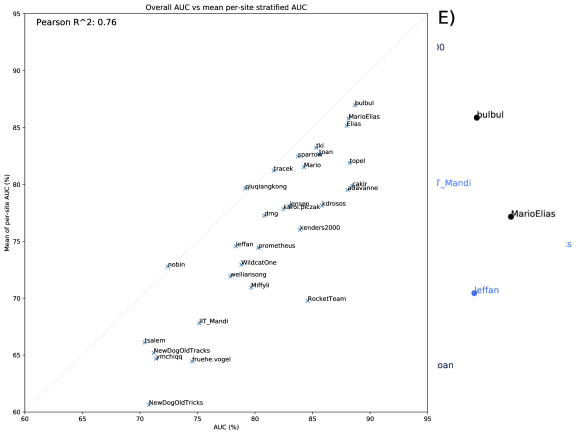
- Performance varied by site, with Warblr data easily detected (AUC > 95%), while some CEZ locations were more challenging (as low as ~80% AUC for leading methods).
- Calibration of detections varied by dataset; some top methods showed good calibration on seen data but poorer calibration on unseen CEZ data, highlighting calibration as a separate consideration for deployment.
- Most submissions used spectrogram/mel representations with data augmentation, and CNN-based deep learning approaches dominated the top results.
- The strongest detector continued to show robust generalisation tendencies across site-based analyses, though the exact rank order varied when evaluated per site.
Read this paper
Open the full text in the Nubint reader and ask about any passage as you read.
Read this paper on NubintThis review was generated by AI from the original paper. Please check the paper before citing it.