
[Paper Review] Automatic Pulmonary Lobe Segmentation Using Deep Learning
This paper presents a deep learning framework for automatic pulmonary lobe segmentation in CT scans using a hybrid loss function combining dice and focal loss to address class imbalance and hard-to-classify voxels. By pre-processing with convex hull cropping and training on 50 manually annotated LUNA16 scans, the model achieves state-of-the-art performance with 91.48% average dice coefficient on LUNA16 and 94.17% on an independent Tianchi dataset, demonstrating strong generalization across datasets.
Pulmonary lobe segmentation is an important task for pulmonary disease related Computer Aided Diagnosis systems (CADs). Classical methods for lobe segmentation rely on successful detection of fissures and other anatomical information such as the location of blood vessels and airways. With the success of deep learning in recent years, Deep Convolutional Neural Network (DCNN) has been widely applied to analyze medical images like Computed Tomography (CT) and Magnetic Resonance Imaging (MRI), which, however, requires a large number of ground truth annotations. In this work, we release our manually labeled 50 CT scans which are randomly chosen from the LUNA16 dataset and explore the use of deep learning on this task. We propose pre-processing CT image by cropping region that is covered by the convex hull of the lungs in order to mitigate the influence of noise from outside the lungs. Moreover, we design a hybrid loss function with dice loss to tackle extreme class imbalance issue and focal loss to force model to focus on voxels that are hard to be discriminated. To validate the robustness and performance of our proposed framework trained with a small number of training examples, we further tested our model on CT scans from an independent dataset. Experimental results show the robustness of the proposed approach, which consistently improves performance across different datasets by a maximum of $5.87\%$ as compared to a baseline model.
Motivation & Objective
- To develop a robust deep learning framework for pulmonary lobe segmentation in CT scans with limited annotated data.
- To address the extreme class imbalance in lung lobe segmentation by combining dice loss and focal loss.
- To improve model generalization across diverse CT datasets through pre-processing with convex hull cropping.
- To release a publicly available, manually annotated dataset of 50 LUNA16 CT scans for supervised pulmonary lobe segmentation research.
Proposed method
- Pre-processes CT scans by cropping the region within the convex hull of the lungs to reduce noise from outside the thorax.
- Uses a hybrid loss function combining dice loss for handling class imbalance and focal loss to focus on hard-to-classify voxels.
- Applies data augmentation via random shifts, z-axis flipping, and XY-plane rotation to improve generalization.
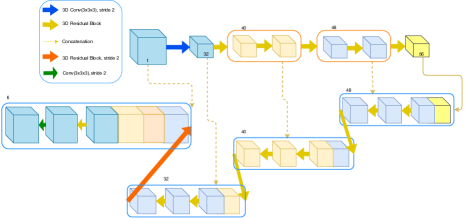
- Trains a 3D U-Net-based deep convolutional neural network using Adam optimizer over 300 epochs with a batch size of one.
- Evaluates performance using the dice coefficient, computing per-lobe and average dice scores across all lobes.
- Validates robustness by testing on an independent holdout set of 10 CT scans from the Tianchi dataset.
Experimental results
Research questions
- RQ1Can a deep learning model achieve high-performance pulmonary lobe segmentation with only 50 manually annotated CT scans?
- RQ2How does the use of a hybrid loss function combining dice and focal loss improve segmentation accuracy in the presence of extreme class imbalance?
- RQ3To what extent does pre-processing with convex hull cropping enhance model robustness and performance on out-of-distribution CT scans?
- RQ4How well does the model generalize to independent datasets not used during training, such as the Tianchi dataset?
- RQ5Does the proposed framework outperform existing state-of-the-art methods in pulmonary lobe segmentation?
Key findings
- The proposed framework achieves a state-of-the-art average dice coefficient of 91.48% on the LUNA16 test set and 94.17% on the Tianchi test set.
- The addition of focal loss to dice loss improves the average dice coefficient by 3.87% on LUNA16 and 3.95% on Tianchi compared to a baseline model using only dice loss.
- Pre-processing with convex hull cropping further increases the average dice coefficient by 0.54% on LUNA16 and 1.92% on Tianchi compared to the hybrid loss-only model.
- The model outperforms the previous state-of-the-art method [7] by up to 2.39% in average dice coefficient across both datasets.
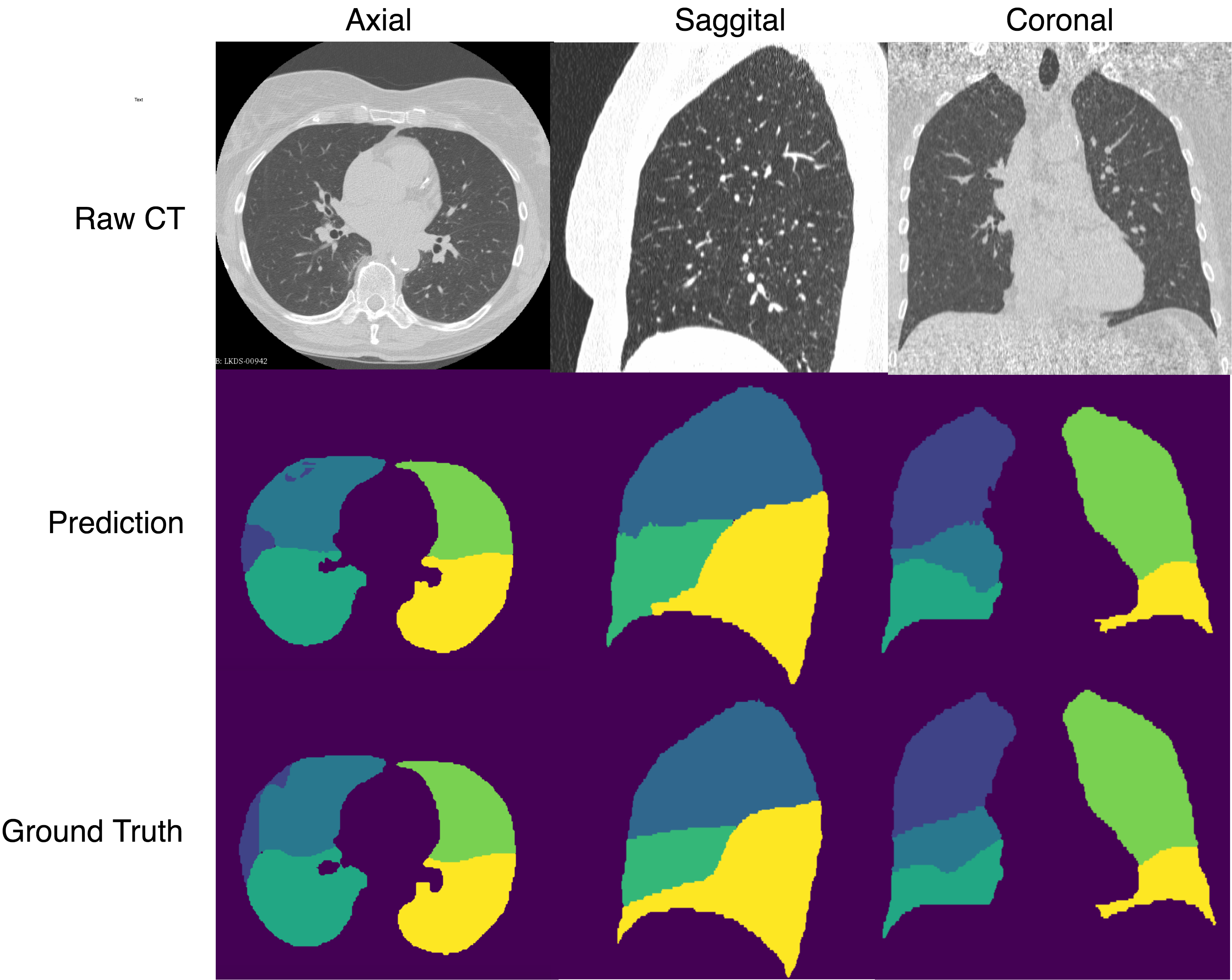
- Qualitative visualizations confirm that the model effectively captures lobe boundaries and reduces false positives, especially in regions near fissures.
- The public release of 50 manually annotated CT scans from LUNA16 provides a valuable benchmark for future supervised pulmonary lobe segmentation research.
Better researchstarts right now
From reading papers to final review, dramatically reduce your research time.
No credit card · Free plan available
This review was created by AI and reviewed by human editors.