
[Paper Review] AutoML-GPT: Automatic Machine Learning with GPT
AutoML-GPT uses a GPT-based controller to automatically run data processing, model design, and hyperparameter tuning via task- and data-card prompts, enabling end-to-end AutoML across vision, NLP, and more. It achieves strong results on unseen datasets and multiple tasks by predicting training logs and hyperparameters.
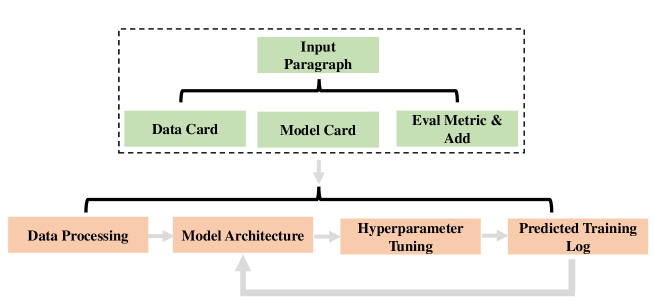
AI tasks encompass a wide range of domains and fields. While numerous AI models have been designed for specific tasks and applications, they often require considerable human efforts in finding the right model architecture, optimization algorithm, and hyperparameters. Recent advances in large language models (LLMs) like ChatGPT show remarkable capabilities in various aspects of reasoning, comprehension, and interaction. Consequently, we propose developing task-oriented prompts and automatically utilizing LLMs to automate the training pipeline. To implement this concept, we present the AutoML-GPT, which employs GPT as the bridge to diverse AI models and dynamically trains models with optimized hyperparameters. AutoML-GPT dynamically takes user requests from the model and data cards and composes the corresponding prompt paragraph. Ultimately, with this prompt paragraph, AutoML-GPT will automatically conduct the experiments from data processing to model architecture, hyperparameter tuning, and predicted training log. By leveraging {\ours}'s robust language capabilities and the available AI models, AutoML-GPT can tackle numerous intricate AI tasks across various tasks and datasets. This approach achieves remarkable results in computer vision, natural language processing, and other challenging areas. Extensive experiments and ablation studies demonstrate that our method can be general, effective, and beneficial for many AI tasks.
Motivation & Objective
- Motivate automatic training of ML pipelines via LLMs to reduce human effort in model selection and hyperparameter tuning.
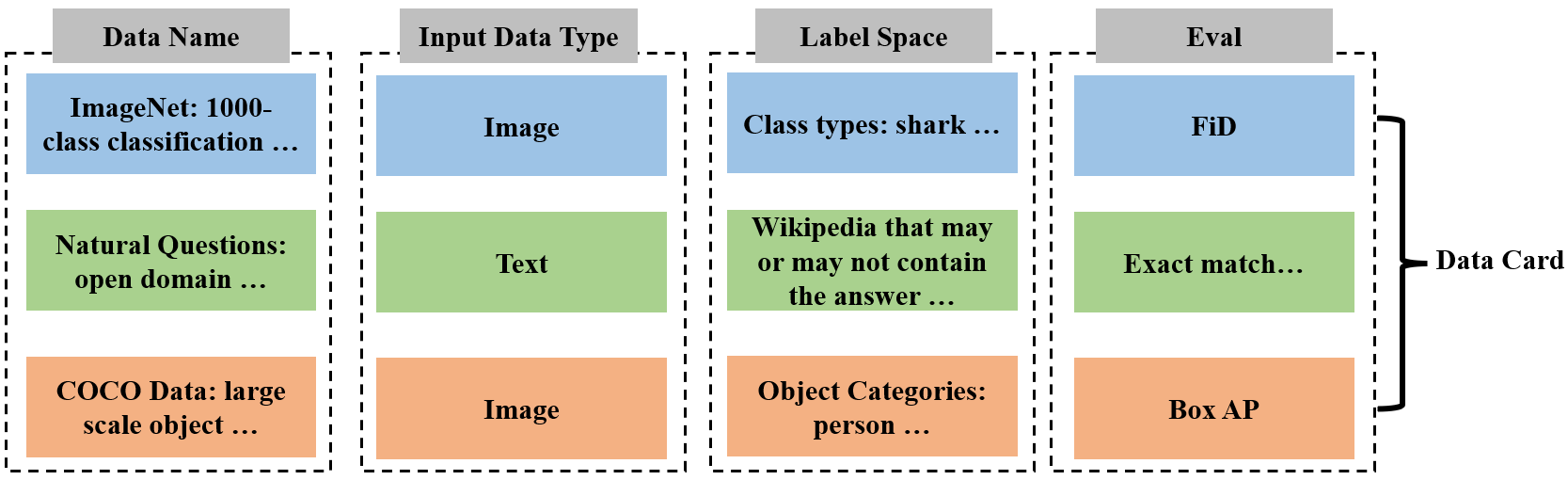
- Propose a prompt-based AutoML pipeline that leverages data cards and model cards as structured inputs.
- Demonstrate end-to-end AutoML performance across vision, NLP, and classification tasks, including unseen datasets.
Proposed method
- Define a fixed-format input prompt paragraph by fusing model cards and data cards.
- Use the LLM as controller to orchestrate data processing, architecture design, hyperparameter tuning, and training-log generation.
- Predict training logs and hyperparameters from the generated prompts to guide subsequent experiments and user interactions.
- Leverage similarity between data cards via a text encoder to transfer hyperparameters to unseen datasets.
- Evaluate AutoML-GPT on multiple tasks and report tuning outcomes and predicted logs.
Experimental results
Research questions
- RQ1Can GPT-based prompts automatically configure data processing, model architectures, and hyperparameters for diverse tasks?
- RQ2How well can AutoML-GPT generalize to unseen datasets using only dataset metadata (data cards)?
- RQ3What is the accuracy of hyperparameter predictions and resulting model performance across vision, QA, and classification tasks?
Key findings
- On unseen datasets, AutoML-GPT achieves 98% Top-1 accuracy for the best-predicted hyperparameters versus 80% with randomly selected hyperparameters.
- Using AutoML-GPT hyperparameters to initialize models yields 82% Top-1 accuracy, outperforming random initialization but below the best AutoML-GPT configuration.
- For a classification task on UCI Adult with XGBoost, AutoML-GPT-based training achieved 85.92% accuracy and a final validation loss of 0.277.
- The object-detection case on COCO demonstrates the end-to-end pipeline from data/card prompts to hyperparameter tuning and training-log generation.
Read this paper
Open the full text in the Nubint reader and ask about any passage as you read.
Read this paper on NubintThis review was generated by AI from the original paper. Please check the paper before citing it.