
[Paper Review] Autonomous Evaluation and Refinement of Digital Agents
This paper proposes domain-general neural evaluators to autonomously assess and refine digital agents for web navigation and device control without human supervision. Using vision-language models to evaluate agent trajectories via captioning-and-reasoning or end-to-end prompting, the method achieves up to 92.9% agreement with oracle metrics and boosts GPT-4 agent performance by 29% on WebArena and 75% in a challenging iOS transfer setting through fine-tuning and inference-time guidance.
We show that domain-general automatic evaluators can significantly improve the performance of agents for web navigation and device control. We experiment with multiple evaluation models that trade off between inference cost, modularity of design, and accuracy. We validate the performance of these models in several popular benchmarks for digital agents, finding between 74.4 and 92.9% agreement with oracle evaluation metrics. Finally, we use these evaluators to improve the performance of existing agents via fine-tuning and inference-time guidance. Without any additional supervision, we improve state-of-the-art performance by 29% on the popular benchmark WebArena, and achieve around 75% relative improvement in device control settings.
Motivation & Objective
- To develop automatic, domain-general evaluators for digital agents that do not require expert demonstrations or hand-designed evaluation functions.
- To improve agent performance through autonomous evaluation and refinement without access to external supervision or oracle metrics.
- To validate the efficacy of neural evaluators in real-world benchmarks like WebArena and Android-in-the-Wild.
- To enable performance gains in low-resource or unseen domains, such as iOS device control, using self-evaluation for behavior cloning.
- To demonstrate that self-evaluation can enhance both training and inference-time policy improvement in open-ended digital agent tasks.
Proposed method
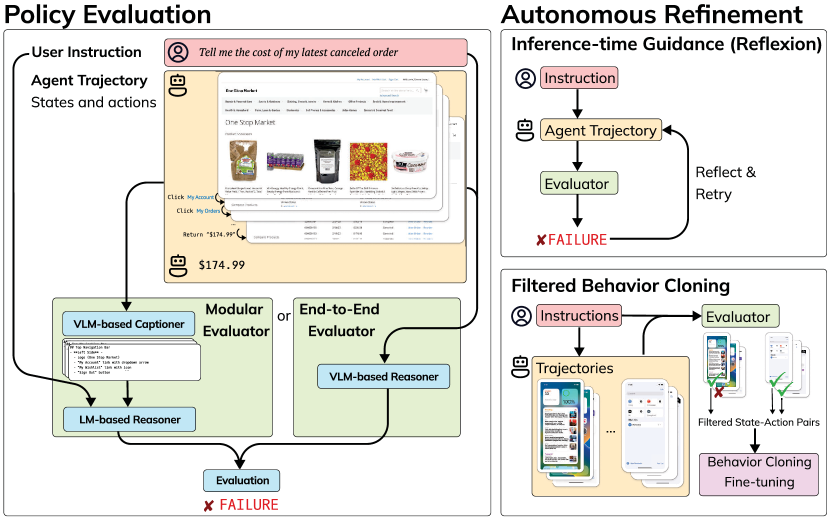
- Proposes two evaluation approaches: a modular caption-then-reason pipeline using a vision-language model (VLM) followed by a language model (LM), and an end-to-end VLM-based evaluation using models like GPT-4V.
- Uses the VLM to generate textual descriptions of agent trajectories from screenshots, then applies an LM to determine success based on instruction and observed outcomes.
- Employs the evaluator as a reward function in Reflexion-style inference-time planning to guide agent behavior without external supervision.
- Applies the evaluator to filter and refine trajectories during behavior cloning, enabling performance gains in low-data or unseen domains like iOS device control.
- Trains and fine-tunes agents using the self-evaluation signal, achieving improved success rates without additional demonstration data.
- Validates evaluation accuracy against oracle metrics on WebArena (82.1% agreement) and Android-in-the-Wild (92.9% agreement).
Experimental results
Research questions
- RQ1Can domain-general neural evaluators accurately assess digital agent performance without access to oracle metrics or expert demonstrations?
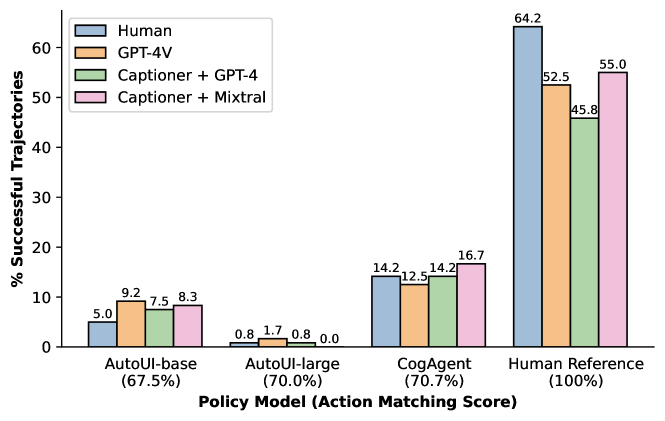
- RQ2How effective are modular caption-then-reason and end-to-end evaluation approaches in matching human-annotated success rates?
- RQ3To what extent can autonomous evaluation improve agent performance in zero-shot or few-shot domain transfer scenarios?
- RQ4Can self-evaluation be used to enhance both training and inference-time policy optimization in real-world digital agent tasks?
- RQ5What is the trade-off between evaluation cost, modularity, and accuracy in automated agent evaluation systems?
Key findings
- The proposed evaluators achieve 82.1% agreement with oracle metrics on WebArena and 92.9% on Android-in-the-Wild, demonstrating high accuracy in automatic evaluation.
- When used as a reward function in Reflexion, the evaluator improves the success rate of the best GPT-4 WebArena agent by 29% relative improvement.
- In a challenging iOS device control domain transfer setting with no existing benchmark or training data, the method achieves a 75% relative improvement in accuracy using filtered behavior cloning.
- The end-to-end VLM-based evaluation approach achieves higher accuracy (92.9%) than the modular caption-then-reason method, though at higher inference cost.
- The evaluators enable significant performance gains without any additional supervision, demonstrating the feasibility of self-improving agents in open-ended digital environments.
- The method generalizes across domains, showing strong performance in both web navigation and mobile device control tasks with minimal in-domain data.
Read this paper
Open the full text in the Nubint reader and ask about any passage as you read.
Read this paper on NubintThis review was generated by AI from the original paper. Please check the paper before citing it.