
[Paper Review] AutoProteinEngine: A Large Language Model Driven Agent Framework for Multimodal AutoML in Protein Engineering
AutoProteinEngine uses an LLM-driven agent framework to perform multimodal AutoML for protein engineering, outperforming zero-shot and manually tuned baselines in classification and regression tasks.
Protein engineering is important for biomedical applications, but conventional approaches are often inefficient and resource-intensive. While deep learning (DL) models have shown promise, their training or implementation into protein engineering remains challenging for biologists without specialized computational expertise. To address this gap, we propose AutoProteinEngine (AutoPE), an agent framework that leverages large language models (LLMs) for multimodal automated machine learning (AutoML) for protein engineering. AutoPE innovatively allows biologists without DL backgrounds to interact with DL models using natural language, lowering the entry barrier for protein engineering tasks. Our AutoPE uniquely integrates LLMs with AutoML to handle model selection for both protein sequence and graph modalities, automatic hyperparameter optimization, and automated data retrieval from protein databases. We evaluated AutoPE through two real-world protein engineering tasks, demonstrating substantial performance improvements compared to traditional zero-shot and manual fine-tuning approaches. By bridging the gap between DL and biologists' domain expertise, AutoPE empowers researchers to leverage DL without extensive programming knowledge. Our code is available at https://github.com/tsynbio/AutoPE.
Motivation & Objective
- Lower the entry barrier for protein engineering by enabling non-DL-expert biologists to use DL models via natural language interfaces.
- Automate model selection for protein sequence and graph modalities, hyperparameter optimization, and data retrieval from public databases.
- Demonstrate improved performance over zero-shot and manually tuned baselines on real-world protein tasks.
Proposed method
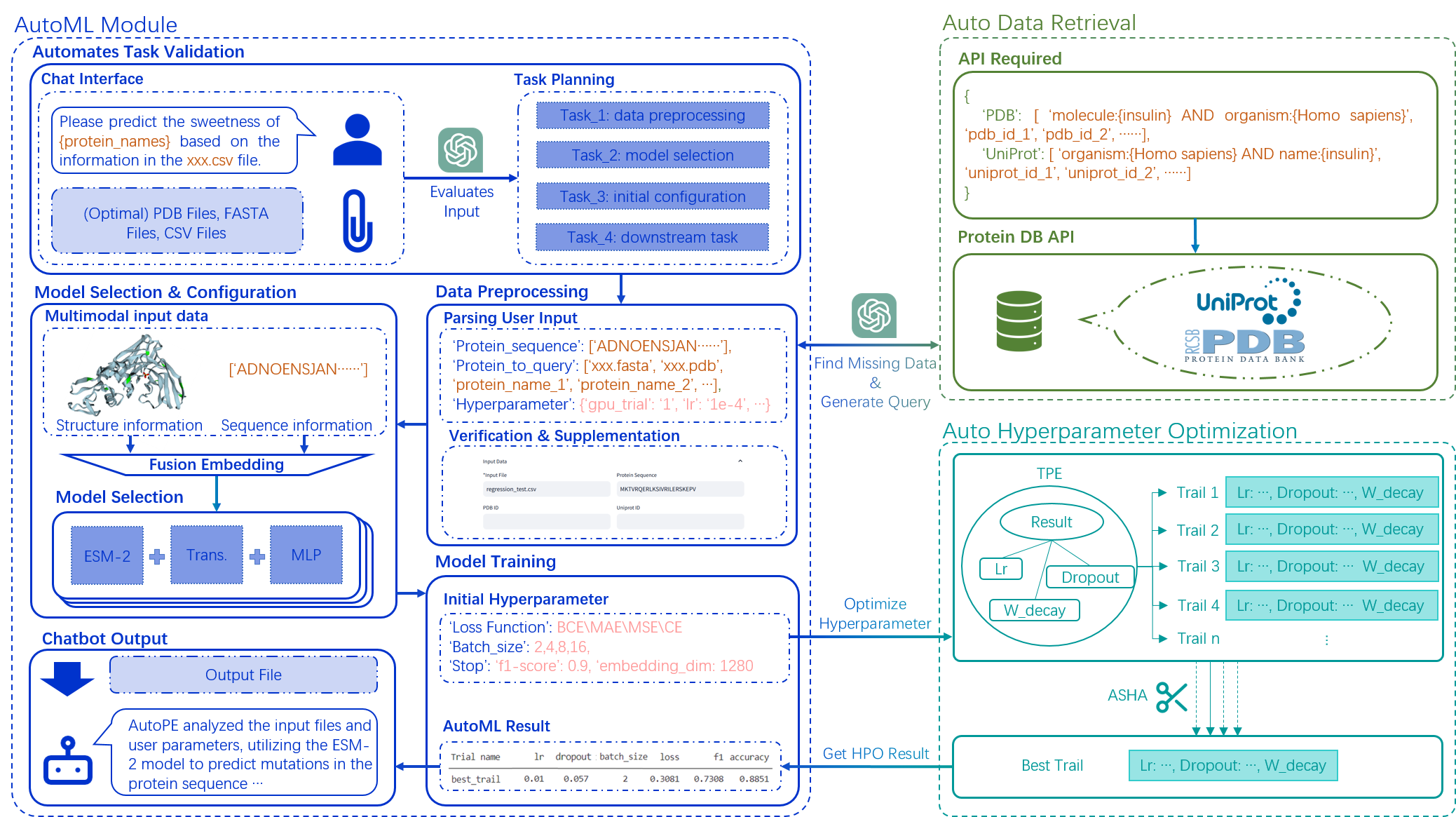
- LLM-driven AutoML pipeline that validates tasks, plans data preprocessing, selects models from a predefined zoo (e.g., ESM, AlphaFold), and configures training.
- Late fusion for multimodal (sequence and graph) protein data to leverage complementary information.
- Auto hyperparameter optimization using Tree-structured Parzen Estimator (TPE) and ASHA via Ray.Tune, guided by natural-language interactions.
- Automated data retrieval from UniProt and PDB guided by LLM-generated queries with fallback dialogue for missing data.
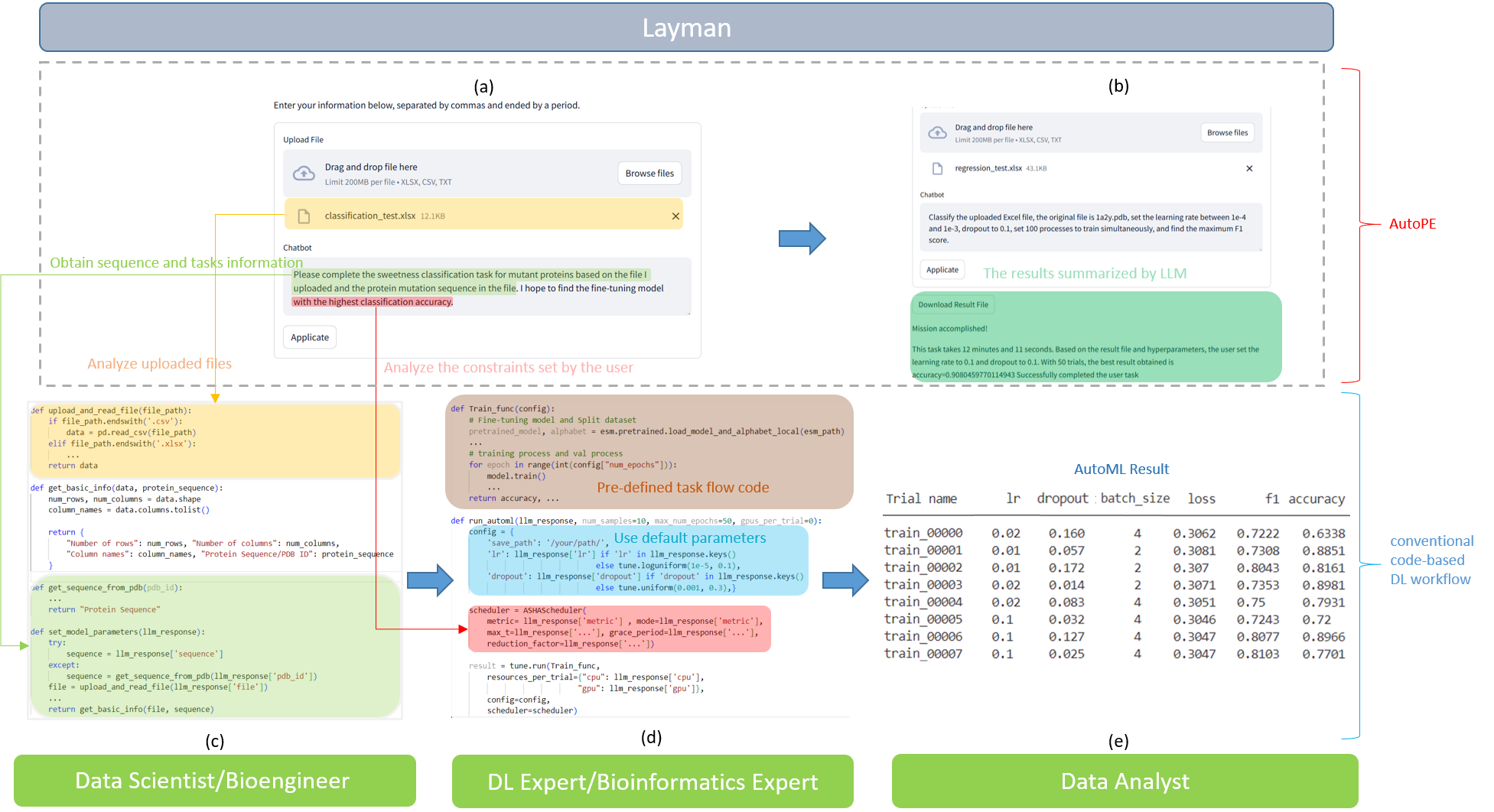
- Interactive, natural-language feedback translating metrics into user-friendly summaries to improve interpretability.
Experimental results
Research questions
- RQ1Can an LLM-driven agent framework perform effective multimodal AutoML for protein engineering tasks involving sequence and graph data?
- RQ2Does automated hyperparameter optimization guided by an LLM improve performance over zero-shot and manually tuned baselines?
- RQ3How effective is automated data retrieval from protein databases in supporting DL model training for protein engineering?
Key findings
- AutoPE with auto HPO achieves the best trade-off of performance and robustness across tasks, outperforming zero-shot and non-HPO variants.
- In Brazzein sweetness classification, AutoPE w/HPO attains F1 0.7306, SRCC 0.4621, and accuracy 0.8908, higher than zero-shot and w/o-HPO variants.
- In STM1221 enzyme activity regression, AutoPE w/HPO achieves RMSE 0.3488, MAE 0.1999, and R2 0.6805, outperforming zero-shot and w/o-HPO variants.
- Manual fine-tuning can yield high accuracy but may underperform in F1 and robustness; AutoPE with HPO provides a better balance and generalizability.
- The framework supports multimodal data fusion and automated data retrieval, reducing the need for specialized DL expertise.
Read this paper
Open the full text in the Nubint reader and ask about any passage as you read.
Read this paper on NubintThis review was generated by AI from the original paper. Please check the paper before citing it.