
[Paper Review] AutoRT: Embodied Foundation Models for Large Scale Orchestration of Robotic Agents
AutoRT systems use vision-language and language models to orchestrate a fleet of real-world robots for diverse data collection, achieving 77k episodes across 20+ robots in 7 months with mixed autonomy and teleoperation.
Foundation models that incorporate language, vision, and more recently actions have revolutionized the ability to harness internet scale data to reason about useful tasks. However, one of the key challenges of training embodied foundation models is the lack of data grounded in the physical world. In this paper, we propose AutoRT, a system that leverages existing foundation models to scale up the deployment of operational robots in completely unseen scenarios with minimal human supervision. AutoRT leverages vision-language models (VLMs) for scene understanding and grounding, and further uses large language models (LLMs) for proposing diverse and novel instructions to be performed by a fleet of robots. Guiding data collection by tapping into the knowledge of foundation models enables AutoRT to effectively reason about autonomy tradeoffs and safety while significantly scaling up data collection for robot learning. We demonstrate AutoRT proposing instructions to over 20 robots across multiple buildings and collecting 77k real robot episodes via both teleoperation and autonomous robot policies. We experimentally show that such "in-the-wild" data collected by AutoRT is significantly more diverse, and that AutoRT's use of LLMs allows for instruction following data collection robots that can align to human preferences.
Motivation & Objective
- Motivate the need for large-scale, real-world robotic data collection beyond lab settings.
- Propose a system that uses foundation models to plan, ground, and execute tasks with a fleet of robots.
- Enable mixed supervision by autonomous policies and human teleoperators under safety constraints.
- Demonstrate real-world deployment across multiple buildings with substantial data collection.
- Show that data collected via AutoRT improves downstream robot learning models.
Proposed method
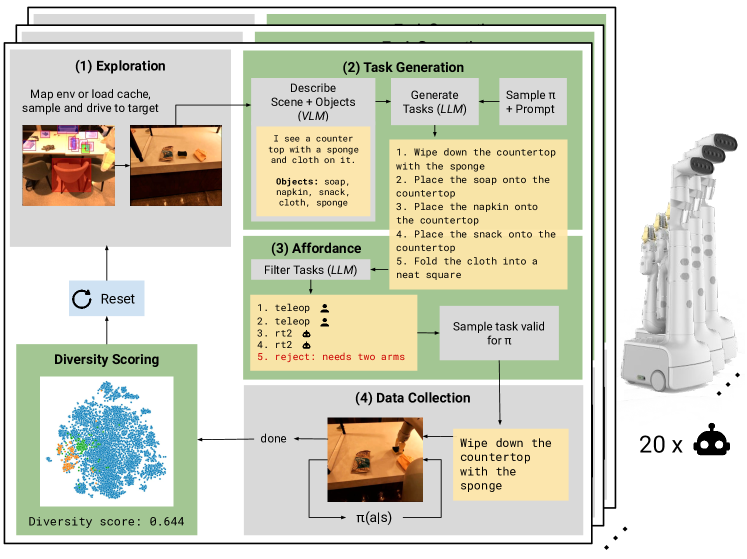
- Use a vision-language model to describe scenes and ground objects.
- Leverage large language models to generate diverse and novel manipulation tasks from scene descriptions.
- Apply a robot constitution with safety and embodiment rules to constrain task proposals.
- Incorporate an affordance filtering step where an LLM critiques and selects feasible tasks and policies.
- Coordinate a fleet of robots with multiple collect policies (teleop, scripted pick, RT-2) under supervision constraints.
- Evaluate diversity and feasibility of generated tasks and demonstrate data utility for RT-1 model fine-tuning.
Experimental results
Research questions
- RQ1Can an embodied foundation-model-driven system scale real-world robotic data collection across a fleet of robots?
- RQ2How effectively can LLMs generate safe, feasible, and diverse manipulation tasks grounded in visual observations?
- RQ3What is the impact of robot constitution and affordance prompting on task safety and relevance?
- RQ4How does AutoRT data influence downstream robot learning models such as RT-1?
- RQ5What are the throughput, diversity, and safety characteristics of in-the-wild data collection with mixed supervision?
Key findings
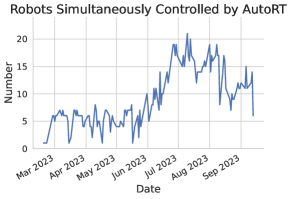
- AutoRT collected 77,000 real-world episodes across 53 robots in 7 months in 4 buildings.
- A single human supervised 3–5 robots, enabling scalable deployment.
- Teleoperation yielded the highest task success rate (82%), while scripted policies were most frequently used (73,293 episodes).
- RT-2 autonomy had low success during collection (4.7%), reflecting domain shift from training data.
- AutoRT data exhibited higher language and visual diversity than baselines, and prompted data can improve RT-1 performance (picking height, wiping).
- Constitutional prompting and self-reflection-based affordance filtering improved safety and feasibility of proposed tasks.
Read this paper
Open the full text in the Nubint reader and ask about any passage as you read.
Read this paper on NubintThis review was generated by AI from the original paper. Please check the paper before citing it.