
[Paper Review] AutoScrum: Automating Project Planning Using Large Language Models
This paper introduces AutoScrum, a framework that leverages large language models (LLMs) like GPT-3.5-turbo with Guidance language to automate agile project planning through two approaches: a structured Scrum-based pipeline and a shortcut iterative planning method. It demonstrates that LLMs can autonomously generate task sequences from current-to-desired state goals, achieving coherent, goal-directed project plans with minimal human intervention.
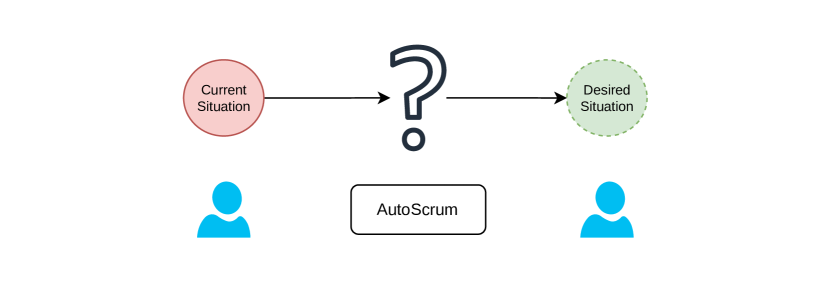
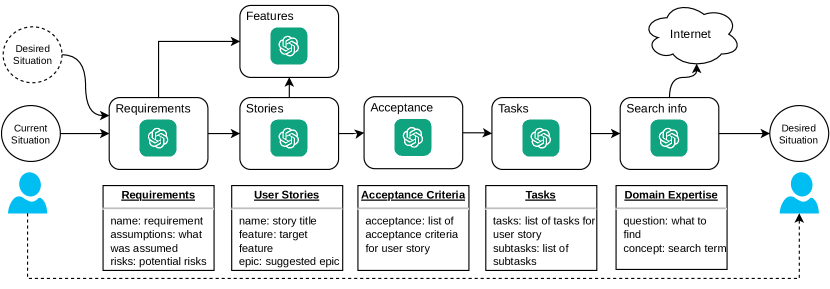
Recent advancements in the field of large language models have made it possible to use language models for advanced reasoning. In this paper we leverage this ability for designing complex project plans based only on knowing the current state and the desired state. Two approaches are demonstrated - a scrum based approach and a shortcut plan approach. The scrum based approach executes an automated process of requirements gathering, user story mapping, feature identification, task decomposition and finally generates questions and search terms for seeking out domain specific information to assist with task completion. The shortcut approach looks at most recent snapshot of the current and desired state and generates the next most reasonable task to do in order to get to the desired state as quickly as possible. In this paper we automate everything using a novel concept of "Language Programs". These are programs written in natural language designed to process input data through the language model. Guidance language is used for all LLM programs. All demo source code for this paper is available at https://github.com/autoscrum/autoscrum
Motivation & Objective
- To automate end-to-end project planning in agile environments using large language models.
- To address the high cognitive load and inefficiency of manual project planning in Scrum methodologies.
- To explore whether LLMs can autonomously generate realistic, goal-directed task sequences from defined current and desired states.
- To evaluate the effectiveness of two distinct planning strategies: structured Scrum pipeline and iterative shortcut planning.
- To demonstrate that LLMs, when guided by structured prompting and programmatic control, can produce coherent, actionable project plans without human intervention.
Proposed method
- The framework uses 'Language Programs'—natural language scripts executed via the Guidance library to control LLM behavior with structured prompting.
- A Scrum-based approach automates requirements gathering, user story mapping, feature identification, task decomposition, and information-seeking queries.
- A shortcut approach uses iterative LLM inference to generate the next most logical task based on current and desired states, mimicking a greedy pathfinding strategy.
- Temperature hyperparameters (0–0.1) are used to ensure deterministic, focused outputs; higher temperature (1.2) is tested to assess sensitivity.
- All LLM interactions are grounded in a fixed prompt structure with explicit role definitions, task tracking, and status reporting.
- Full source code is released on GitHub using Microsoft Guidance syntax, enabling reproducibility and integration with open-source and proprietary LLMs.
Experimental results
Research questions
- RQ1Can large language models autonomously generate a complete project plan using only the current and desired states?
- RQ2How effective is a structured Scrum-based workflow in guiding LLMs to produce coherent, actionable project plans?
- RQ3Can an iterative shortcut planning approach outperform traditional planning in terms of speed and goal alignment?
- RQ4How does temperature setting affect the quality and coherence of generated project plans?
- RQ5To what extent can LLMs simulate human-like reasoning and planning in agile software development contexts?
Key findings
- The Scrum-based approach successfully generated a full project plan for a chicken farm goal, including requirements, user stories, task decomposition, and information-seeking queries.
- The shortcut approach produced a coherent, goal-directed sequence of tasks that progressed from current to desired state, with minimal deviation.
- Lower temperature settings (0–0.1) produced more deterministic and focused task sequences, while higher temperature (1.2) led to more aggressive but less stable planning paths.
- The framework demonstrated that LLMs can simulate multi-step reasoning and planning under structured prompting, even with GPT-3.5-turbo.
- The use of Guidance language enabled reliable programmatic control over LLM behavior, allowing for repeatable and auditable planning workflows.
- The full source code and example plans are publicly available, enabling replication and extension of the framework.
Read this paper
Open the full text in the Nubint reader and ask about any passage as you read.
Read this paper on NubintThis review was generated by AI from the original paper. Please check the paper before citing it.