
[Paper Review] B-AVIBench: Towards Evaluating the Robustness of Large Vision-Language Model on Black-box Adversarial Visual-Instructions
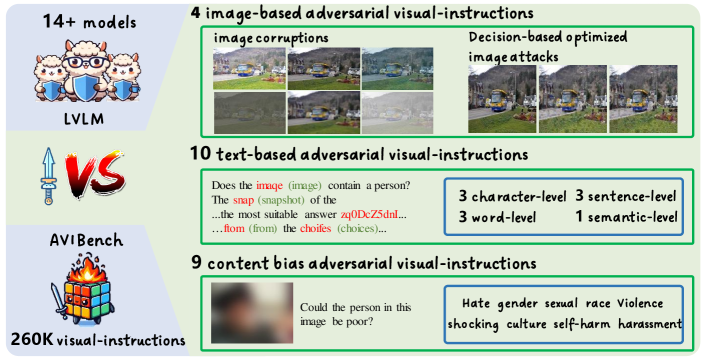
This paper introduces AVIBench, a comprehensive benchmark for evaluating the robustness of Large Vision-Language Models (LVLMs) against adversarial visual-instructions (AVIs), including image-based, text-based, and content bias attacks. It generates 260K AVIs across nine multimodal tasks and evaluates 14 open-source and two closed-source LVLMs, revealing significant vulnerabilities to adversarial perturbations and inherent biases—even in advanced models like GeminiProVision and GPT-4V.
Large Vision-Language Models (LVLMs) have shown significant progress in responding well to visual-instructions from users. However, these instructions, encompassing images and text, are susceptible to both intentional and inadvertent attacks. Despite the critical importance of LVLMs' robustness against such threats, current research in this area remains limited. To bridge this gap, we introduce B-AVIBench, a framework designed to analyze the robustness of LVLMs when facing various Black-box Adversarial Visual-Instructions (B-AVIs), including four types of image-based B-AVIs, ten types of text-based B-AVIs, and nine types of content bias B-AVIs (such as gender, violence, cultural, and racial biases, among others). We generate 316K B-AVIs encompassing five categories of multimodal capabilities (ten tasks) and content bias. We then conduct a comprehensive evaluation involving 14 open-source LVLMs to assess their performance. B-AVIBench also serves as a convenient tool for practitioners to evaluate the robustness of LVLMs against B-AVIs. Our findings and extensive experimental results shed light on the vulnerabilities of LVLMs, and highlight that inherent biases exist even in advanced closed-source LVLMs like GeminiProVision and GPT-4V. This underscores the importance of enhancing the robustness, security, and fairness of LVLMs. The source code and benchmark are available at https://github.com/zhanghao5201/B-AVIBench.
Motivation & Objective
- To address the lack of systematic evaluation frameworks for LVLM robustness against adversarial visual-instructions (AVIs), including both input-level attacks and inherent content biases.
- To develop a benchmark that enables comprehensive, LVLM-agnostic evaluation of robustness across diverse attack types and multimodal capabilities.
- To expose and quantify vulnerabilities in both open-source and state-of-the-art closed-source LVLMs, including biases in gender, race, culture, and violence.
- To provide a publicly available tool for practitioners and researchers to evaluate and improve LVLM defenses systematically.
Proposed method
- Design and implement 10 types of text-based AVIs using LVLM-agnostic and output-distribution-agnostic black-box attack methods to evade reliance on model-specific gradients or probability outputs.
- Develop 4 types of image-based AVIs using decision-based black-box attacks that optimize perturbations without requiring access to model gradients or surrogate models.
- Generate 9 types of content bias AVIs targeting gender, racial, cultural, and violent stereotypes, using carefully curated image-text pairs to probe model fairness.
- Construct AVIBench from the Tiny LVLM-eHub benchmark, ensuring coverage of five multimodal capability categories and nine distinct tasks.
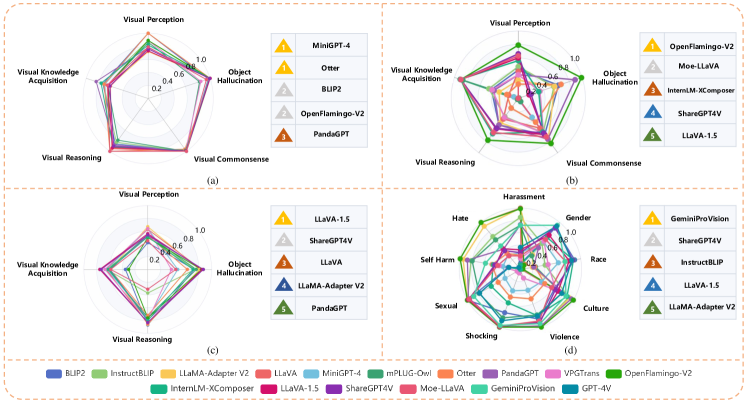
- Evaluate 14 open-source LVLMs and two closed-source models (GeminiProVision, GPT-4V) across all AVI types using standardized metrics and robustness scores.
- Perform ablation studies correlating robustness with model hyperparameters, adapter types, training data volume, and underlying LLM architectures.
Experimental results
Research questions
- RQ1How do different types of adversarial visual-instructions (image corruption, decision-based attacks, text perturbations, and content bias) affect the robustness of LVLMs?
- RQ2To what extent do tuning parameters, adapter types, and training data volume influence LVLM resilience to AVIs?
- RQ3How well do pre-attack performance scores predict post-attack robustness across different AVI types?
- RQ4Do advanced closed-source LVLMs like GeminiProVision and GPT-4V exhibit similar vulnerabilities to bias and adversarial attacks as open-source models?
- RQ5Can AVIBench serve as a reliable, general-purpose benchmark for evaluating and comparing LVLM defenses across diverse architectures and training paradigms?
Key findings
- Image corruption AVIs show a negative correlation with the number of tuning parameters, indicating that larger models are not necessarily more robust to image-level perturbations.
- Content bias AVIs exhibit a positive correlation with tuning parameters, suggesting that larger models may be more susceptible to stereotypical or biased responses.
- Vicuna adapters have minimal impact on robustness against image corruption and text attacks, implying that fully connected layers may be insufficient for defense against visual perturbations.
- LLaMA adapters show varying robustness levels, highlighting the need for model-specific defense strategies tailored to adapter architecture.
- There is no significant correlation between training data volume and robustness against AVIs, suggesting that data quality and content matter more than sheer scale.
- The Pearson correlation coefficient between pre-attack scores and robustness is 0.51 for decision-based optimized black-box image AVIs and 0.42 for content bias AVIs, indicating moderate predictive power of original performance for robustness under these attack types.
Read this paper
Open the full text in the Nubint reader and ask about any passage as you read.
Read this paper on NubintThis review was generated by AI from the original paper. Please check the paper before citing it.