
[Paper Review] Back-Translation-Style Data Augmentation for End-to-End ASR
This paper proposes a back-translation-style data augmentation method for end-to-end automatic speech recognition (E2E-ASR) that leverages unpaired text by training a text-to-encoder (TTE) model to predict hidden states from a pre-trained E2E-ASR encoder. By using these generated hidden states as additional training data, the ASR decoder achieves improved performance and reduced unknown word rates without requiring paired speech-text data, with experiments on LibriSpeech showing significant gains in CER and WER.
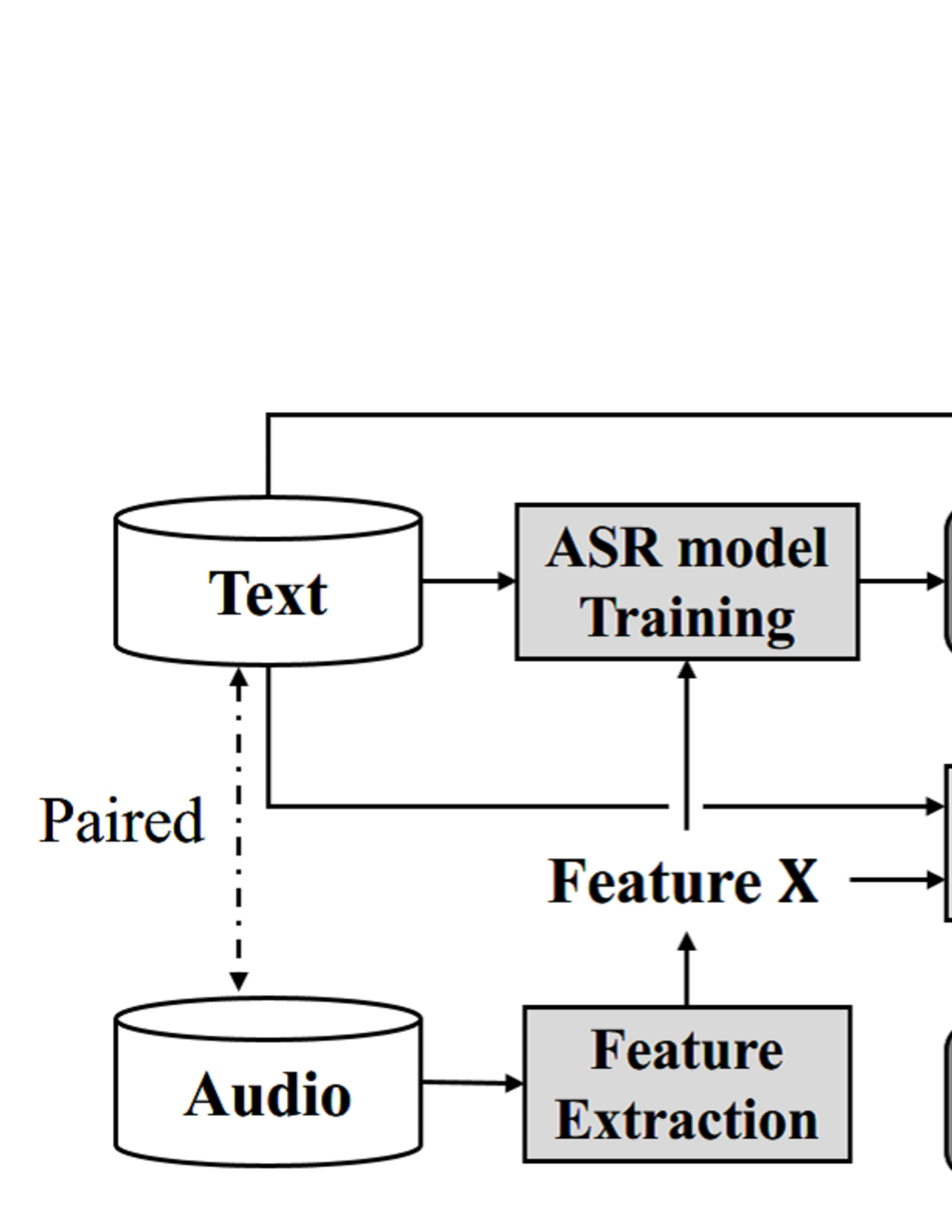
In this paper we propose a novel data augmentation method for attention-based end-to-end automatic speech recognition (E2E-ASR), utilizing a large amount of text which is not paired with speech signals. Inspired by the back-translation technique proposed in the field of machine translation, we build a neural text-to-encoder model which predicts a sequence of hidden states extracted by a pre-trained E2E-ASR encoder from a sequence of characters. By using hidden states as a target instead of acoustic features, it is possible to achieve faster attention learning and reduce computational cost, thanks to sub-sampling in E2E-ASR encoder, also the use of the hidden states can avoid to model speaker dependencies unlike acoustic features. After training, the text-to-encoder model generates the hidden states from a large amount of unpaired text, then E2E-ASR decoder is retrained using the generated hidden states as additional training data. Experimental evaluation using LibriSpeech dataset demonstrates that our proposed method achieves improvement of ASR performance and reduces the number of unknown words without the need for paired data.
Motivation & Objective
- To improve end-to-end ASR performance using large amounts of unpaired text that are not paired with speech signals.
- To address the limitation of attention-based E2E-ASR models in leveraging large-scale unpaired text due to the absence of a separate language model module.
- To reduce computational cost and accelerate attention learning during training by using hidden states as targets instead of raw acoustic features.
- To mitigate overfitting and speaker-specific bias in synthetic data generation by leveraging sub-sampled encoder representations.
- To enable effective data augmentation without requiring text-to-speech synthesis or phoneme-based generation pipelines.
Proposed method
- Train a text-to-encoder (TTE) model to predict the hidden states of a pre-trained E2E-ASR encoder from character sequences.
- Use the hidden states—derived from sub-sampled encoder outputs—as targets instead of raw acoustic features to reduce computational cost and avoid modeling speaker variability.
- Train the TTE model using a combination of mean squared error and L1 norm loss to improve attention learning speed and prevent auto-encoder-like behavior.
- Generate synthetic hidden states from a large corpus of unpaired text using the trained TTE model.
- Retrain the E2E-ASR decoder using both original training data and the generated hidden states as additional supervision.
- Combine the proposed method with shallow fusion using a character-based language model to further improve recognition performance.
Experimental results
Research questions
- RQ1Can unpaired text be effectively leveraged to improve end-to-end ASR performance without requiring paired speech-text data?
- RQ2Does using hidden states from the ASR encoder as targets in a text-to-encoder model lead to faster and more efficient attention learning compared to using raw acoustic features?
- RQ3Can synthetic data generated via back-translation-style methods reduce the number of unknown words in ASR recognition?
- RQ4How does the use of hidden states instead of acoustic features affect model generalization and speaker variability in synthetic data?
- RQ5Can the proposed method be effectively combined with existing language model integration techniques such as shallow fusion?
Key findings
- The proposed method reduced word error rate (WER) from 23.0% to 21.6% on the LibriSpeech validation set, and from 22.9% to 22.0% on the evaluation set when combined with a language model.
- The use of L1 norm loss in the TTE model's objective function accelerated attention learning, enabling effective attention to be learned in less than one-third the number of epochs compared to using only mean squared error.
- Retraining the decoder with only generated hidden states led to overfitting and no performance gain, indicating that combining synthetic data with original data is essential.
- The method successfully reduced the number of unknown words by leveraging the language model capacity of the decoder through synthetic data, improving vocabulary coverage.
- The approach is compatible with shallow fusion, as combining it with a character-based language model further improved recognition performance on both validation and test sets.
- The results suggest that speaker variability in generated hidden states is limited, and future work should incorporate multi-speaker modeling to improve data diversity.
Read this paper
Open the full text in the Nubint reader and ask about any passage as you read.
Read this paper on NubintThis review was generated by AI from the original paper. Please check the paper before citing it.