
[Paper Review] BackdoorBox: A Python Toolbox for Backdoor Learning
BackdoorBox is an open-source Python toolbox that implements and compares a wide range of backdoor attacks and defenses under a unified, flexible framework for DNN security research.
Third-party resources ($e.g.$, samples, backbones, and pre-trained models) are usually involved in the training of deep neural networks (DNNs), which brings backdoor attacks as a new training-phase threat. In general, backdoor attackers intend to implant hidden backdoor in DNNs, so that the attacked DNNs behave normally on benign samples whereas their predictions will be maliciously changed to a pre-defined target label if hidden backdoors are activated by attacker-specified trigger patterns. To facilitate the research and development of more secure training schemes and defenses, we design an open-sourced Python toolbox that implements representative and advanced backdoor attacks and defenses under a unified and flexible framework. Our toolbox has four important and promising characteristics, including consistency, simplicity, flexibility, and co-development. It allows researchers and developers to easily implement and compare different methods on benchmark or their local datasets. This Python toolbox, namely exttt{BackdoorBox}, is available at \url{https://github.com/THUYimingLi/BackdoorBox}.
Motivation & Objective
- Provide a unified, flexible framework to implement and compare backdoor attacks and defenses.
- Facilitate reproducible research by consistent interfaces and configurable pipelines.
- Support local datasets and models, enabling customized experimentation.
- Encourage collaboration through co-development and open-source hosting.
- Offer ready-to-use examples and documentation to lower the barrier to entry.
Proposed method
- Implement a base class architecture for poison-only backdoor attacks and training-controlled attacks to ensure consistency.
- Integrate trigger insertion via torchvision.transforms with configurable poisoned_transform_train_index/poisoned_transform_test_index for realistic scenarios.
- Categorize defenses into six types (pre-processing, model repairing, poison suppression, model diagnosis, sample diagnosis, certified defenses) and implement representative methods.
- Provide supported datasets (MINIST, CIFAR-10) and local datasets via torchvision, with a PyTorch-based implementation and a requirements.txt for easy setup.
- Offer open-source code hosting (GitHub) to enable co-development and rapid updates.
- Include practical demos and testing files to illustrate usage for both attacks and defenses.
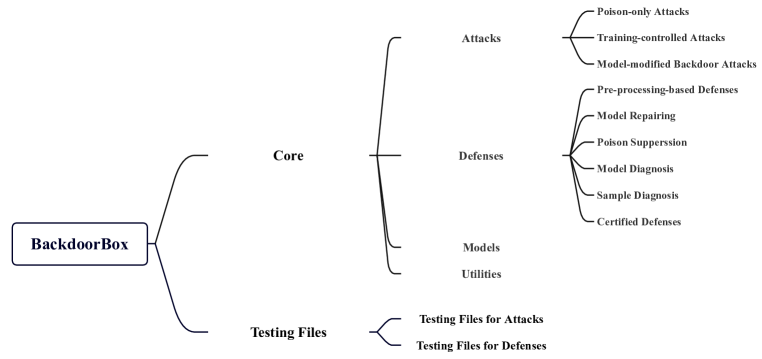
Experimental results
Research questions
- RQ1What is the design of a unified framework that supports multiple backdoor attack and defense methods?
- RQ2How many representative backdoor attacks and defenses can be implemented under a single, consistent interface?
- RQ3How flexible and reproducible are attack/defense experiments when using a common toolbox?
- RQ4What datasets and models does the toolbox support, and how can users incorporate their own data and architectures?
- RQ5Can the toolbox facilitate joint or separate use of attack and defense modules for benchmarking?
Key findings
- The toolbox implements more than 20 representative backdoor attacks and defenses.
- All methods are developed under a unified framework with high consistency and shared base classes.
- Users can apply attacks/defenses to user-specified samples and models, and modules can be used jointly or separately.
- BackdoorBox supports PyTorch with Python 3, and dependencies are listed in requirements.txt.
- The project emphasizes consistency, simplicity, flexibility, and co-development, with open-source collaboration on GitHub.
- It provides practical demos, documentation, and testing files to ease adoption, including examples for BadNets and PhysicalBA.
Read this paper
Open the full text in the Nubint reader and ask about any passage as you read.
Read this paper on NubintThis review was generated by AI from the original paper. Please check the paper before citing it.