
[Paper Review] Bagging Provides Assumption-free Stability
This paper establishes finite-sample, assumption-free stability guarantees for bagging in supervised learning, proving that subbagged models are inherently stable regardless of the base algorithm, data distribution, or covariate dimension. The key result shows that stability holds under minimal conditions, with bounds optimal up to constants, even for highly unstable base learners.
Bagging is an important technique for stabilizing machine learning models. In this paper, we derive a finite-sample guarantee on the stability of bagging for any model. Our result places no assumptions on the distribution of the data, on the properties of the base algorithm, or on the dimensionality of the covariates. Our guarantee applies to many variants of bagging and is optimal up to a constant. Empirical results validate our findings, showing that bagging successfully stabilizes even highly unstable base algorithms.
Motivation & Objective
- To provide finite-sample stability guarantees for bagging without assumptions on data distribution, base algorithm, or covariate dimension.
- To establish that bagging stabilizes any base algorithm—even highly unstable ones—under minimal conditions.
- To extend stability results to unbounded outputs via adaptive clipping and finite ensemble sizes.
- To offer deterministic, out-of-distribution valid stability bounds that are optimal up to constants.
Proposed method
- Introduces a novel definition of algorithmic stability based on the fraction of training points whose removal causes prediction changes exceeding a threshold ε.
- Uses Hoeffding’s inequality and concentration bounds to control the deviation of bagged predictions from their infinite-sample limits.
- Applies a coupling argument to compare the full-data and leave-one-out models, bounding the probability of large prediction shifts.
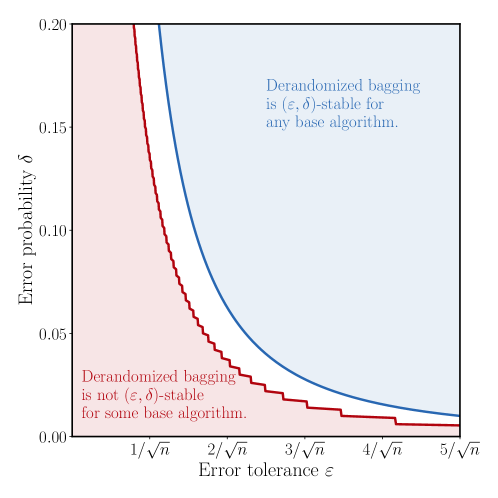
- Derives stability bounds via integration of tail probabilities, leading to a bound of the form δε² ≳ 1/n · p/(1−p) for subbagging with m = pn samples.
- Extends results to unbounded outputs using adaptive clipping and finite ensemble size B, introducing a robustness term R(𝒟,x) to control extreme values.
- Employs a randomized resampling mechanism (via uniform random permutations) to model bootstrap sampling and derive deterministic bounds.
Experimental results
Research questions
- RQ1Can bagging stabilize any base learning algorithm without assumptions on the data or algorithm?
- RQ2What finite-sample stability guarantees can be derived for bagging under minimal conditions?
- RQ3How does the stability of bagging scale with sample size and subsample size m in subbagging?
- RQ4Can stability be guaranteed for unbounded outputs using adaptive clipping and finite B?
- RQ5Are the derived stability bounds optimal up to constants?
Key findings
- Bagging achieves (ε,δ)-stability for any base algorithm with bounded outputs, with δε² ≳ 1/n · p/(1−p), where p = m/n.
- The stability guarantee holds deterministically for any data distribution, any base algorithm, and any test point, including out-of-distribution points.
- The bound is optimal up to a constant factor, as shown by matching lower bounds in the analysis.
- For unbounded outputs, adaptively clipped bagging achieves (ε + √(2/B log(4/δ′)), δ_I + δ + δ′, R)-stability, with R capturing output range.
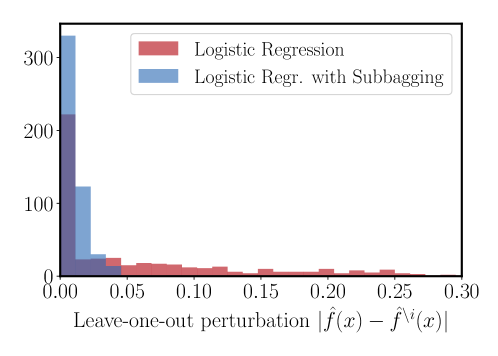
- Empirical results confirm that bagging significantly reduces prediction variance and stabilizes even highly unstable base models like logistic regression.
- The results extend to various bagging variants, including subbagging and finite-B ensembles, with minimal assumptions on the resampling mechanism.
Read this paper
Open the full text in the Nubint reader and ask about any passage as you read.
Read this paper on NubintThis review was generated by AI from the original paper. Please check the paper before citing it.