
[Paper Review] Bailando: 3D Dance Generation by Actor-Critic GPT with Choreographic Memory
Bailando proposes a novel music-to-3D-dance generation framework that uses a choreographic memory to quantize dance poses into interpretable, human-understandable units via unsupervised VQ-VAE, and an actor-critic fine-tuned GPT with cross-conditional attention to generate temporally coherent, beat-aligned dance sequences. The method achieves state-of-the-art performance on AIST++ with significant improvements in motion quality and music synchronization.
Driving 3D characters to dance following a piece of music is highly challenging due to the spatial constraints applied to poses by choreography norms. In addition, the generated dance sequence also needs to maintain temporal coherency with different music genres. To tackle these challenges, we propose a novel music-to-dance framework, Bailando, with two powerful components: 1) a choreographic memory that learns to summarize meaningful dancing units from 3D pose sequence to a quantized codebook, 2) an actor-critic Generative Pre-trained Transformer (GPT) that composes these units to a fluent dance coherent to the music. With the learned choreographic memory, dance generation is realized on the quantized units that meet high choreography standards, such that the generated dancing sequences are confined within the spatial constraints. To achieve synchronized alignment between diverse motion tempos and music beats, we introduce an actor-critic-based reinforcement learning scheme to the GPT with a newly-designed beat-align reward function. Extensive experiments on the standard benchmark demonstrate that our proposed framework achieves state-of-the-art performance both qualitatively and quantitatively. Notably, the learned choreographic memory is shown to discover human-interpretable dancing-style poses in an unsupervised manner.
Motivation & Objective
- To address the challenge of generating 3D dances that are spatially valid and choreographically expressive under physical pose constraints.
- To ensure temporal coherence between diverse motion tempos and music beats across multiple genres.
- To enable interpretable, reusable dance units without manual annotation through unsupervised representation learning.
- To improve dance quality and music alignment via reinforcement learning with a novel beat-align reward function.
Proposed method
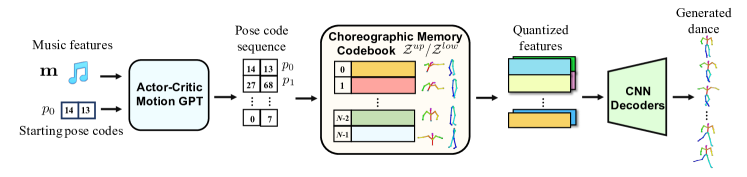
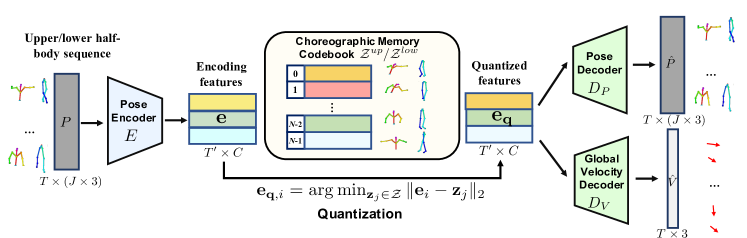
- A VQ-VAE-based choreographic memory learns to encode and quantize 3D human poses into a discrete codebook, representing meaningful dance poses in an unsupervised manner.
- The pose sequence is split into upper and lower body halves, each encoded and quantized separately to improve representational capacity and compositional flexibility.
- An actor-critic fine-tuned Generative Pre-trained Transformer (GPT) autoregressively predicts future pose code pairs conditioned on music features and initial pose codes.
- A cross-conditional causal attention mechanism enables coherent motion generation between upper and lower body by allowing inter-body attention during autoregressive decoding.
- An on-policy reinforcement learning scheme with a custom beat-align reward function aligns motion tempo with music beats, improving synchronization.
- A CNN-based decoder reconstructs the final 3D dance sequence from the quantized pose codes.
Experimental results
Research questions
- RQ1Can an unsupervised VQ-VAE-based choreographic memory effectively learn interpretable, reusable dance units from raw 3D pose sequences?
- RQ2How can a GPT-based model generate temporally coherent and music-synchronized dance sequences when conditioned on music and initial pose?
- RQ3To what extent does cross-conditional attention improve inter-body motion coherence in 3D dance generation?
- RQ4Can actor-critic reinforcement learning with a beat-align reward function significantly improve synchronization between motion and music beats?
- RQ5Does the proposed framework outperform existing state-of-the-art methods in both quantitative metrics and qualitative user perception?
Key findings
- The full actor-critic GPT model achieves a FID score of 28.16 and a beat-align score (BAS) of 0.2332, significantly outperforming baseline models.
- Removing the quantization step increases FID by 135.41, demonstrating that pose quantization is essential for motion quality.
- Eliminating cross-conditional attention reduces motion quality by 8.66 (30%) for upper body and 3.70 (31%) for lower body, proving its role in inter-body coherence.
- The actor-critic finetuning improves the BAS from 0.2245 to 0.2332 and reduces FID by 2.20 (19%), confirming the effectiveness of the reward-based optimization.
- The choreographic memory learns human-interpretable dance poses—such as leg lifts and bicep curls—where individual codes correspond to distinct, expressive dance positions.
- The framework enables interpretable choreography as a sequence of code selections and transitions, offering a disentangled, modular representation of dance motion.
Better researchstarts right now
From reading papers to final review, dramatically reduce your research time.
No credit card · Free plan available
This review was created by AI and reviewed by human editors.