
[Paper Review] BanglaAutoKG: Automatic Bangla Knowledge Graph Construction with Semantic Neural Graph Filtering
BanglaAutoKG is a novel, fully automated framework for constructing semantically enriched Bangla Knowledge Graphs from any text using multilingual LLMs, BERT-based embeddings, and a GNN-powered semantic filtering pipeline. It achieves high-quality KG construction with minimal human intervention, demonstrating universal applicability across diverse Bangla text types.
Knowledge Graphs (KGs) have proven essential in information processing and reasoning applications because they link related entities and give context-rich information, supporting efficient information retrieval and knowledge discovery; presenting information flow in a very effective manner. Despite being widely used globally, Bangla is relatively underrepresented in KGs due to a lack of comprehensive datasets, encoders, NER (named entity recognition) models, POS (part-of-speech) taggers, and lemmatizers, hindering efficient information processing and reasoning applications in the language. Addressing the KG scarcity in Bengali, we propose BanglaAutoKG, a pioneering framework that is able to automatically construct Bengali KGs from any Bangla text. We utilize multilingual LLMs to understand various languages and correlate entities and relations universally. By employing a translation dictionary to identify English equivalents and extracting word features from pre-trained BERT models, we construct the foundational KG. To reduce noise and align word embeddings with our goal, we employ graph-based polynomial filters. Lastly, we implement a GNN-based semantic filter, which elevates contextual understanding and trims unnecessary edges, culminating in the formation of the definitive KG. Empirical findings and case studies demonstrate the universal effectiveness of our model, capable of autonomously constructing semantically enriched KGs from any text.
Motivation & Objective
- To address the critical lack of comprehensive Bangla knowledge resources, including KGs, NER models, and encoders.
- To develop a universal, automated framework for constructing high-quality Bangla KGs from diverse text sources without human-labeled data.
- To overcome noise in pre-trained embeddings and improve semantic relevance through graph-based filtering and GNNs.
- To enable scalable, context-aware knowledge extraction for Bangla, supporting applications in information retrieval, cultural preservation, and AI.
Proposed method
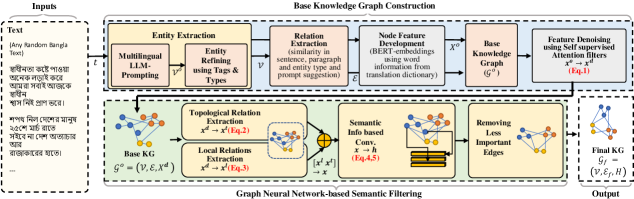
- Utilizes multilingual LLMs to extract named entities and their types from raw Bangla text.
- Employs a translation dictionary to map Bangla entities to English equivalents, enabling cross-lingual semantic alignment.
- Constructs initial word embeddings using a pre-trained BERT model fine-tuned for Bangla.
- Applies graph-based polynomial filters to denoise embeddings by leveraging local neighborhood and topological structure.
- Implements a GNN-based semantic filter with self-supervised attention to prune irrelevant edges and retain contextually significant relations.
- Automatically refines the initial KG into a final, semantically enriched graph through iterative filtering and contextual refinement.
Experimental results
Research questions
- RQ1Can multilingual LLMs effectively extract entities and relations from diverse Bangla text types without fine-tuning?
- RQ2How effective is dictionary-based cross-lingual mapping in improving semantic coherence of Bangla KGs?
- RQ3To what extent can graph-based polynomial filtering reduce embedding noise in low-resource language KGs?
- RQ4Can a GNN-based semantic filter significantly improve KG quality by removing spurious or irrelevant relations?
- RQ5How universally applicable is the proposed framework across varying text domains such as news, Wikipedia, and literary texts?
Key findings
- The framework successfully constructs semantically coherent Bangla KGs from diverse text sources, including Wikipedia, news, and literary content, with minimal human intervention.
- Ablation studies confirm that both the GNN-based semantic filter and polynomial filtering significantly improve KG quality compared to baseline methods.
- The integration of multilingual LLMs and translation dictionaries enables robust cross-lingual entity alignment even in low-resource settings.
- The model demonstrates strong generalization across text types, including complex and metaphorical writings, though performance varies slightly on archaic or highly poetic texts.
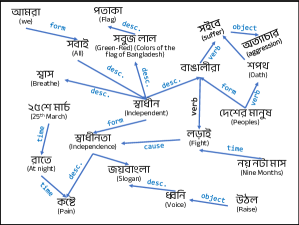
- Empirical results and case studies validate the framework’s ability to autonomously generate high-quality KGs, with clear improvements in entity relevance and relation accuracy.
Read this paper
Open the full text in the Nubint reader and ask about any passage as you read.
Read this paper on NubintThis review was generated by AI from the original paper. Please check the paper before citing it.