
[Paper Review] Basic syntax from speech: Spontaneous concatenation in unsupervised deep neural networks
This paper demonstrates that unsupervised deep convolutional neural networks (CNNs) trained on raw speech can spontaneously generate concatenated word sequences—such as two- or three-word compounds—without exposure to multi-word inputs. Using a ciwGAN architecture, the models learn to combine individual lexical items into novel, unobserved word combinations and even produce full reduplication, suggesting that basic syntactic operations like concatenation can emerge from acoustic input alone.
Computational models of syntax are predominantly text-based. Here we propose that the most basic first step in the evolution of syntax can be modeled directly from raw speech in a fully unsupervised way. We focus on one of the most ubiquitous and elementary suboperation of syntax -- concatenation. We introduce spontaneous concatenation: a phenomenon where convolutional neural networks (CNNs) trained on acoustic recordings of individual words start generating outputs with two or even three words concatenated without ever accessing data with multiple words in the input. We replicate this finding in several independently trained models with different hyperparameters and training data. Additionally, networks trained on two words learn to embed words into novel unobserved word combinations. We also show that the concatenated outputs contain precursors to compositionality. To our knowledge, this is a previously unreported property of CNNs trained in the ciwGAN/fiwGAN setting on raw speech and has implications both for our understanding of how these architectures learn as well as for modeling syntax and its evolution in the brain from raw acoustic inputs. We also propose a potential neural mechanism called disinhibition that outlines a possible neural pathway towards concatenation and compositionality and suggests our modeling is useful for generating testable prediction for biological and artificial neural processing of speech.
Motivation & Objective
- To investigate whether unsupervised deep neural networks can learn basic syntactic properties, such as word concatenation, directly from raw speech.
- To test if convolutional neural networks trained only on single words can spontaneously produce multi-word outputs without exposure to multi-word data.
- To explore whether models trained on one- and two-word inputs can embed words into novel, unobserved combinations, mimicking early language acquisition stages.
- To examine the role of latent space in encoding unobserved linguistic structures, such as compound words and reduplication.
- To assess the implications of spontaneous concatenation for modeling syntax evolution and language acquisition in neural architectures.
Proposed method
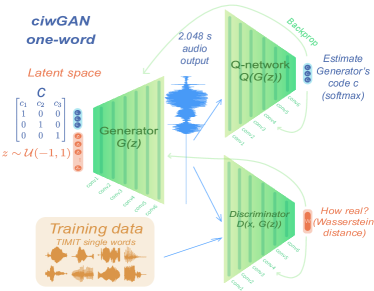
- Training a ciwGAN and modified fiwGAN on raw audio from the TIMIT dataset using only single-word inputs.
- Using a generator network with latent codes c (one-hot or binary) and random noise z to produce 2.048-second audio samples.
- Employing a Discriminator with Wasserstein loss to distinguish real from generated audio, and a separate Q-network to decode the latent code c from generated audio.
- Training the generator to maximize Discriminator error and minimize Q-network error, thereby encouraging informative and disentangled representations of linguistic units.
- Evaluating model outputs for spontaneous concatenation, reduplication, and novel word combinations not present in training data.
- Using a two-stage experimental design: one-word training followed by two-word input training with withheld combinations to test embedding of novel pairs.
Experimental results
Research questions
- RQ1Can unsupervised deep neural networks trained solely on single-word audio inputs spontaneously generate concatenated two- or three-word sequences?
- RQ2Do these models exhibit spontaneous reduplication—full repetition of words—despite never being exposed to repeated words during training?
- RQ3Can models trained on both one- and two-word inputs embed individual words into novel, unobserved two-word combinations?
- RQ4How does the latent space of the generator encode unobserved linguistic structures like compound words and reduplicated forms?
- RQ5To what extent can spontaneous concatenation in these models mirror early stages of human language acquisition or syntactic evolution?
Key findings
- The one-word model generated greasy greasy for the latent code [0,0,-40,0,0] in 7 out of 10 trials, demonstrating spontaneous full reduplication without exposure to repeated words.
- The generator produced novel two- and three-word concatenated sequences in the absence of any multi-word training data, indicating spontaneous concatenation.
- Models trained on two-word inputs successfully embedded words into unobserved combinations, suggesting the ability to generalize beyond training data.
- Negative values in the latent code were used to encode novel concatenated outputs, indicating the network exploits unused latent space for linguistic innovation.
- The models generated salient, interpretable, and rarely ambiguous outputs, with transcriptions performed by authors to ensure accuracy.
- The results suggest that basic syntactic operations like concatenation can emerge from raw acoustic input in unsupervised models, even without language-specific inductive biases.
Read this paper
Open the full text in the Nubint reader and ask about any passage as you read.
Read this paper on NubintThis review was generated by AI from the original paper. Please check the paper before citing it.