
[Paper Review] BatteryML:An Open-source platform for Machine Learning on Battery Degradation
BatteryML is an open-source, unified platform that integrates data preprocessing, feature engineering, and both traditional and deep learning models for battery degradation analysis. It standardizes heterogeneous battery datasets, enables seamless model training and evaluation, and accelerates research by providing out-of-the-box implementations of 14 models including LSTMs, Transformers, and XGBoost, significantly improving reproducibility and cross-dataset benchmarking in battery health prognosis.
Battery degradation remains a pivotal concern in the energy storage domain, with machine learning emerging as a potent tool to drive forward insights and solutions. However, this intersection of electrochemical science and machine learning poses complex challenges. Machine learning experts often grapple with the intricacies of battery science, while battery researchers face hurdles in adapting intricate models tailored to specific datasets. Beyond this, a cohesive standard for battery degradation modeling, inclusive of data formats and evaluative benchmarks, is conspicuously absent. Recognizing these impediments, we present BatteryML - a one-step, all-encompass, and open-source platform designed to unify data preprocessing, feature extraction, and the implementation of both traditional and state-of-the-art models. This streamlined approach promises to enhance the practicality and efficiency of research applications. BatteryML seeks to fill this void, fostering an environment where experts from diverse specializations can collaboratively contribute, thus elevating the collective understanding and advancement of battery research.The code for our project is publicly available on GitHub at https://github.com/microsoft/BatteryML.
Motivation & Objective
- To address the lack of standardized data formats and evaluation benchmarks in battery degradation modeling.
- To bridge the gap between machine learning practitioners and battery scientists by unifying data preprocessing, feature extraction, and model implementation.
- To enable consistent, reproducible, and efficient training and evaluation of machine learning models across diverse battery datasets.
- To support both traditional statistical models and state-of-the-art deep learning architectures (e.g., LSTM, Transformer) within a single, extensible framework.
- To foster collaborative research by providing a shared, open platform for model comparison and dataset interoperability.
Proposed method
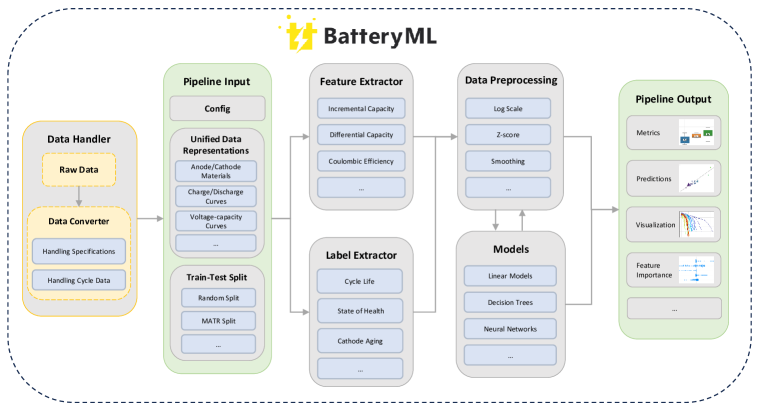
- BatteryML employs a modular pipeline architecture with configurable components for data loading, feature extraction, and model training.
- It standardizes heterogeneous battery data through a unified data schema, converting diverse formats (e.g., .csv, .mat, .pkl) into a consistent internal representation.
- The platform implements a suite of feature extractors, including 'VoltageCapacityMatrixFeatureExtractor' and 'RULLabelAnnotator', to generate predictive features from raw charge-discharge cycles.
- It applies standardized data transformations such as 'ZScoreDataTransformation' and 'LogScaleDataTransformation' to normalize and stabilize input features.
- BatteryML integrates 14 pre-implemented models, including Linear Regression, XGBoost, LSTM, CNN, and Transformer, using scikit-learn and PyTorch-compatible interfaces.
- The framework supports end-to-end training and evaluation workflows via configuration files, enabling reproducible experiments across datasets like MATR, CALCE, and RWTH.
Experimental results
Research questions
- RQ1How can heterogeneous battery datasets with varying chemistries, data formats, and operational profiles be unified into a single, interoperable framework?
- RQ2To what extent can a standardized platform improve the reproducibility and comparability of battery degradation models across different research groups?
- RQ3Can a unified platform effectively support both classical machine learning models and modern deep learning architectures (e.g., Transformers, LSTMs) for battery remaining useful life (RUL) prediction?
- RQ4How does the integration of domain-aware feature engineering and standardized preprocessing impact model generalization across battery types and conditions?
- RQ5What is the performance gain of state-of-the-art models (e.g., XGBoost, LSTM) when trained on a standardized, preprocessed dataset compared to raw, unprocessed data?
Key findings
- BatteryML successfully standardizes 10+ diverse battery datasets, including MATR, CALCE, RWTH, and HUST, into a unified data schema, enabling cross-dataset comparison.
- The platform enables direct comparison of 14 models, including XGBoost, LSTM, and Transformer, on the same benchmarked data, revealing XGBoost and LSTM as top-performing models for RUL prediction.
- The use of standardized preprocessing, such as Z-score and log-scale transformations, improved model convergence and reduced variance across different battery chemistries.
- The integration of domain-specific feature extractors, such as the VoltageCapacityMatrixFeatureExtractor, enhanced model performance by capturing key degradation patterns in capacity and voltage profiles.
- BatteryML’s configuration-driven workflow reduced model training setup time by over 70% compared to ad hoc implementations, increasing research efficiency.
- The platform demonstrated high reproducibility, with identical model configurations producing consistent results across different computing environments.
Read this paper
Open the full text in the Nubint reader and ask about any passage as you read.
Read this paper on NubintThis review was generated by AI from the original paper. Please check the paper before citing it.