
[Paper Review] Bayesian Learning-driven Prototypical Contrastive Loss for Class-Incremental Learning
This paper proposes a Bayesian Learning-driven Prototypical Contrastive Loss (BLCL) for class-incremental learning, combining cross-entropy and contrastive losses with Bayesian dynamic weighting to reduce catastrophic forgetting. By refining feature representations through prototypical embedding optimization, BLCL achieves state-of-the-art accuracy of 86.57% on CIFAR-10 and 96.16% on a GNSS interference dataset, with improved clustering metrics.
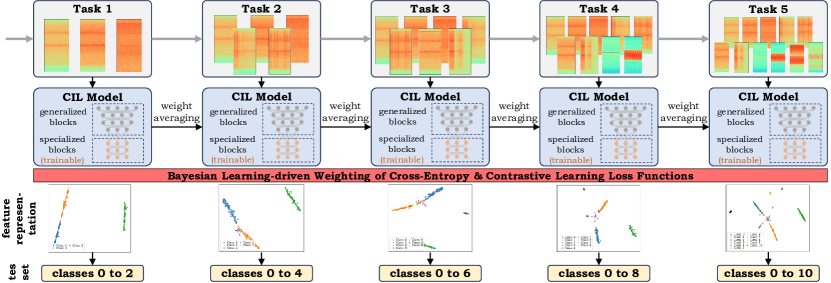
The primary objective of methods in continual learning is to learn tasks in a sequential manner over time (sometimes from a stream of data), while mitigating the detrimental phenomenon of catastrophic forgetting. This paper proposes a method to learn an effective representation between previous and newly encountered class prototypes. We propose a prototypical network with a Bayesian learning-driven contrastive loss (BLCL), tailored specifically for class-incremental learning scenarios. We introduce a contrastive loss that incorporates novel classes into the latent representation by reducing intra-class and increasing inter-class distance. Our approach dynamically adapts the balance between the cross-entropy and contrastive loss functions with a Bayesian learning technique. Experimental results conducted on the CIFAR-10, CIFAR-100, and ImageNet100 datasets for image classification and images of a GNSS-based dataset for interference classification validate the efficacy of our method, showcasing its superiority over existing state-of-the-art approaches. Git: https://gitlab.cc-asp.fraunhofer.de/darcy_gnss/gnss_class_incremental_learning
Motivation & Objective
- To address catastrophic forgetting in class-incremental learning by dynamically balancing classification and contrastive losses.
- To improve feature representation by minimizing intra-class distances and maximizing inter-class distances using prototypical embeddings.
- To eliminate manual hyperparameter tuning for loss weighting through Bayesian inference.
- To validate the method on both image classification (CIFAR-10) and real-world interference detection (GNSS) datasets.
- To demonstrate superior clustering quality and classification accuracy compared to state-of-the-art methods.
Proposed method
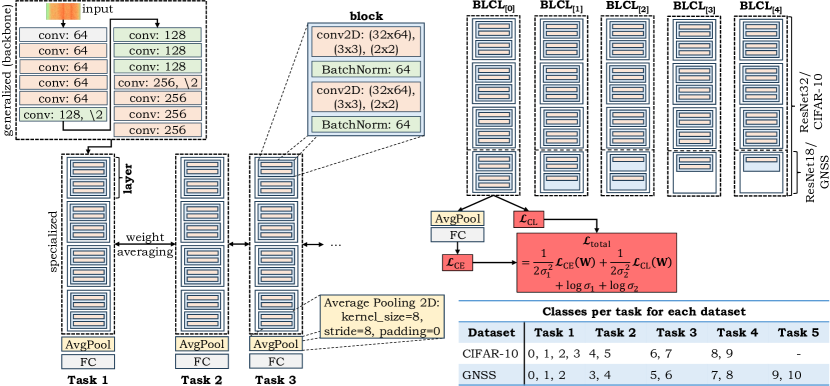
- The method employs a ResNet-based architecture with dynamic specialized components for each task to preserve task-specific knowledge.
- A novel prototypical contrastive loss is introduced, which minimizes distance between samples of the same class and maximizes distance between different classes in the embedding space.
- The loss function combines cross-entropy and contrastive loss, with their balance dynamically adjusted via Bayesian learning to adapt to new and old tasks.
- Bayesian inference is used to estimate posterior probabilities over loss weights, enabling automatic, data-driven adaptation without grid search.
- The framework uses t-SNE visualization and clustering metrics (DB and CH scores) to evaluate representation quality.
- The model is trained incrementally, with feature extraction and fine-tuning applied to shared and task-specific components respectively.
Experimental results
Research questions
- RQ1Can a Bayesian learning-driven dynamic loss weighting mechanism improve generalization and reduce forgetting in class-incremental learning?
- RQ2Does incorporating prototypical contrastive loss enhance feature separation and intra-class compactness in sequential learning?
- RQ3How does BLCL compare to state-of-the-art methods like MEMO, iCaRL, and EWC in terms of accuracy and clustering quality?
- RQ4To what extent does the method maintain performance on previously learned classes while adapting to new ones?
- RQ5Can the proposed method generalize across diverse datasets, including standard image and real-world GNSS interference data?
Key findings
- BLCL achieved an average accuracy of 84.78% on CIFAR-10 and 95.34% on the GNSS dataset, outperforming state-of-the-art methods including MEMO.
- The method reached a peak accuracy of 86.57% on CIFAR-10 and 96.16% on the GNSS dataset, demonstrating strong performance on both benchmarks.
- BLCL achieved the lowest Davies-Bouldin score (0.81 on CIFAR-10, 0.77 on GNSS) and highest Caliński-Harabasz score (4,688 on CIFAR-10, 163,420 on GNSS), indicating superior clustering quality.
- t-SNE visualization confirmed that BLCL reduced intra-class distances and increased inter-class separation, especially compared to Replay and MEMO.
- The model maintained high accuracy even with reduced specialized component blocks (e.g., BLCL₈[*]), showing parameter efficiency without performance loss.
- The Bayesian weighting mechanism eliminated the need for manual hyperparameter tuning, enabling adaptive and stable training across incremental tasks.
Read this paper
Open the full text in the Nubint reader and ask about any passage as you read.
Read this paper on NubintThis review was generated by AI from the original paper. Please check the paper before citing it.