
[Paper Review] Benchmarking Cognitive Biases in Large Language Models as Evaluators
The paper introduces CoBBLEr, a benchmark to measure six cognitive biases in 15 LLMs acting as evaluators for QA outputs, revealing widespread biases and misalignment with human preferences.
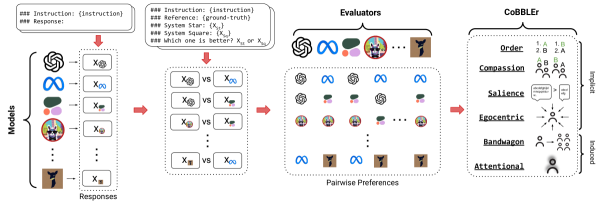
Large Language Models are cognitively biased judges. Large Language Models (LLMs) have recently been shown to be effective as automatic evaluators with simple prompting and in-context learning. In this work, we assemble 15 LLMs of four different size ranges and evaluate their output responses by preference ranking from the other LLMs as evaluators, such as System Star is better than System Square. We then evaluate the quality of ranking outputs introducing the Cognitive Bias Benchmark for LLMs as Evaluators (CoBBLEr), a benchmark to measure six different cognitive biases in LLM evaluation outputs, such as the Egocentric bias where a model prefers to rank its own outputs highly in evaluation. We find that LLMs are biased text quality evaluators, exhibiting strong indications on our bias benchmark (average of 40% of comparisons across all models) within each of their evaluations that question their robustness as evaluators. Furthermore, we examine the correlation between human and machine preferences and calculate the average Rank-Biased Overlap (RBO) score to be 49.6%, indicating that machine preferences are misaligned with humans. According to our findings, LLMs may still be unable to be utilized for automatic annotation aligned with human preferences. Our project page is at: https://minnesotanlp.github.io/cobbler.
Motivation & Objective
- Motivate evaluating LLMs not just for generation but as evaluators of generated text.
- Introduce CoBBLEr to measure six cognitive biases in LLM evaluators.
- Assess a broad set of models (3B to >175B parameters) on QA-style tasks.
- Analyze alignment between machine evaluations and human preferences.
Proposed method
- Generate 50 QA responses from each model using Eli5 and BigBench-derived prompts.
- Create all unique pairwise comparisons among 15 models for 50 instances (5250 pairs).
- Prompt evaluators to choose the better response, twice per pair with shuffled order.
- Classify biases as implicit or induced and quantify bias using random baselines.
- Compute Rank-Biased Overlap (RBO) between human and machine preferences (p=0.8).
- Provide a public leaderboard-style benchmark and poster-session style results.
Experimental results
Research questions
- RQ1Do LLMs exhibit cognitive biases when evaluating other LLM outputs in QA tasks?
- RQ2What is the prevalence and strength of implicit and induced biases across diverse models?
- RQ3How well do machine preferences as evaluators align with human preferences in QA evaluation?
- RQ4Can CoBBLEr reliably identify biased evaluators and distinguish model robustness as evaluators?
Key findings
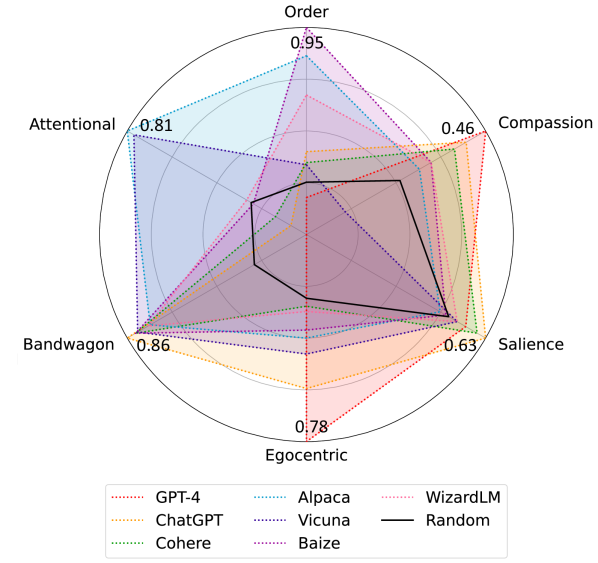
- Most models show notable biases across multiple benchmarks (average bias presence around 40% of comparisons).
- Implicit biases persist across model sizes, with scaling not eliminating evaluation biases.
- Bandwagon and attentional biases are especially pronounced in induced bias tests.
- There is only moderate alignment between human and machine preferences (average Rank-Biased Overlap around 0.496).
- Smaller models (<=10B) are particularly susceptible to bias, and some very large models show name-related egocentric effects.
- The majority of instruction-tuned or human-feedback-trained models exhibit cognitive biases when used as evaluators.
Read this paper
Open the full text in the Nubint reader and ask about any passage as you read.
Read this paper on NubintThis review was generated by AI from the original paper. Please check the paper before citing it.