
[Paper Review] Benchmarking LLM powered Chatbots: Methods and Metrics
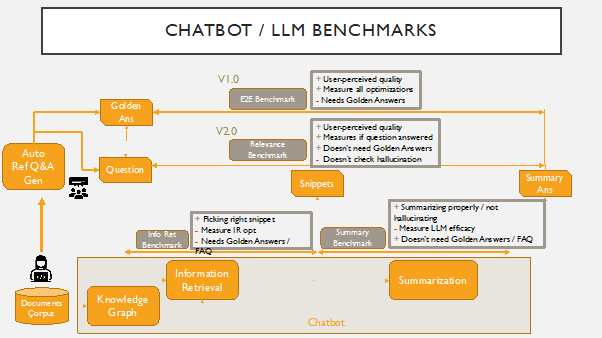
The paper introduces the End-to-End (E2E) chatbot benchmark that uses semantic similarity between chatbot answers and golden human answers via text embeddings (USE and ST) to assess accuracy and usefulness, and compares it against ROUGE metrics.
Autonomous conversational agents, i.e. chatbots, are becoming an increasingly common mechanism for enterprises to provide support to customers and partners. In order to rate chatbots, especially ones powered by Generative AI tools like Large Language Models (LLMs) we need to be able to accurately assess their performance. This is where chatbot benchmarking becomes important. In this paper, we propose the use of a novel benchmark that we call the E2E (End to End) benchmark, and show how the E2E benchmark can be used to evaluate accuracy and usefulness of the answers provided by chatbots, especially ones powered by LLMs. We evaluate an example chatbot at different levels of sophistication based on both our E2E benchmark, as well as other available metrics commonly used in the state of art, and observe that the proposed benchmark show better results compared to others. In addition, while some metrics proved to be unpredictable, the metric associated with the E2E benchmark, which uses cosine similarity performed well in evaluating chatbots. The performance of our best models shows that there are several benefits of using the cosine similarity score as a metric in the E2E benchmark.
Motivation & Objective
- Motivate robust evaluation of enterprise chatbots powered by large language models (LLMs).
- Propose an End-to-End (E2E) benchmark that measures semantic similarity between chatbot answers and expert golden answers.
- Assess E2E against traditional metrics like ROUGE and demonstrate benefits of embedding-based similarity.
- Explore the impact of prompt engineering on E2E performance and compare with ROUGE outcomes.
Proposed method
- Define the E2E benchmark based on cosine similarity between embedding vectors of golden answers and chatbot answers.
- Use two embedding libraries—Universal Sentence Encoder (USE) and Sentence Transformer (ST)—to obtain sentence embeddings.
- Compute cosine similarity S(G,A) = (X_G · X_A) / (|X_G||X_A|) between golden and chatbot answers.
- Compare E2E results to ROUGE scores (ROUGE-1, ROUGE-2, ROUGE-LCS) on the same answer pairs.
- Evaluate on a product support chatbot and analyze correlations between embedding-based scores and ROUGE scores.
- Examine the effect of prompt engineering (standard vs enhanced prompts) on E2E and ROUGE metrics.
Experimental results
Research questions
- RQ1How does the E2E benchmark using cosine similarity of sentence embeddings perform relative to ROUGE-based evaluation for LLM-powered chatbots?
- RQ2Do embedding-based E2E scores reflect improvements from prompt engineering better than ROUGE scores?
- RQ3What is the relationship between USE and ST embeddings in measuring chatbot performance?
- RQ4Can E2E distinguish between meaningful improvements vs noise (e.g., random words) in evaluations?
- RQ5How sensitive is the E2E benchmark to different embedding models?
Key findings
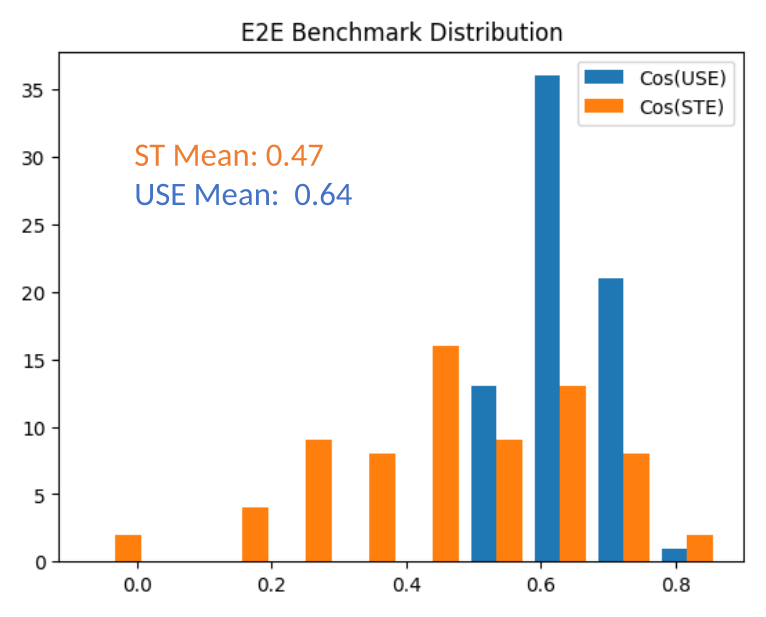
- E2E with USE yields a mean cosine similarity around 0.64; E2E with ST yields around 0.47 for the evaluated chatbot.
- There is a strong correlation (R^2 ≈ 0.7) between USE-based and ST-based E2E results.
- ROUGE metrics showed limited correlation with embedding-based E2E results and did not consistently reflect improvements from prompt engineering.
- E2E benchmarking with ST embeddings showed a sharper improvement when applying engineered prompts, indicating higher sensitivity to prompt design.
- E2E scores drop to near random when tested against random words, with ST outperforming USE in that scenario.
- Prompt engineering (enhanced prompts) substantially improves ST-based E2E results more than USE-based results.
Read this paper
Open the full text in the Nubint reader and ask about any passage as you read.
Read this paper on NubintThis review was generated by AI from the original paper. Please check the paper before citing it.