
[Paper Review] Benchmarking Machine Translation with Cultural Awareness
The paper curates a culturally rich parallel corpus and proposes prompting strategies to inject cultural knowledge into LLM-based MT, showing improvements over traditional NMT on culturally nuanced text.
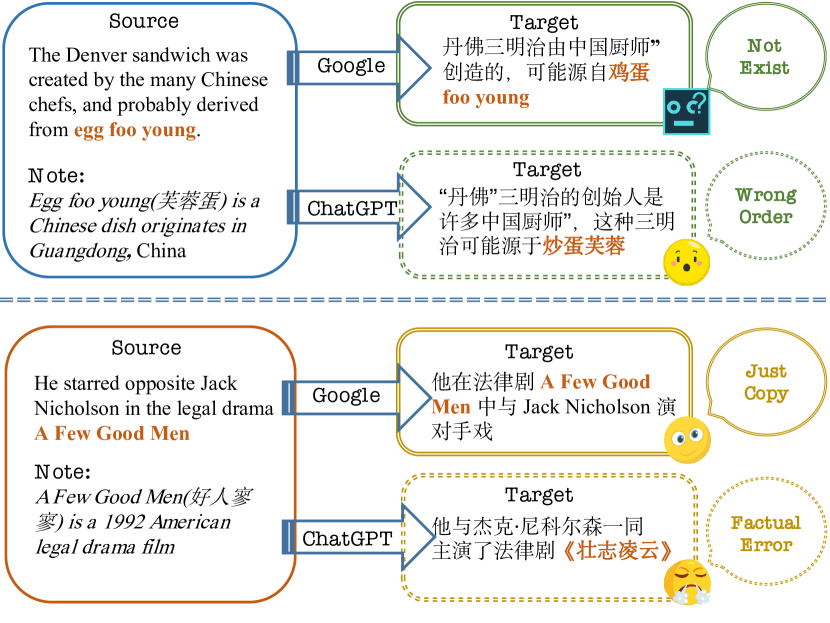
Translating culture-related content is vital for effective cross-cultural communication. However, many culture-specific items (CSIs) often lack viable translations across languages, making it challenging to collect high-quality, diverse parallel corpora with CSI annotations. This difficulty hinders the analysis of cultural awareness of machine translation (MT) systems, including traditional neural MT and the emerging MT paradigm using large language models (LLM). To address this gap, we introduce a novel parallel corpus, enriched with CSI annotations in 6 language pairs for investigating Culturally-Aware Machine Translation--CAMT. Furthermore, we design two evaluation metrics to assess CSI translations, focusing on their pragmatic translation quality. Our findings show the superior ability of LLMs over neural MTs in leveraging external cultural knowledge for translating CSIs, especially those lacking translations in the target culture.
Motivation & Objective
- Motivate the need for cultural awareness in MT due to cultural-specific concepts being underrepresented in general corpora.
- Create a culturally relevant parallel corpus with rich annotations of cultural-specific items (CSIs).
- Investigate prompting strategies to inject external/internal cultural knowledge into LLM-based translation.
- Provide an automatic and human evaluation framework focused on CSI translation quality.
- Benchmark prompting-based LLM MT against traditional NMT and commercial MT systems.
Proposed method
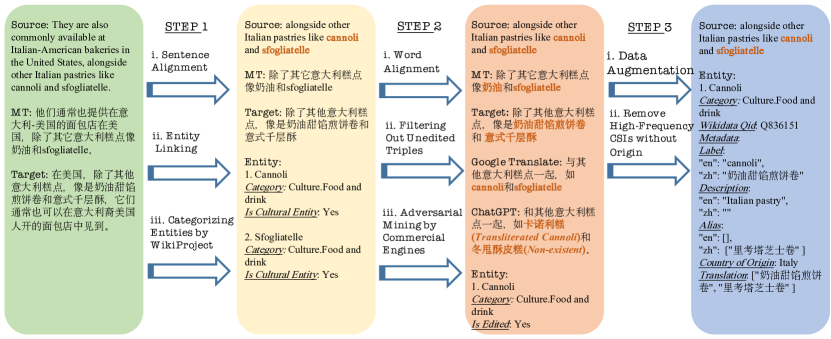
- Construct a cultural taxonomy linking CSI categories to Wikipedia Wikiproject categories.
- Build a culturally focused parallel corpus from Wikipedia with CSI annotations and Wikidata metadata.
- Apply adversarial mining to extract hard CSI translation cases that challenge commercial MT systems.
- Develop prompting strategies (external/ internal knowledge) to guide LLM-based MT for CSIs.
- Introduce CSI-Match, a fine-grained automatic metric for CSI translation quality; use human evaluation to assess CSI translations.
Experimental results
Research questions
- RQ1Can a culturally curated parallel corpus enable reliable evaluation of MT systems’ cultural awareness?
- RQ2Do prompting strategies that inject external or internal CSI knowledge improve LLM-based MT translating culturally specific content?
- RQ3How well do prompting-based LLM translations compare to traditional NMT and commercial MT in CSI translation accuracy?
Key findings
- External knowledge prompts (CSI dictionaries and CSI explanations) substantially improve CSI translation accuracy over basic prompts.
- Direct CSI translations in prompts (CT) outperform CSI explanations (CE) in automatic CSI-focused metrics.
- Self-knowledge prompts (SE, SC, SR) do not consistently improve over a basic instruction prompt.
- On the CSI-focused metric CSI-Match, prompting-based LLM translations show stronger alignment with human judgment than generic automatic metrics.
- Google Translate generally outperforms base NMT (mBART) and GPT-3.5 on standard metrics, but prompting-based LLMs can surpass Google on CSI translation after external knowledge integration.
- The CSI-Match metric correlates more with human CSI translation accuracy than BLEU, BLEURT, or COMET.
Read this paper
Open the full text in the Nubint reader and ask about any passage as you read.
Read this paper on NubintThis review was generated by AI from the original paper. Please check the paper before citing it.