
[Paper Review] Benchmarking Out-of-Distribution Generalization Capabilities of DNN-based Encoding Models for the Ventral Visual Cortex
This paper introduces MacaqueITBench, a large-scale dataset of macaque inferior temporal cortex responses to over 300,000 images, and benchmarks DNN-based encoding models under out-of-distribution (OOD) shifts. It finds that model performance drops to as low as 20% of in-distribution performance under simple image attribute shifts (e.g., contrast, hue), and shows that a simple cosine distance metric between pre-trained DNN features strongly predicts OOD generalization failure.
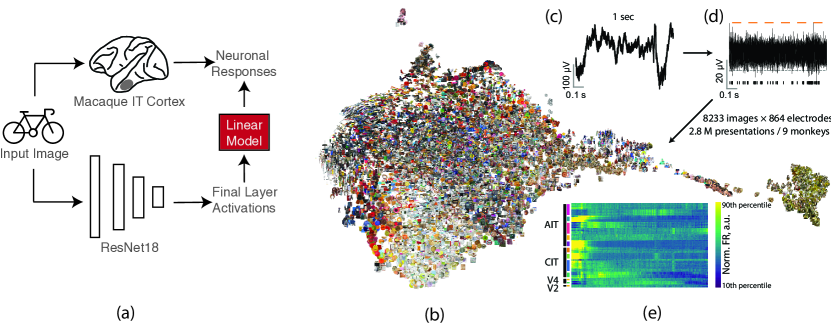
We characterized the generalization capabilities of DNN-based encoding models when predicting neuronal responses from the visual cortex. We collected extit{MacaqueITBench}, a large-scale dataset of neural population responses from the macaque inferior temporal (IT) cortex to over $300,000$ images, comprising $8,233$ unique natural images presented to seven monkeys over $109$ sessions. Using extit{MacaqueITBench}, we investigated the impact of distribution shifts on models predicting neural activity by dividing the images into Out-Of-Distribution (OOD) train and test splits. The OOD splits included several different image-computable types including image contrast, hue, intensity, temperature, and saturation. Compared to the performance on in-distribution test images -- the conventional way these models have been evaluated -- models performed worse at predicting neuronal responses to out-of-distribution images, retaining as little as $20\%$ of the performance on in-distribution test images. The generalization performance under OOD shifts can be well accounted by a simple image similarity metric -- the cosine distance between image representations extracted from a pre-trained object recognition model is a strong predictor of neural predictivity under different distribution shifts. The dataset of images, neuronal firing rate recordings, and computational benchmarks are hosted publicly at: https://bit.ly/3zeutVd.
Motivation & Objective
- To investigate the out-of-distribution (OOD) generalization capabilities of DNN-based encoding models for the primate ventral visual cortex.
- To identify whether and how distribution shifts in low-level image attributes (e.g., contrast, saturation) impair neural response prediction.
- To develop and validate a computable metric that predicts OOD model performance drop based on image representation similarity.
- To provide a publicly available, large-scale neural dataset (MacaqueITBench) to support future research on neural encoding and generalization.
Proposed method
- Collected neural population responses from macaque IT cortex across 109 sessions, using 8,233 unique natural images presented over 300,000 times.
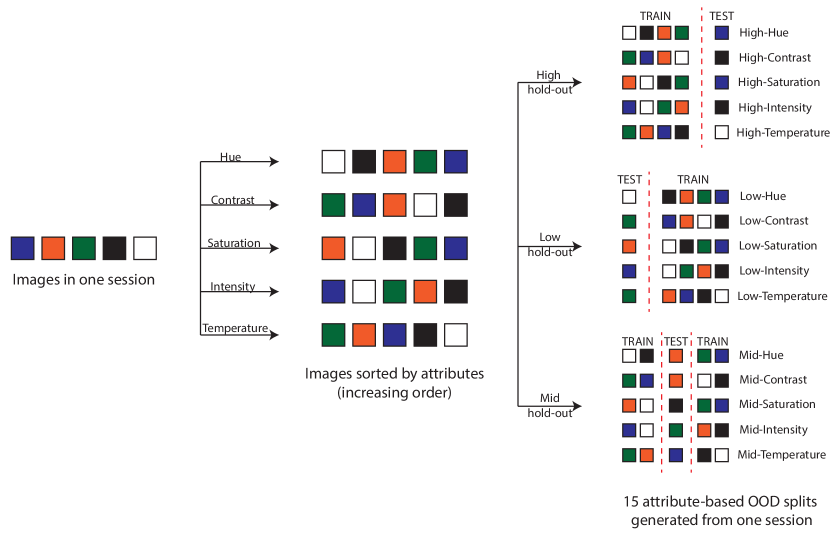
- Constructed OOD splits by varying image attributes (contrast, hue, intensity, temperature, saturation), creating Near OOD and Far OOD test sets.
- Trained linear encoding models using features from a pre-trained ResNet18 to predict neuronal firing rates from image inputs.
- Proposed the Closest-Cosine Distance (DCCD) metric to quantify distribution shift size between training and test image representations.
- Used Spearman correlation to evaluate the predictive power of DCCD, MMD, and Covariate-Shift metrics on OOD performance drops.
- Evaluated model performance across multiple OOD splits and sessions, comparing in-distribution, Near OOD, and Far OOD test distributions.
Experimental results
Research questions
- RQ1How do DNN-based encoding models for the ventral visual cortex perform under out-of-distribution image shifts compared to in-distribution generalization?
- RQ2To what extent do low-level image attribute shifts (e.g., contrast, hue, saturation) degrade neural response prediction performance?
- RQ3Can a computable image similarity metric predict the magnitude of performance drop under OOD shifts?
- RQ4Which metric—Closest-Cosine Distance, MMD, or Covariate-Shift—best predicts OOD generalization failure in neural encoding models?
Key findings
- DNN-based encoding models suffer severe performance degradation under OOD shifts, retaining as little as 20% of their in-distribution performance.
- The performance drop under OOD shifts correlates strongly with the size of the distribution shift, as measured by the Closest-Cosine Distance (DCCD) metric.
- The DCCD metric achieved a Spearman correlation of -0.49 with OOD performance drop across three levels of distribution shift (InD, Near OOD, Far OOD).
- Across 15 attribute-based OOD splits (hue, saturation, temperature, contrast, intensity), DCCD showed a Spearman correlation of -0.45 with OOD performance, outperforming MMD and Covariate-Shift.
- The model performance decreased significantly and progressively from in-distribution to Near OOD and then to Far OOD test sets, with p < 0.01 in paired t-tests.
- The Closest-Cosine Distance metric, computed from ResNet18 features, is a strong predictor of OOD neural predictivity, suggesting that representation similarity drives generalization failure.
Read this paper
Open the full text in the Nubint reader and ask about any passage as you read.
Read this paper on NubintThis review was generated by AI from the original paper. Please check the paper before citing it.