
[Paper Review] Benchmarking Robustness in Neural Radiance Fields
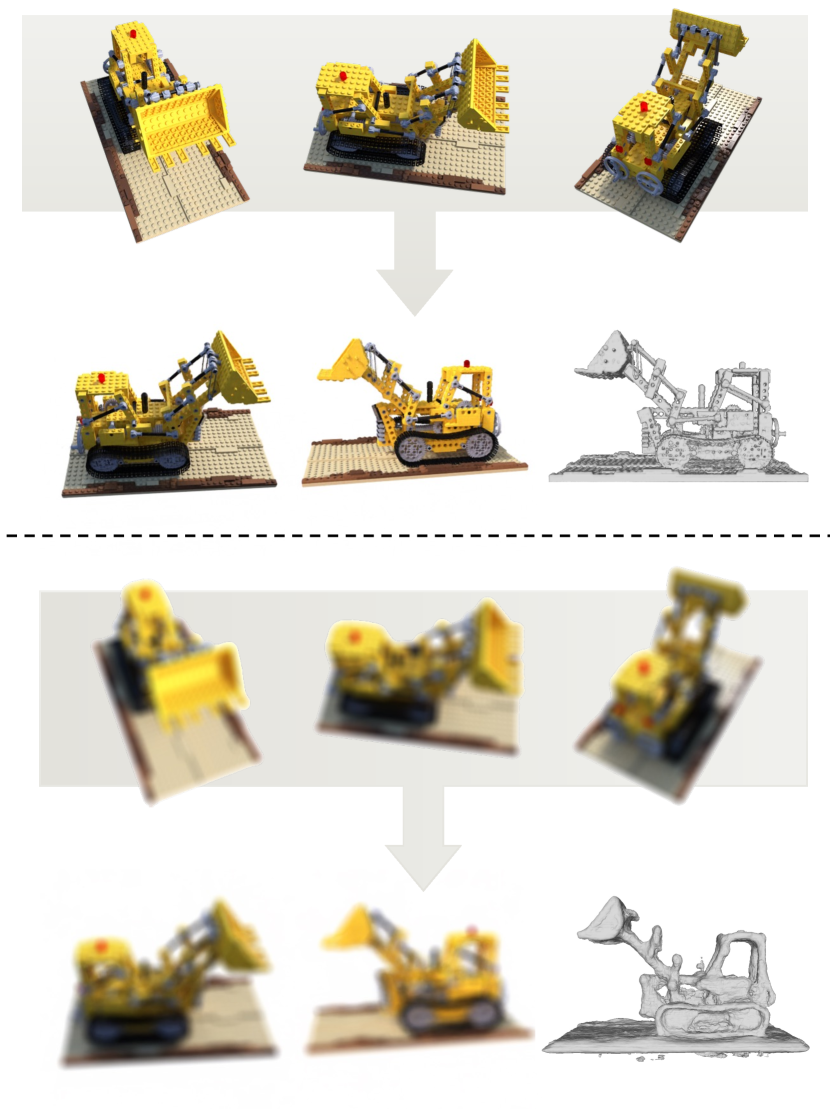
This paper introduces the first comprehensive benchmark for evaluating the robustness of Neural Radiance Fields (NeRF) under various visual corruptions. It reveals that NeRF-based methods suffer significant performance degradation under corruption, feature encoders contribute marginally to robustness, and standard data augmentation techniques fail to improve robustness, highlighting critical gaps for real-world deployment.
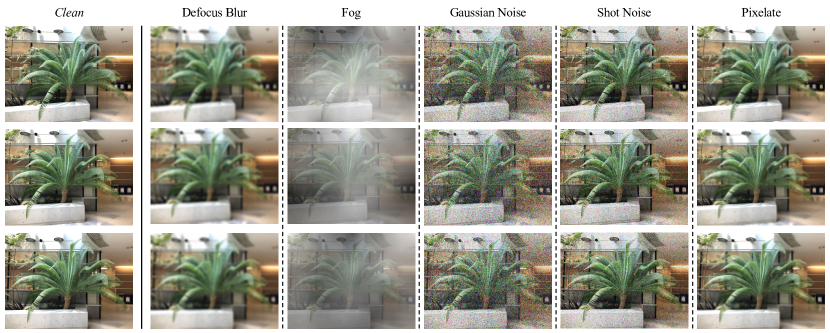
Neural Radiance Field (NeRF) has demonstrated excellent quality in novel view synthesis, thanks to its ability to model 3D object geometries in a concise formulation. However, current approaches to NeRF-based models rely on clean images with accurate camera calibration, which can be difficult to obtain in the real world, where data is often subject to corruption and distortion. In this work, we provide the first comprehensive analysis of the robustness of NeRF-based novel view synthesis algorithms in the presence of different types of corruptions. We find that NeRF-based models are significantly degraded in the presence of corruption, and are more sensitive to a different set of corruptions than image recognition models. Furthermore, we analyze the robustness of the feature encoder in generalizable methods, which synthesize images using neural features extracted via convolutional neural networks or transformers, and find that it only contributes marginally to robustness. Finally, we reveal that standard data augmentation techniques, which can significantly improve the robustness of recognition models, do not help the robustness of NeRF-based models. We hope that our findings will attract more researchers to study the robustness of NeRF-based approaches and help to improve their performance in the real world.
Motivation & Objective
- To address the lack of systematic evaluation of NeRF robustness under real-world image corruptions.
- To identify how different types and severities of corruption affect NeRF-based novel view synthesis performance.
- To investigate whether standard data augmentation and feature encoder scaling improve robustness in generalizable NeRF methods.
- To evaluate the impact of corruption on camera pose estimation via structure-from-motion (SfM) pipelines.
- To establish new benchmark datasets (LLFF-C and Blender-C) for robustness evaluation of NeRF-based systems.
Proposed method
- Constructed two corrupted benchmark datasets: LLFF-C and Blender-C, derived from standard NeRF datasets with controlled corruptions.
- Designed metrics to evaluate both image quality (PSNR) and geometric fidelity (mesh reconstruction) under corruption.
- Evaluated state-of-the-art NeRF-based methods (e.g., IBRNet, MVSNeRF, GPNR) on clean and corrupted data to measure robustness degradation.
- Tested data augmentation techniques (e.g., Augmix) on generalizable NeRF models to assess their impact on robustness.
- Analyzed the role of feature encoders in generalizable NeRFs by varying their scale and observing performance changes.
- Evaluated pose estimation reliability using COLMAP on corrupted images, measuring triangulated points, track length, and registration success.
Experimental results
Research questions
- RQ1How do different types and severities of visual corruption affect the performance of NeRF-based novel view synthesis models?
- RQ2How does corruption impact the reliability of camera pose estimation via SfM pipelines in real-world scenarios?
- RQ3To what extent do standard image data augmentation techniques improve the robustness of NeRF-based models?
- RQ4Does scaling the feature encoder in generalizable NeRF methods enhance robustness against image corruptions?
- RQ5Why do generalizable NeRF methods show limited robustness despite using pre-trained feature extractors?
Key findings
- NeRF-based models suffer significant performance degradation under all tested corruptions, with PSNR dropping substantially even at low corruption levels.
- Corruption sensitivity in NeRF differs fundamentally from image recognition models, with distinct failure modes and vulnerability patterns.
- Scaling the feature encoder in generalizable NeRF methods provides only marginal improvement in robustness, indicating limited contribution to corruption resilience.
- Fine-tuning generalizable NeRF models on corrupted data leads to overfitting and often degrades performance compared to using the pretrained model directly.
- Standard data augmentation techniques like Augmix fail to improve robustness in NeRF, as augmented images do not correspond to valid 3D scenes, breaking cross-view consistency.
- Pose estimation via COLMAP degrades with increasing corruption ratio and severity, with a 50% corruption ratio reducing triangulated points by ~30% and mean track length by ~20%.
Read this paper
Open the full text in the Nubint reader and ask about any passage as you read.
Read this paper on NubintThis review was generated by AI from the original paper. Please check the paper before citing it.