
[Paper Review] Benign Overfitting in Multiclass Classification: All Roads Lead to Interpolation
This paper establishes that in high-dimensional multiclass linear classification, empirical risk minimization with cross-entropy or least-squares loss, and one-vs-all SVM, all converge to interpolating solutions with identical generalization performance under sufficient overparameterization. It proves that benign overfitting occurs universally in multiclass settings when data follow Gaussian mixtures or multinomial logistic models, extending prior binary classification results to multiclass scenarios with rigorous non-asymptotic bounds.
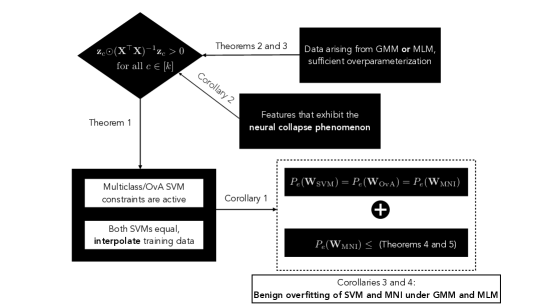
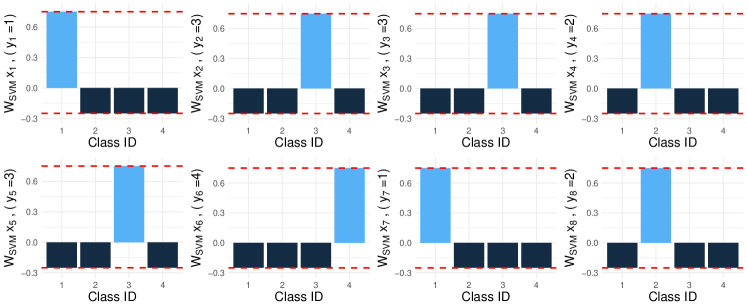
The literature on "benign overfitting" in overparameterized models has been mostly restricted to regression or binary classification; however, modern machine learning operates in the multiclass setting. Motivated by this discrepancy, we study benign overfitting in multiclass linear classification. Specifically, we consider the following training algorithms on separable data: (i) empirical risk minimization (ERM) with cross-entropy loss, which converges to the multiclass support vector machine (SVM) solution; (ii) ERM with least-squares loss, which converges to the min-norm interpolating (MNI) solution; and, (iii) the one-vs-all SVM classifier. First, we provide a simple sufficient deterministic condition under which all three algorithms lead to classifiers that interpolate the training data and have equal accuracy. When the data is generated from Gaussian mixtures or a multinomial logistic model, this condition holds under high enough effective overparameterization. We also show that this sufficient condition is satisfied under "neural collapse", a phenomenon that is observed in training deep neural networks. Second, we derive novel bounds on the accuracy of the MNI classifier, thereby showing that all three training algorithms lead to benign overfitting under sufficient overparameterization. Ultimately, our analysis shows that good generalization is possible for SVM solutions beyond the realm in which typical margin-based bounds apply.
Motivation & Objective
- To close the gap in theoretical understanding of benign overfitting in multiclass classification, which has so far been limited to regression and binary classification.
- To establish conditions under which different training algorithms—ERM with cross-entropy, ERM with least-squares, and one-vs-all SVM—produce identical interpolating solutions.
- To derive non-asymptotic generalization bounds for the minimum-norm interpolating (MNI) classifier in multiclass settings under Gaussian mixture and multinomial logistic models.
- To show that classical margin-based bounds fail to predict generalization in high-dimensional multiclass regimes, while interpolation still leads to good performance.
- To demonstrate that the equivalence between squared loss and cross-entropy loss, previously observed in binary classification, extends to multiclass classification under effective overparameterization.
Proposed method
- Proposes a deterministic sufficient condition under which multiclass SVM, one-vs-all SVM with simplex encoding, and minimum-norm interpolating (MNI) solutions are identical and interpolate the training data.
- Uses geometric and probabilistic arguments to show that under high-dimensional Gaussian mixture models (GMM) or multinomial logistic models (MLM), the sufficient condition holds with high probability.
- Applies union bounds and concentration inequalities to derive high-probability bounds on classification error for one-vs-all (OvA) and one-vs-one (OvO) SVM classifiers.
- Derives non-asymptotic bounds on the classification error of the MNI solution by relating it to margin-based generalization, leveraging symmetry and high-dimensional concentration.
- Demonstrates equivalence of loss functions (cross-entropy and least-squares) in the sense that both lead to the same interpolating solution and generalization performance under the same overparameterization regime.
- Employs tools from high-dimensional probability and random matrix theory to analyze the behavior of classifiers under increasing dimensionality and sample size.
Experimental results
Research questions
- RQ1Under what conditions do empirical risk minimization with cross-entropy loss, least-squares loss, and one-vs-all SVM all yield identical interpolating solutions in multiclass classification?
- RQ2Can benign overfitting be rigorously established in multiclass linear classification beyond the binary classification regime?
- RQ3Do classical margin-based generalization bounds fail to predict performance in high-dimensional multiclass settings, even when good generalization is observed?
- RQ4Is there a non-asymptotic overparameterization threshold beyond which all three training algorithms achieve zero training error and good test accuracy?
- RQ5Does the equivalence between squared loss and cross-entropy loss observed in binary classification extend to multiclass problems under the same overparameterization conditions?
Key findings
- A deterministic sufficient condition is derived under which multiclass SVM, one-vs-all SVM with simplex encoding, and minimum-norm interpolating (MNI) solutions are identical and interpolate all training data points.
- For Gaussian mixture models (GMM) and multinomial logistic models (MLM), the sufficient condition for interpolation and identical solutions holds with high probability when the data dimension p exceeds a non-asymptotic threshold involving n, k, and the norm of the class means.
- The classification error of the MNI classifier is bounded by an exponential decay term depending on the norm of the class means and the overparameterization ratio, showing that generalization is possible even when margin-based bounds fail.
- The one-vs-all (OvA) SVM and MNI solutions are equivalent under the same sufficient condition, with the equivalence holding with probability at least 1 - c₁/n - c₂k exp(-n/(c₃k²)) under the stated overparameterization.
- The one-vs-one (OvO) SVM classifier also achieves benign overfitting under a similar overparameterization condition, with classification error bounded by (k-1) times the error of a single binary classifier, leading to exponential decay in error with increasing class mean norm.
- The paper establishes that the equivalence between cross-entropy and least-squares loss in terms of generalization performance extends to multiclass classification, with both losses leading to identical interpolating solutions under sufficient overparameterization.
Read this paper
Open the full text in the Nubint reader and ask about any passage as you read.
Read this paper on NubintThis review was generated by AI from the original paper. Please check the paper before citing it.