
[Paper Review] BERTChem-DDI : Improved Drug-Drug Interaction Prediction from text using Chemical Structure Information
This paper proposes BERTChem-DDI, a novel method that enhances Drug-Drug Interaction (DDI) prediction by jointly leveraging BioBERT-based contextual embeddings from biomedical text and chemical structure representations derived from SMILES-encoded molecules via a Variational Autoencoder (ChemVAE). The approach achieves a 3.4% improvement in macro F1-score over strong baselines on the DDIExtraction 2013 dataset, demonstrating that integrating molecular structure information significantly boosts relation classification performance in biomedical NLP.
Traditional biomedical version of embeddings obtained from pre-trained language models have recently shown state-of-the-art results for relation extraction (RE) tasks in the medical domain. In this paper, we explore how to incorporate domain knowledge, available in the form of molecular structure of drugs, for predicting Drug-Drug Interaction from textual corpus. We propose a method, BERTChem-DDI, to efficiently combine drug embeddings obtained from the rich chemical structure of drugs along with off-the-shelf domain-specific BioBERT embedding-based RE architecture. Experiments conducted on the DDIExtraction 2013 corpus clearly indicate that this strategy improves other strong baselines architectures by 3.4\% macro F1-score.
Motivation & Objective
- To improve Drug-Drug Interaction (DDI) prediction from biomedical text by incorporating domain-specific chemical structure knowledge.
- To investigate whether molecular representations derived from SMILES via Variational Autoencoders can enhance relation classification in DDI extraction.
- To develop a unified framework that jointly leverages textual context and chemical structure embeddings for better DDI classification.
- To establish a new state-of-the-art performance on the DDIExtraction 2013 benchmark dataset.
Proposed method
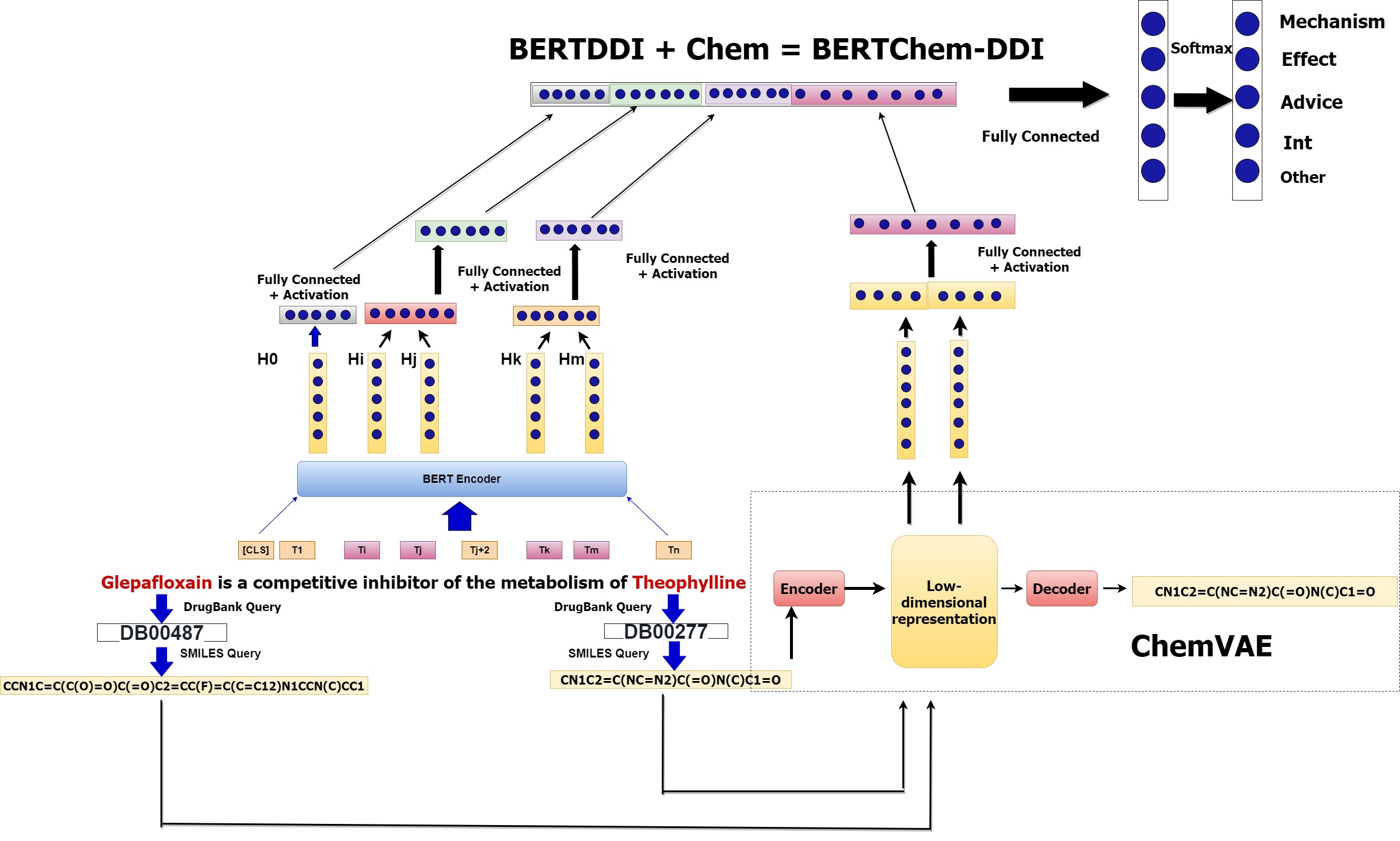
- The model uses BioBERT-based contextual embeddings for drug mentions in sentences, with pooled representations from the final hidden states of entity tokens.
- Drug-specific representations are obtained via average pooling over token embeddings, followed by shared parameter feedforward layers to produce contextualized entity vectors.
- A separate ChemVAE is trained on canonical SMILES strings from ZINC and DrugBank to learn low-dimensional latent representations of molecular structures.
- The final model, BERTChem-DDI, concatenates the [CLS] token representation, and the two entity representations (from text and chemistry), followed by a fully connected layer and softmax for classification.
- Chemical structure embeddings are initialized using a 292-dimensional latent vector from the trained ChemVAE, which are then fine-tuned alongside the BERT parameters.
- The model is trained end-to-end using cross-entropy loss with Adam optimizer, batch size 16, and 5 epochs, with sequence length capped at 300 tokens.
Experimental results
Research questions
- RQ1Can integrating molecular structure information from SMILES representations improve the performance of text-based DDI relation classification?
- RQ2How does the addition of chemically informed embeddings affect performance across different DDI relation types?
- RQ3Does the fusion of domain-specific biomedical language representations with chemical structure embeddings lead to a new state-of-the-art result on the DDIExtraction 2013 benchmark?
- RQ4Which component—textual context or chemical structure—contributes more significantly to performance gains?
Key findings
- The best-performing BERT-DDI model using BioBERT v1.0 PubMed PMC achieved a macro F1-score of 0.822, outperforming other contextual embedding variants.
- Adding ChemVAE-derived chemical structure embeddings to the best BERT-DDI model increased the macro F1-score by 1.6%, reaching 0.838.
- The performance gain was most significant for the Mechanism (3.2%) and Advice (2.11%) relation types, indicating that structural information aids in understanding pharmacological mechanisms.
- BERTChem-DDI achieved a new state-of-the-art macro F1-score of 0.838 on the DDIExtraction 2013 dataset, surpassing existing baselines by 3.4%.
- Ablation studies confirmed that domain-specific embeddings (BioBERT) are crucial, with a 2.3% improvement over general-domain BERT.
- The ChemVAE model successfully learned meaningful molecular representations from SMILES strings, which were effective when integrated into the DDI classification pipeline.
Read this paper
Open the full text in the Nubint reader and ask about any passage as you read.
Read this paper on NubintThis review was generated by AI from the original paper. Please check the paper before citing it.