
[Paper Review] Better speech synthesis through scaling
TorToise combines autoregressive decoding with DDPMs for text-to-speech, guided by a CLVP re-ranking model, achieving high realism and multi-voice TTS with open-source weights and data.
In recent years, the field of image generation has been revolutionized by the application of autoregressive transformers and DDPMs. These approaches model the process of image generation as a step-wise probabilistic processes and leverage large amounts of compute and data to learn the image distribution. This methodology of improving performance need not be confined to images. This paper describes a way to apply advances in the image generative domain to speech synthesis. The result is TorToise -- an expressive, multi-voice text-to-speech system. All model code and trained weights have been open-sourced at https://github.com/neonbjb/tortoise-tts.
Motivation & Objective
- Motivate scaling and generalist architectures for TTS beyond traditional constrained models.
- Leverage autoregressive decoding to generate text-aligned speech tokens and diffusion to produce high-quality spectrograms.
- Incorporate a speech conditioning input to capture voice characteristics and prosody.
- Use a contrastive discriminator (CLVP) to re-rank candidates for higher realism.
- Demonstrate training on large-scale, diverse datasets to improve synthesis quality.
Proposed method
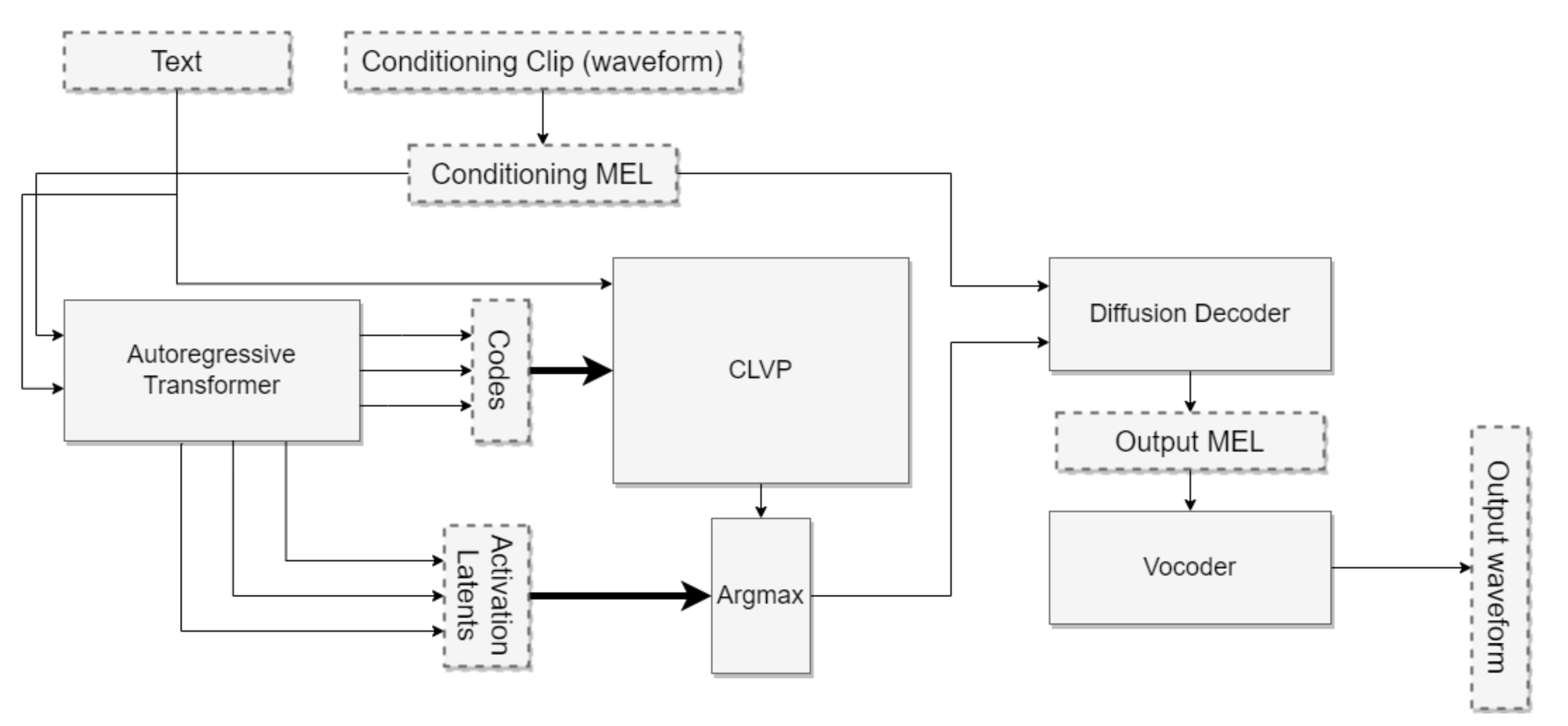
- Combine an autoregressive decoder conditioned on text and speech-conditioned encodings to predict speech tokens.
- Train a diffusion decoder to convert speech tokens to MEL spectrograms and then to waveforms.
- Introduce a CLVP model to score text-speech pairs for re-ranking outputs.
- Employ a “TorToise Trick” by fine-tuning the diffusion model on the AR latent space for efficiency and quality.
- Use a large LibriTTS + HiFiTTS based dataset plus a 49,000-hour extended audiobook/podcast dataset for training.
- Inference samples multiple AR outputs, re-ranks with CLVP, and decodes top candidates via diffusion and a vocoder.
Experimental results
Research questions
- RQ1Can scaling autoregressive and diffusion-based models improve TTS realism across multiple voices?
- RQ2Does incorporating speech conditioning inputs reduce search space and improve prosody and voice characteristics?
- RQ3Can a contrastive speech-text model effectively re-rank TTS outputs to improve quality?
- RQ4What is the impact of training on extremely large, diverse datasets on TTS performance?
- RQ5How does the combination of AR decoding and DDPMs compare to traditional TTS pipelines in both quality and latency?
Key findings
- TorToise reportedly outperforms prior TTS models in realism by leveraging generalist transformer architectures and large-scale data.
- A large, high-quality dataset (LibriTTS, HiFiTTS) plus a 49k-hour extended dataset enables strong performance.
- The AR+DDPM architecture, with speech conditioning and the TorToise Trick, yields high-quality speech synthesis.
- CLVP re-ranking enables efficient selection of top outputs, reducing reliance on diffusion-only generation at inference.
- Inference uses nucleus sampling for AR and DDIM-based diffusion with specific scheduling for quality-speed trade-offs.
Read this paper
Open the full text in the Nubint reader and ask about any passage as you read.
Read this paper on NubintThis review was generated by AI from the original paper. Please check the paper before citing it.