
[Paper Review] Beyond Adapting SAM: Towards End-to-End Ultrasound Image Segmentation via Auto Prompting
SAMUS extends SAM with a parallel CNN encoder, adapters, and cross-branch attention to enable end-to-end ultrasound segmentation with improved generalization and lower deployment costs, demonstrated on US30K.
End-to-end medical image segmentation is of great value for computer-aided diagnosis dominated by task-specific models, usually suffering from poor generalization. With recent breakthroughs brought by the segment anything model (SAM) for universal image segmentation, extensive efforts have been made to adapt SAM for medical imaging but still encounter two major issues: 1) severe performance degradation and limited generalization without proper adaptation, and 2) semi-automatic segmentation relying on accurate manual prompts for interaction. In this work, we propose SAMUS as a universal model tailored for ultrasound image segmentation and further enable it to work in an end-to-end manner denoted as AutoSAMUS. Specifically, in SAMUS, a parallel CNN branch is introduced to supplement local information through cross-branch attention, and a feature adapter and a position adapter are jointly used to adapt SAM from natural to ultrasound domains while reducing training complexity. AutoSAMUS is realized by introducing an auto prompt generator (APG) to replace the manual prompt encoder of SAMUS to automatically generate prompt embeddings. A comprehensive ultrasound dataset, comprising about 30k images and 69k masks and covering six object categories, is collected for verification. Extensive comparison experiments demonstrate the superiority of SAMUS and AutoSAMUS against the state-of-the-art task-specific and SAM-based foundation models. We believe the auto-prompted SAM-based model has the potential to become a new paradigm for end-to-end medical image segmentation and deserves more exploration. Code and data are available at https://github.com/xianlin7/SAMUS.
Motivation & Objective
- Motivate universal yet clinically friendly ultrasound segmentation.
- Leverage SAM's foundation while addressing medical-domain limitations.
- Improve local detail capture and boundary delineation in ultrasound targets.
- Reduce GPU requirements and enable deployment on entry-level hardware.
Proposed method
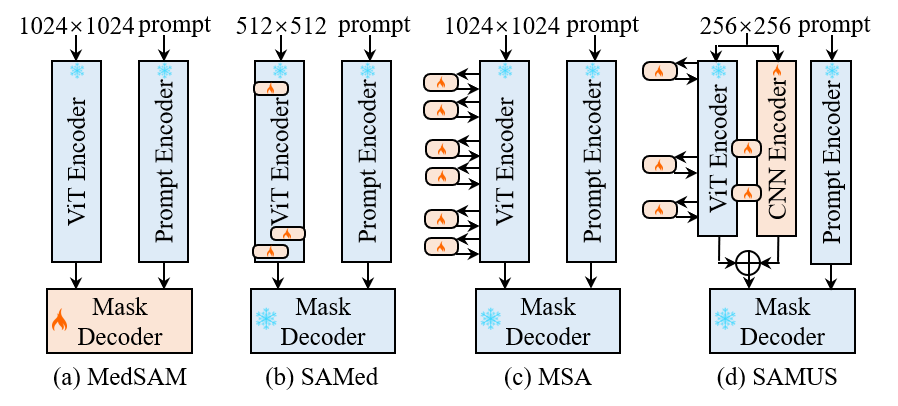
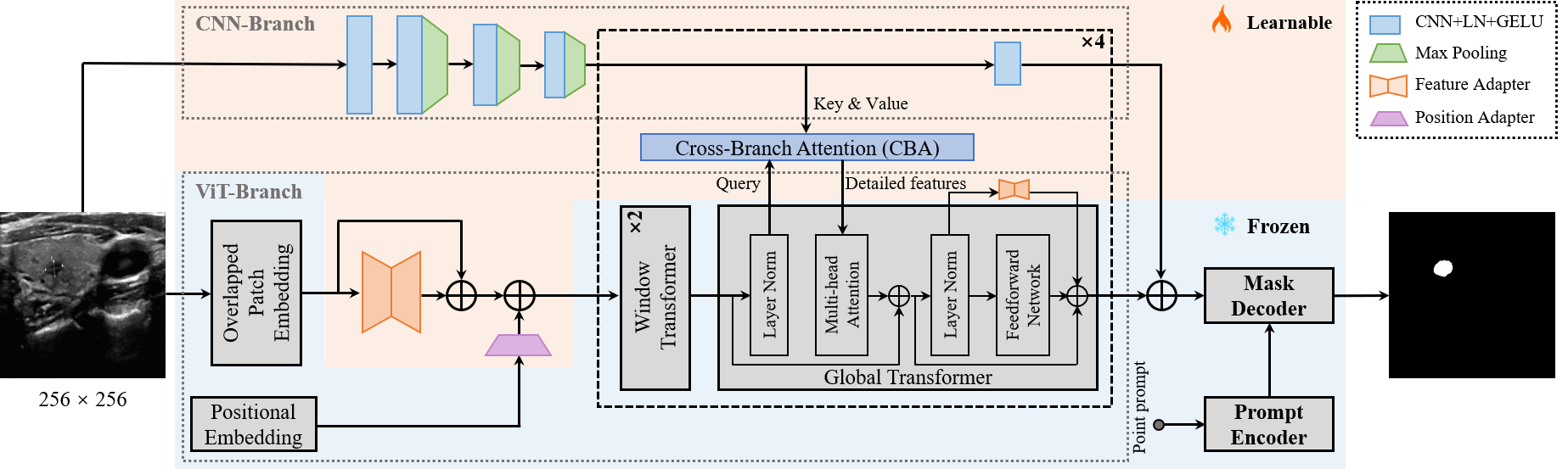
- Retain SAM's prompt encoder and mask decoder; modify the image encoder for medical use.
- Add a parallel CNN branch to inject local features via cross-branch attention.
- Introduce a position adapter and five feature adapters to adapt ViT to medical domains and smaller inputs.
- Implement overlapped patch embedding to preserve boundary information.
- Train with adapters, CNN branch, and cross-branch attention while freezing core SAM components; use a dice + BCE loss with a single-point positive prompt.
Experimental results
Research questions
- RQ1Can SAM be effectively adapted for ultrasound segmentation without retraining the entire model?
- RQ2Do local feature integration and compact adapters improve boundary preservation and small-object segmentation in ultrasound images?
- RQ3How does SAMUS perform in both seen (training) and unseen ultrasound datasets compared to task-specific models and other foundation models?
Key findings
- SAMUS achieves higher average Dice scores than state-of-the-art task-specific methods across TN3K, BUSI, CAMUS-LV, CAMUS-MYO, and CAMUS-LA (average Dice: 84.45%, 85.77%, 93.73%, 87.46%, 91.58%).
- In comparisons with foundation models, SAMUS consistently delivers superior Dice scores on seeable data (e.g., 83.05–93.73 range) and better generalization to unseen datasets (e.g., average gains over baselines on unseen data).
- Ablation shows all four components (CNN branch, cross-branch attention, feature adapter, position adapter) contribute to performance, with the position adapter alone dramatically boosting Dice on several datasets.
- SAMUS reduces GPU memory cost to ~28% of full SAM training and runs about 3x faster in inference, while maintaining or improving segmentation and generalization.
Read this paper
Open the full text in the Nubint reader and ask about any passage as you read.
Read this paper on NubintThis review was generated by AI from the original paper. Please check the paper before citing it.