
[Paper Review] Beyond Chain-of-Thought, Effective Graph-of-Thought Reasoning in Language Models
Introduces Graph-of-Thought (GoT) reasoning, a non-linear graph-based approach that enhances reasoning in LLMs by integrating thought graphs with text and vision, achieving state-of-the-art results on GSM8K and ScienceQA with fewer parameters.
With the widespread use of language models (LMs) in NLP tasks, researchers have discovered the potential of Chain-of-thought (CoT) to assist LMs in accomplishing complex reasoning tasks by generating intermediate steps. However, human thought processes are often non-linear, rather than simply sequential chains of thoughts. Therefore, we propose Graph-of-Thought (GoT) reasoning, which models human thought processes not only as a chain but also as a graph. By representing thought units as nodes and connections between them as edges, our approach captures the non-sequential nature of human thinking and allows for a more realistic modeling of thought processes. GoT adopts a two-stage framework with an additional GoT encoder for thought graph representation and fuses the graph representation with the original input representation through a gated fusion mechanism. We evaluate GoT's performance on a text-only reasoning task (AQUA-RAT) and a multimodal reasoning task (ScienceQA). Our model achieves significant improvement over the strong CoT baseline on the AQUA-RAT test set and boosts accuracy from 85.19% to 87.59% using the T5-base model over the state-of-the-art Multimodal-CoT on the ScienceQA test set.
Motivation & Objective
- Motivate modeling human reasoning as non-linear graphs rather than linear chains.
- Propose ECC-based graph construction to create dense, deducible thought graphs.
- Develop a GoT encoder with a graph attention network and gated fusion to integrate graph, text, and vision features.
- Demonstrate two-stage reasoning (rationale generation then answer) on text-only and multimodal tasks.
- Show GoT's effectiveness and parameter efficiency versus CoT and Multimodal-CoT baselines.
Proposed method
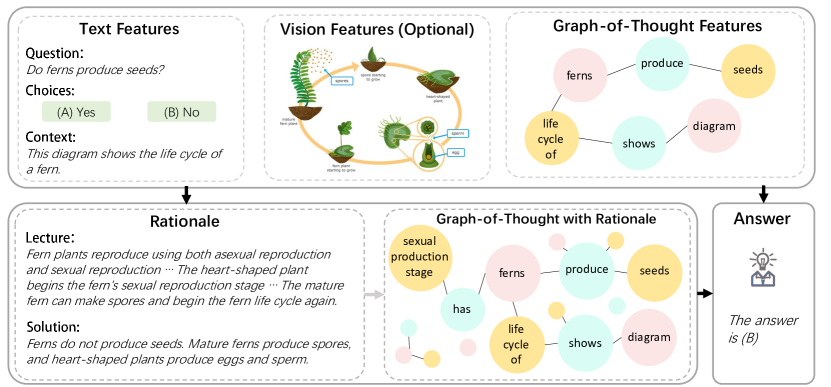
- Construct thought graphs via Extract-Cluster-Coreference (ECC) to produce nodes and edges from deductive triplets.
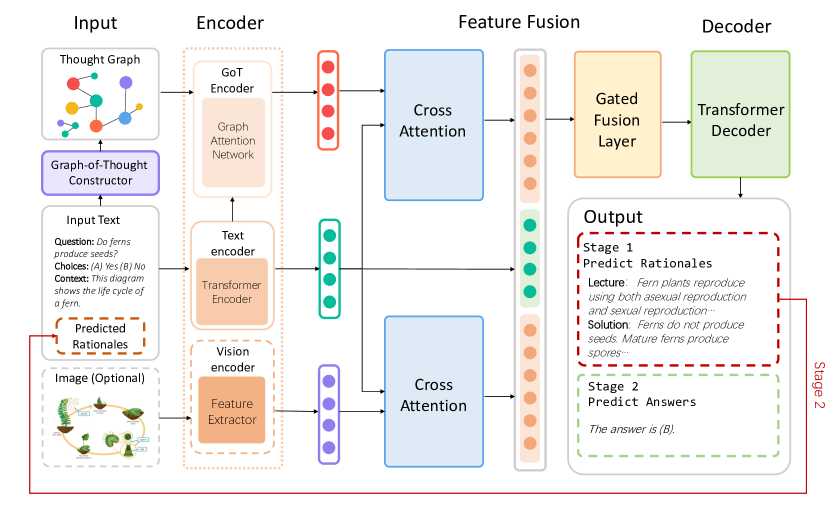
- Encode text with a Transformer, graph with a Graph Attention Network (GAT), and vision with a vision encoder when available.
- Use cross-attention to align text with vision and graph nodes, followed by a gated fusion to produce fused representations.
- Apply a two-stage framework: rationale generation followed by final answer generation, using the predicted rationales in the second stage.
- Fine-tune T5-based UnifiedQA models (base and large) on GSM8K and ScienceQA, with a two-stage GoT setup and gated fusion.
- Optional multimodal extensions fuse text, vision, and GoT representations through a single-head attention alignment and a gated fusion mechanism.
Experimental results
Research questions
- RQ1Can Graph-of-Thought better capture non-sequential reasoning than chain-of-thought in LLMs?
- RQ2Does integrating a reasoning graph with text (and vision) improve performance on text-only and multimodal math/science tasks?
- RQ3Is GoT parameter-efficient compared to larger Multimodal-CoT baselines while achieving state-of-the-art results?
- RQ4How does GoT perform across different subjects and question classes, including image-assisted tasks?
- RQ5What is the impact of ECC-based graph construction and multi-head GoT encoding on final reasoning accuracy?
Key findings
- GoT improves GSM8K end-to-end accuracy by 3.41% (GoT-base) and 5.08% (GoT-large) over a CoT baseline.
- GoT achieves ScienceQA accuracy of 91.54% (GoT-base) and 92.77% (GoT-large), surpassing Multimodal-CoT baselines with similar or fewer parameters.
- On GSM8K, GoT-base reaches 66.11% and GoT-large reaches 82.18% against UnifiedQA baselines, showing notable gains with fewer parameters.
- On ScienceQA, GoT with base achieves 91.68% and large achieves 92.77%, approaching or surpassing large Multimodal-CoT and competitive with larger models.
- Ablation studies confirm the necessity of the multi-head GoT encoder and the effectiveness of realistic thought graphs over random graphs; GoT outperforms enlarged Multimodal-CoT by 3.00%.
Read this paper
Open the full text in the Nubint reader and ask about any passage as you read.
Read this paper on NubintThis review was generated by AI from the original paper. Please check the paper before citing it.