
[Paper Review] Beyond Clicks: Modeling Multi-Relational Item Graph for Session-Based Target Behavior Prediction
This paper proposes MGNN-SPred, a multi-relational graph neural network that models global item-item relations across multiple behavior types (e.g., click, buy) to improve session-based target behavior prediction. By constructing a Multi-Relational Item Graph (MRIG) and using a gating mechanism to fuse representations from target and auxiliary behaviors, MGNN-SPred achieves state-of-the-art performance on two real-world datasets, demonstrating the value of leveraging sparse but important behaviors like purchases.
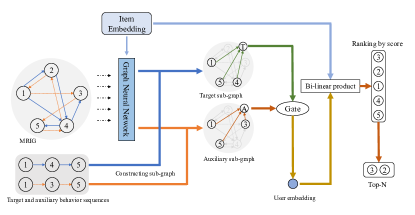
Session-based target behavior prediction aims to predict the next item to be interacted with specific behavior types (e.g., clicking). Although existing methods for session-based behavior prediction leverage powerful representation learning approaches to encode items' sequential relevance in a low-dimensional space, they suffer from several limitations. Firstly, they focus on only utilizing the same type of user behavior for prediction, but ignore the potential of taking other behavior data as auxiliary information. This is particularly crucial when the target behavior is sparse but important (e.g., buying or sharing an item). Secondly, item-to-item relations are modeled separately and locally in one behavior sequence, and they lack a principled way to globally encode these relations more effectively. To overcome these limitations, we propose a novel Multi-relational Graph Neural Network model for Session-based target behavior Prediction, namely MGNN-SPred for short. Specifically, we build a Multi-Relational Item Graph (MRIG) based on all behavior sequences from all sessions, involving target and auxiliary behavior types. Based on MRIG, MGNN-SPred learns global item-to-item relations and further obtains user preferences w.r.t. current target and auxiliary behavior sequences, respectively. In the end, MGNN-SPred leverages a gating mechanism to adaptively fuse user representations for predicting next item interacted with target behavior. The extensive experiments on two real-world datasets demonstrate the superiority of MGNN-SPred by comparing with state-of-the-art session-based prediction methods, validating the benefits of leveraging auxiliary behavior and learning item-to-item relations over MRIG.
Motivation & Objective
- To address the limitation of existing session-based recommendation models that rely solely on target behavior sequences and ignore auxiliary behavior data.
- To overcome the lack of a global, principled method for encoding item-to-item relations across multiple behavior types.
- To improve prediction accuracy for sparse but important target behaviors (e.g., buying, sharing) by leveraging richer behavioral signals.
- To develop a unified framework that jointly models user preferences across target and auxiliary behavior sequences using graph neural networks.
Proposed method
- Construct a Multi-Relational Item Graph (MRIG) from all user behavior sequences, where nodes represent items and edges represent different behavior types (e.g., click, buy).
- Use graph neural networks (GNNs) to propagate representations across the MRIG, capturing high-order item-to-item relations in a global manner.
- Learn separate user preference representations for both target and auxiliary behavior sequences using distinct sub-graphs within the MRIG.
- Apply a learnable gating mechanism to adaptively fuse the target and auxiliary behavior representations into a unified user preference vector.
- Train the model end-to-end to predict the next item in the target behavior sequence using cross-entropy loss.
Experimental results
Research questions
- RQ1Can incorporating auxiliary behavior sequences (e.g., clicks) improve prediction performance for sparse target behaviors like purchases?
- RQ2Does modeling global item-to-item relations across multiple behavior types lead to better session-based recommendation than local, behavior-sequence-specific modeling?
- RQ3How effective is the proposed gating mechanism in fusing representations from target and auxiliary behavior sequences?
- RQ4What is the impact of GNN depth and sequence length on model performance in the proposed framework?
Key findings
- MGNN-SPred achieves state-of-the-art performance on both the WeChat and YooChoose datasets, outperforming existing SOTA methods in H@100, M@100, and N@100 metrics.
- The ablation study confirms that removing auxiliary behavior edges (w/o ae) leads to a performance drop, validating the benefit of auxiliary data.
- Removing the auxiliary sub-graph modeling (w/o asg) results in a significant performance decrease, showing the importance of separate modeling of auxiliary sequences.
- Replacing the gating mechanism with simple summation (w/o g) degrades performance, proving the effectiveness of adaptive fusion.
- The model’s performance improves with GNN depth up to 2, but degrades beyond depth 3, indicating optimal representation propagation depth.
- Performance peaks at different sequence lengths for WeChat and YooChoose, reflecting differences in average session length across datasets.
Read this paper
Open the full text in the Nubint reader and ask about any passage as you read.
Read this paper on NubintThis review was generated by AI from the original paper. Please check the paper before citing it.