
[Paper Review] Beyond Demographic Parity: Redefining Equal Treatment
This paper proposes a new formalization of equal treatment in machine learning by analyzing feature-level model explanations via Shapley values, defining explanation distributions across protected groups, and using a Classifier Two-Sample Test (C2ST) based on AUC to detect unequal treatment. It demonstrates that demographic parity can mask unfairness, and the proposed method identifies disparities missed by traditional metrics, with an open-source tool, explanationspace, released for practical use.
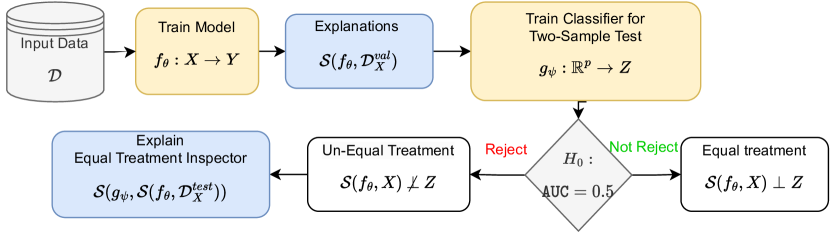
Liberalism-oriented political philosophy reasons that all individuals should be treated equally independently of their protected characteristics. Related work in machine learning has translated the concept of \emph{equal treatment} into terms of \emph{equal outcome} and measured it as \emph{demographic parity} (also called \emph{statistical parity}). Our analysis reveals that the two concepts of equal outcome and equal treatment diverge; therefore, demographic parity does not faithfully represent the notion of \emph{equal treatment}. We propose a new formalization for equal treatment by (i) considering the influence of feature values on predictions, such as computed by Shapley values decomposing predictions across its features, (ii) defining distributions of explanations, and (iii) comparing explanation distributions between populations with different protected characteristics. We show the theoretical properties of our notion of equal treatment and devise a classifier two-sample test based on the AUC of an equal treatment inspector. We study our formalization of equal treatment on synthetic and natural data. We release exttt{explanationspace}, an open-source Python package with methods and tutorials.
Motivation & Objective
- To address the divergence between philosophical equal treatment and machine learning fairness metrics like demographic parity.
- To formalize equal treatment based on feature-level model explanations rather than outcome distributions.
- To develop a method that detects unequal treatment even when outcomes appear balanced across groups.
- To create an interpretable, open-source tool for practitioners to audit models for unfair treatment.
- To establish a theoretical and empirical foundation for measuring fairness through explanation distributions.
Proposed method
- Using Shapley values to decompose model predictions into feature-level attributions for each individual.
- Defining explanation distributions as the collection of Shapley values across individuals in each protected group.
- Comparing explanation distributions between groups using a Classifier Two-Sample Test (C2ST) based on AUC.
- Designing the Equal Treatment Inspector as a diagnostic tool that flags unequal treatment and explains contributing features.
- Implementing the method in the open-source Python package explanationspace, compatible with scikit-learn.
- Validating the approach on synthetic and real-world datasets, including UCI and U.S. Census data.
Experimental results
Research questions
- RQ1Does demographic parity reliably reflect philosophical equal treatment, or can it mask unfair treatment?
- RQ2Can explanation distributions derived from Shapley values effectively capture unequal treatment across protected groups?
- RQ3How does the proposed C2ST-based method compare to existing fairness metrics in detecting hidden disparities?
- RQ4What features contribute most to unequal treatment as revealed by the Equal Treatment Inspector?
- RQ5Can the method be practically applied to real-world models with interpretable diagnostics?
Key findings
- The method detects unequal treatment even when demographic parity is satisfied, revealing that outcome parity does not ensure equal treatment.
- On the UCI Adult dataset, the Equal Treatment Inspector identified significant disparities in explanation distributions between racial groups, with AUC values indicating distinguishable distributions (e.g., 0.651 ± 0.009 for White-Black in employment).
- LIME-based explanations showed lower stability and higher runtime compared to SHAP, with SHAP consistently outperforming in both accuracy and efficiency.
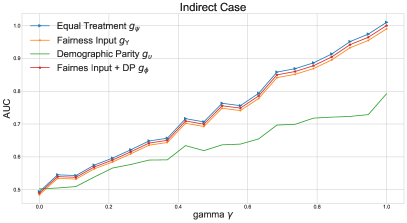
- The AUC of the C2ST on synthetic data showed strong detection capability, with values above 0.6 in both indirect and uninformative cases.
- The explanationspace package enables end-to-end auditing of models for unequal treatment with minimal integration overhead.
- In mobility-related tasks, the method detected meaningful disparities (e.g., AUC = 0.753 ± 0.02 for Asian-Mixed), even when outcome-based fairness metrics were close to parity.
Read this paper
Open the full text in the Nubint reader and ask about any passage as you read.
Read this paper on NubintThis review was generated by AI from the original paper. Please check the paper before citing it.