
[Paper Review] Beyond Question-Based Biases: Assessing Multimodal Shortcut Learning in Visual Question Answering
The paper introduces VQA-CE, an evaluation protocol to identify and test multimodal shortcuts in VQA datasets, revealing that state-of-the-art models rely on such shortcuts and that bias-reduction methods are largely ineffective without retraining."
We introduce an evaluation methodology for visual question answering (VQA) to better diagnose cases of shortcut learning. These cases happen when a model exploits spurious statistical regularities to produce correct answers but does not actually deploy the desired behavior. There is a need to identify possible shortcuts in a dataset and assess their use before deploying a model in the real world. The research community in VQA has focused exclusively on question-based shortcuts, where a model might, for example, answer "What is the color of the sky" with "blue" by relying mostly on the question-conditional training prior and give little weight to visual evidence. We go a step further and consider multimodal shortcuts that involve both questions and images. We first identify potential shortcuts in the popular VQA v2 training set by mining trivial predictive rules such as co-occurrences of words and visual elements. We then introduce VQA-CounterExamples (VQA-CE), an evaluation protocol based on our subset of CounterExamples i.e. image-question-answer triplets where our rules lead to incorrect answers. We use this new evaluation in a large-scale study of existing approaches for VQA. We demonstrate that even state-of-the-art models perform poorly and that existing techniques to reduce biases are largely ineffective in this context. Our findings suggest that past work on question-based biases in VQA has only addressed one facet of a complex issue. The code for our method is available at https://github.com/cdancette/detect-shortcuts.
Motivation & Objective
- Identify multimodal shortcuts in VQA datasets by mining textual-visual co-occurrences.
- Develop VQA-CounterExamples (VQA-CE) evaluation to probe model reliance on shortcuts without retraining.
- Evaluate a range of VQA models and bias-reduction methods on the VQA v2 dataset using VQA-CE.
- Analyze which shortcuts are most exploited and how counterexamples affect model performance.
Proposed method
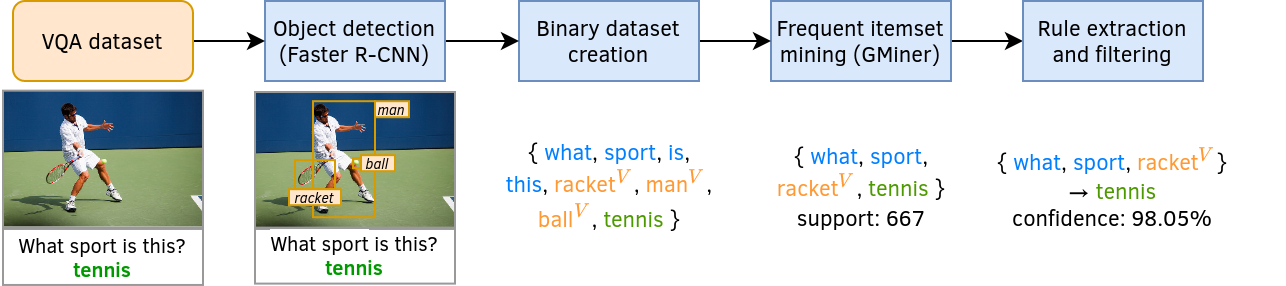
- Encode each VQA triplet (image, question, answer) as a binary vector over word tokens, detected objects, and answers.
- Apply frequent itemset mining (GMiner) to extract antecedents and consequents forming rules A -> C.
- Filter rules by training confidence and redundancy to obtain a set of plausible shortcuts.
- Construct a shortcut-based classifier from high-confidence rules and assess its predictive power on validation data.
- Create Counterexamples and Easy subsets in the VQA v2 validation set where shortcuts fail or succeed respectively, without retraining models.
- Assess model performance using the VQA-CE protocol by comparing overall accuracy to accuracy on Counterexamples and Easy subsets.
![Figure 1: Overview of this work. We first mine simple predictive rules in the training data such as: what + sport + $\color[rgb]{1,0.49609375,0}{\mathrm{racket}^{V}}$ $\rightarrow$ tennis . We then search for counterexamples in the validation set that identify some rules as undesirable statistical s](https://ar5iv.labs.arxiv.org/html/2104.03149/assets/images/big-picture.png)
Experimental results
Research questions
- RQ1What multimodal shortcuts (text + visual cues) exist in the VQA v2 training data?
- RQ2Do current VQA models rely on these multimodal shortcuts, and can bias-reduction methods mitigate this reliance?
- RQ3How do Shortcut-based Counterexamples reveal weaknesses in state-of-the-art VQA models compared to standard evaluation?
- RQ4Can we identify which specific shortcuts are most exploited by particular models?
Key findings
- A large set of multimodal shortcuts exist in VQA v2 training data; many are predictive on validation data and predominantly multimodal (~90%).
- State-of-the-art VQA models exhibit significant accuracy drops on the Counterexamples subset (roughly 29 points loss across models like UpDown, SAN, BLOCK, VilBERT).
- A shortcut-based classifier using mined rules achieves 42.26% overall accuracy on VQA v2 validation, comparable to strong baselines, yet yields 0% on Counterexamples, illustrating reliance on shortcuts.
- bias-reduction methods (e.g., RUBi, LMH variants, ESR) provide limited improvement on Counterexamples and often hurt Easy-subset performance, indicating limited transfer to natural multimodal shortcuts.
- Certain shortcuts correlate highly with model predictions (including high-confidence multimodal rules), and some reach 100% correlation with model outputs, underscoring that models exploit these shortcuts in practice.
Better researchstarts right now
From reading papers to final review, dramatically reduce your research time.
No credit card · Free plan available
This review was created by AI and reviewed by human editors.