
[Paper Review] Beyond Self-Attention: Deformable Large Kernel Attention for Medical Image Segmentation
This paper proposes Deformable Large Kernel Attention (D-LKA), a lightweight, efficient attention mechanism that replaces self-attention in Vision Transformers for medical image segmentation. By using large convolutional kernels with deformable sampling grids, D-LKA captures global context with linear complexity, enabling superior 3D volumetric feature learning. The resulting D-LKA Net achieves state-of-the-art performance on Synapse, NIH Pancreas, and Skin Lesion datasets with fewer parameters and FLOPs.
Medical image segmentation has seen significant improvements with transformer models, which excel in grasping far-reaching contexts and global contextual information. However, the increasing computational demands of these models, proportional to the squared token count, limit their depth and resolution capabilities. Most current methods process D volumetric image data slice-by-slice (called pseudo 3D), missing crucial inter-slice information and thus reducing the model's overall performance. To address these challenges, we introduce the concept of extbf{Deformable Large Kernel Attention (D-LKA Attention)}, a streamlined attention mechanism employing large convolution kernels to fully appreciate volumetric context. This mechanism operates within a receptive field akin to self-attention while sidestepping the computational overhead. Additionally, our proposed attention mechanism benefits from deformable convolutions to flexibly warp the sampling grid, enabling the model to adapt appropriately to diverse data patterns. We designed both 2D and 3D adaptations of the D-LKA Attention, with the latter excelling in cross-depth data understanding. Together, these components shape our novel hierarchical Vision Transformer architecture, the extit{D-LKA Net}. Evaluations of our model against leading methods on popular medical segmentation datasets (Synapse, NIH Pancreas, and Skin lesion) demonstrate its superior performance. Our code implementation is publicly available at the: https://github.com/mindflow-institue/deformableLKA
Motivation & Objective
- To address the high computational cost of self-attention in Vision Transformers for medical image segmentation.
- To overcome the limitations of 2D slice-wise processing in 3D medical image analysis by enabling cross-slice feature integration.
- To improve global context modeling while preserving local details, overcoming the local-receptive-field constraints of CNNs.
- To develop a lightweight, parameter-efficient attention mechanism that maintains high performance on medical segmentation benchmarks.
Proposed method
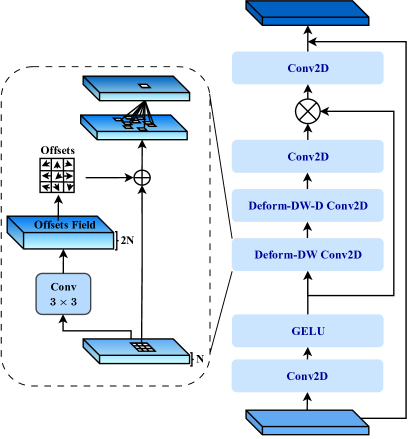
- Proposes Deformable Large Kernel Attention (D-LKA), which uses large convolutional kernels to simulate the long-range modeling of self-attention with linear complexity.
- Introduces a learnable, differentiable deformation grid that dynamically warps the sampling locations to adapt to complex anatomical structures.
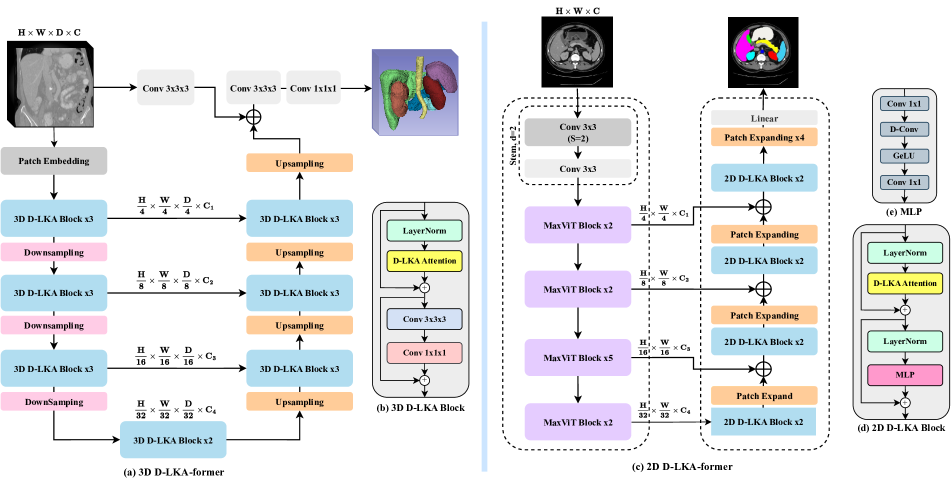
- Designs a 3D variant of D-LKA to capture inter-slice dependencies in volumetric medical images, enhancing 3D context understanding.
- Builds a hierarchical Vision Transformer architecture (D-LKA Net) that combines D-LKA blocks with skip connections for feature refinement.
- Employs a hybrid encoder-decoder structure combining CNN and transformer components to balance local detail and global context.
- Uses a multi-scale feature aggregation strategy through skip connections to preserve spatial resolution and improve segmentation accuracy.
Experimental results
Research questions
- RQ1Can a large kernel convolutional mechanism effectively replace self-attention in Vision Transformers for medical image segmentation while reducing computational cost?
- RQ2How does deformable sampling in large kernel attention improve feature representation for irregularly shaped organs in 3D medical images?
- RQ3To what extent does 3D D-LKA enhance cross-slice feature learning compared to 2D pseudo-3D approaches?
- RQ4What is the contribution of skip connections and deformable convolutions to the final segmentation performance in the D-LKA Net architecture?
- RQ5Can a lightweight attention mechanism outperform existing SOTA models in terms of both accuracy and model efficiency on medical segmentation benchmarks?
Key findings
- On the Synapse dataset, D-LKA Net achieved a DSC of 87.49%, outperforming UNETR++ (80.59%) and UNETR (77.42%) with 37.73M fewer parameters.
- On the NIH Pancreas dataset, D-LKA Net achieved a DSC of 81.22%, a 0.63% improvement over UNETR++ and a 1.04-point reduction in HD95.
- The 3D LKA variant with deformable convolutions achieved a 0.63% higher DSC than the non-deformable version, demonstrating the benefit of adaptive sampling.
- Ablation studies showed that skip connections significantly improve performance, with the highest-level skip connection alone improving DSC by 0.42%.
- The model achieved the lowest number of parameters (62.07M) among SOTA methods on the Pancreas dataset, indicating high efficiency.
- Qualitative results showed that D-LKA Net better captures the irregular shape of the pancreas compared to UNETR and UNETR++, reducing segmentation artifacts.
Read this paper
Open the full text in the Nubint reader and ask about any passage as you read.
Read this paper on NubintThis review was generated by AI from the original paper. Please check the paper before citing it.