
[Paper Review] Beyond Summarization: Designing AI Support for Real-World Expository Writing Tasks
This paper proposes a framework for AI-assisted expository writing that supports evidence-based, knowledge-generating tasks like literature reviews and clinical notes. It introduces three core components—supporting reading and evidence extraction, facilitating information synthesis, and enabling evidence-aware text composition—using LLMs to augment, not replace, the author's sensemaking process while minimizing bias and hallucination.
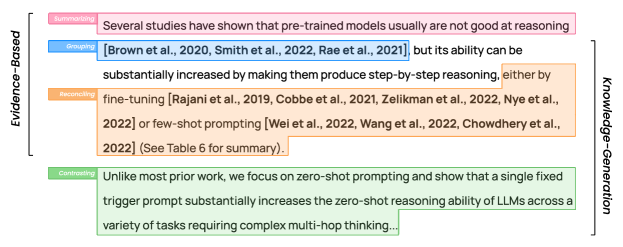
Large language models have introduced exciting new opportunities and challenges in designing and developing new AI-assisted writing support tools. Recent work has shown that leveraging this new technology can transform writing in many scenarios such as ideation during creative writing, editing support, and summarization. However, AI-supported expository writing--including real-world tasks like scholars writing literature reviews or doctors writing progress notes--is relatively understudied. In this position paper, we argue that developing AI supports for expository writing has unique and exciting research challenges and can lead to high real-world impacts. We characterize expository writing as evidence-based and knowledge-generating: it contains summaries of external documents as well as new information or knowledge. It can be seen as the product of authors' sensemaking process over a set of source documents, and the interplay between reading, reflection, and writing opens up new opportunities for designing AI support. We sketch three components for AI support design and discuss considerations for future research.
Motivation & Objective
- To address the underexplored domain of AI-assisted expository writing in real-world expert contexts such as academic literature reviews and clinical documentation.
- To identify the unique challenges in expository writing, including the need to synthesize new knowledge from external sources while maintaining fidelity to evidence.
- To design AI support that enhances the author’s sensemaking process without replacing their cognitive control or introducing bias.
- To propose a three-component framework for AI support: reading augmentation, information synthesis, and evidence-aware composition.
- To emphasize the importance of author agency, verification mechanisms, and minimizing hallucination in LLM-generated content during expository writing tasks.
Proposed method
- Supporting reading through evidence-aware LLMs that extract key facts from source documents and link them back to original text for verification.
- Using LLMs to assist in organizing and grouping evidence based on semantic similarity, enabling authors to identify patterns and relationships across documents.
- Facilitating synthesis by suggesting connections between pieces of evidence and proposing new conceptual frameworks, while allowing authors to verify and ground these ideas in source material.
- Enabling text composition through incremental, short-form LLM generation triggered by the author, with explicit prompts and cited evidence to ensure transparency and reduce hallucination.
- Designing the AI interface to allow authors to maintain control, with AI acting as a collaborator rather than a replacement, particularly during ideation and writing phases.
- Embedding verification mechanisms at each stage—evidence extraction, synthesis, and generation—so that all AI outputs are traceable and auditable to source documents.
Experimental results
Research questions
- RQ1How can AI support be designed to enhance the sensemaking process in expository writing without undermining author control or introducing bias?
- RQ2What role should LLMs play in reading and evidence extraction when writing is evidence-based and knowledge-generating?
- RQ3How can AI facilitate the synthesis of disparate pieces of evidence into coherent, novel insights without replacing the author’s cognitive reasoning?
- RQ4What design patterns minimize hallucination and ensure traceability of AI-generated content in expository writing tasks?
- RQ5How can incremental, evidence-aware text generation improve the quality and reliability of AI-assisted writing compared to long-form generation?
Key findings
- Expository writing is distinct from summarization because it generates new knowledge from evidence, requiring support beyond simple text compression.
- LLMs can effectively support evidence extraction by identifying and linking key facts to source documents, improving accuracy and traceability.
- Supporting synthesis through semantic grouping and connection suggestion helps authors discover relationships between documents that may not be immediately apparent.
- Incremental, short-form text generation with explicit prompts and cited evidence reduces the risk of hallucination and improves verifiability compared to long-form generation.
- Author control and verification mechanisms are essential to prevent bias and ensure that AI-generated content reflects the author’s intended meaning and evidence base.
- The framework’s three components—reading support, synthesis facilitation, and evidence-aware composition—collectively enable more reliable, high-quality expository writing with AI assistance.
Read this paper
Open the full text in the Nubint reader and ask about any passage as you read.
Read this paper on NubintThis review was generated by AI from the original paper. Please check the paper before citing it.