
[Paper Review] Beyond Surface Statistics: Scene Representations in a Latent Diffusion Model
This paper investigates whether latent diffusion models (LDMs) like Stable Diffusion develop internal representations of 3D scene geometry despite being trained only on 2D images. Using linear probing and intervention experiments, it demonstrates that LDMs encode linear representations of depth and salient object/background distinctions early in the denoising process, and these representations causally influence image generation, suggesting LDMs learn more than surface-level statistics.
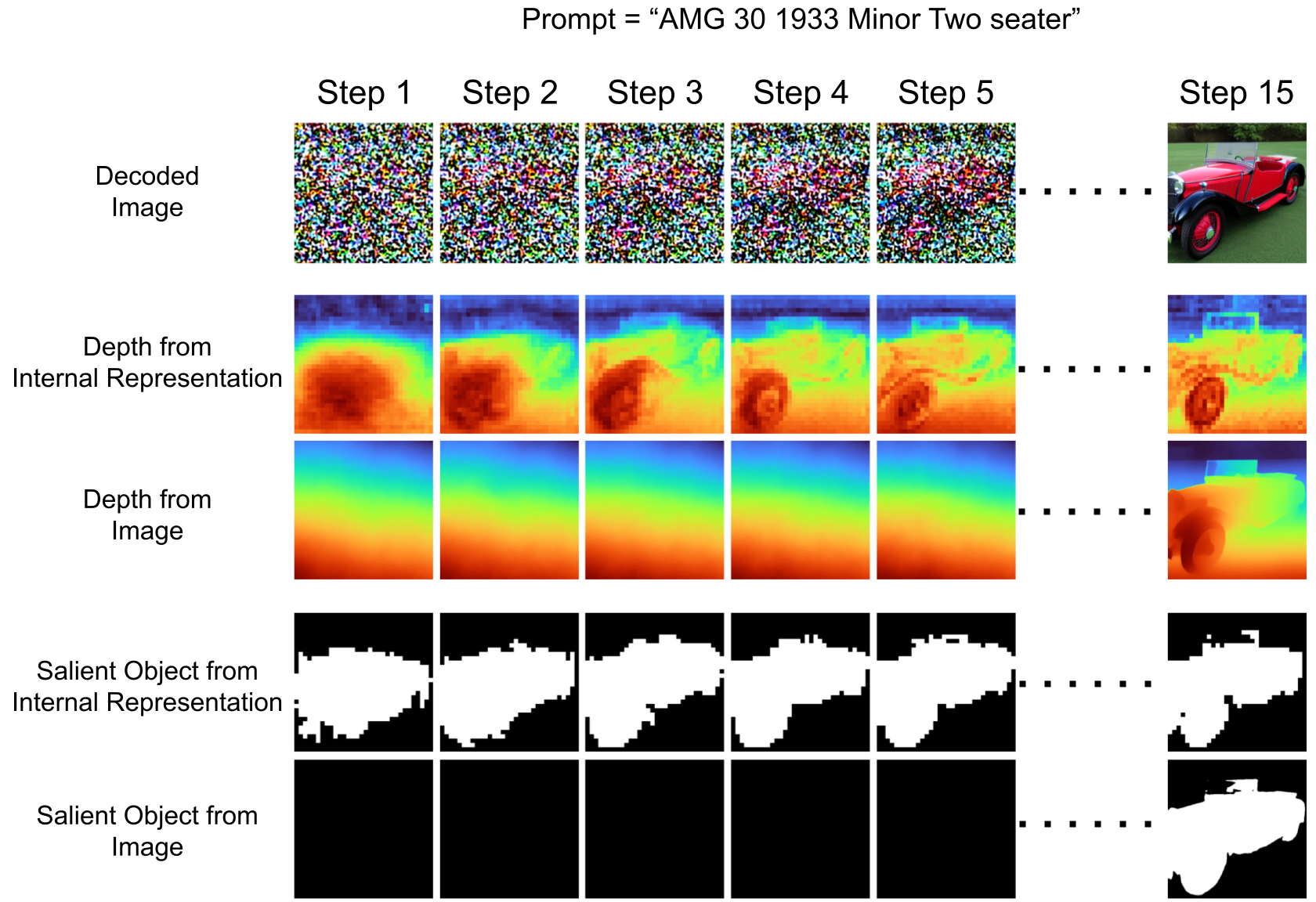
Latent diffusion models (LDMs) exhibit an impressive ability to produce realistic images, yet the inner workings of these models remain mysterious. Even when trained purely on images without explicit depth information, they typically output coherent pictures of 3D scenes. In this work, we investigate a basic interpretability question: does an LDM create and use an internal representation of simple scene geometry? Using linear probes, we find evidence that the internal activations of the LDM encode linear representations of both 3D depth data and a salient-object / background distinction. These representations appear surprisingly early in the denoising process$-$well before a human can easily make sense of the noisy images. Intervention experiments further indicate these representations play a causal role in image synthesis, and may be used for simple high-level editing of an LDM's output. Project page: https://yc015.github.io/scene-representation-diffusion-model/
Motivation & Objective
- To determine whether latent diffusion models (LDMs) learn internal representations of 3D scene geometry beyond surface-level statistics.
- To investigate whether such representations emerge early in the denoising process and are causally involved in image generation.
- To explore whether these internal representations can be manipulated to control high-level scene attributes like depth and saliency.
- To provide evidence that LDMs build world-like internal models rather than merely memorizing pixel-word correlations.
Proposed method
- Applied linear probing to intermediate activations of a pretrained Stable Diffusion LDM to detect representations of continuous depth and salient-object/background distinctions.
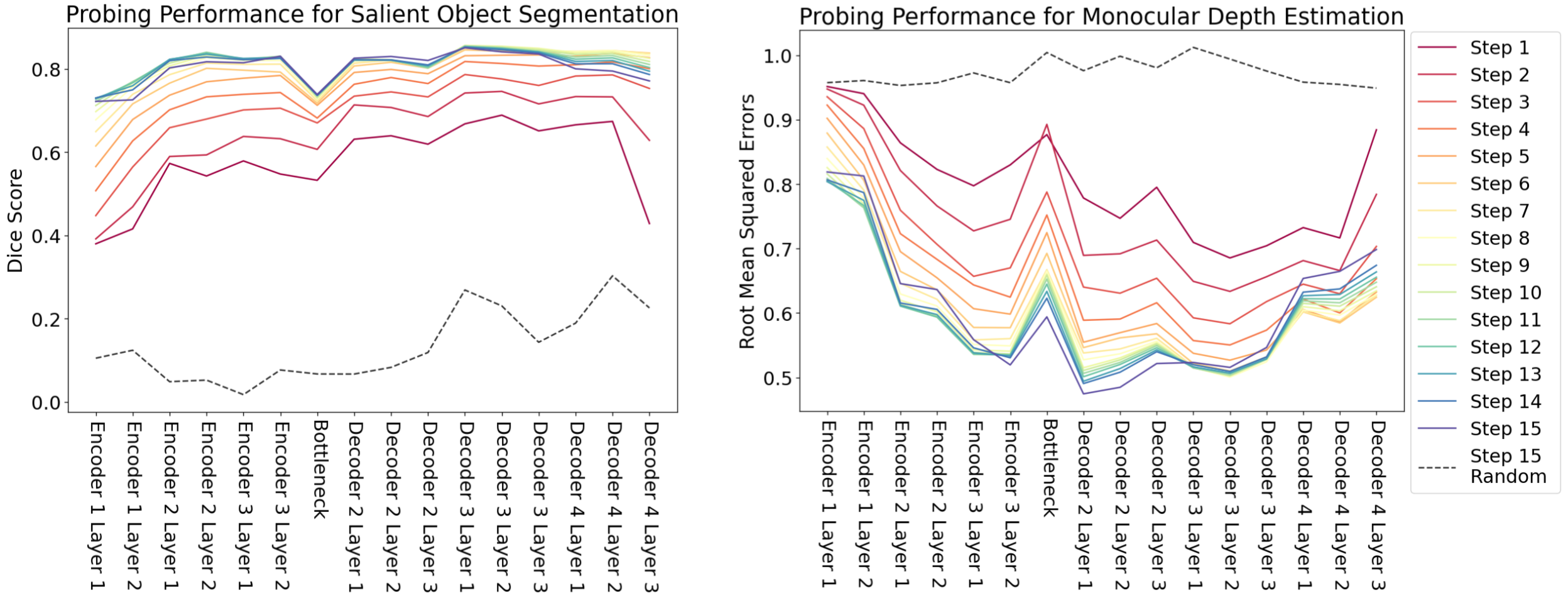
- Trained probing classifiers on internal activations at different denoising steps to assess when geometric representations emerge.
- Conducted intervention experiments by modifying the internal depth and saliency representations to measure causal effects on generated images.
- Used root mean square error (RMSE) to quantify the difference between target depth maps and intervened outputs, comparing to null interventions.
- Evaluated performance using baseline probes on off-the-shelf models applied to decoded RGB images at each denoising step.
- Performed fine-grained interventions to insert new salient objects at specific depth levels, demonstrating control over scene geometry.
Experimental results
Research questions
- RQ1Does a latent diffusion model trained only on 2D images develop an internal representation of 3D scene depth?
- RQ2Does the model also encode a distinction between salient objects and background in its internal activations?
- RQ3At what stage of the denoising process do these geometric representations emerge?
- RQ4Do these internal representations play a causal role in shaping the final image output?
- RQ5Can manipulating these internal representations enable high-level editing of scene geometry?
Key findings
- Linear probing revealed that internal activations of the LDM encode a linear representation of continuous depth and a salient-object/background distinction, even without explicit depth supervision.
- These geometric representations emerge early in the denoising process—well before human perception can discern coherent structures.
- Intervention experiments showed that modifying the internal depth representation reduced median RMSE to 0.63, significantly below the null intervention's 1.02, confirming a causal role.
- Fine-grained interventions successfully inserted new salient objects at desired depth levels, demonstrating control over scene geometry via internal representation editing.
- The model's internal representations of depth and saliency were found to be robust and interpretable, with high probing accuracy even on untrained random baselines.
- These findings suggest that LDMs learn more than surface statistics, potentially recapitulating aspects of world modeling or computer graphics pipelines.
Read this paper
Open the full text in the Nubint reader and ask about any passage as you read.
Read this paper on NubintThis review was generated by AI from the original paper. Please check the paper before citing it.