
[Paper Review] Beyond the Rozanov Bound on Electromagnetic Absorption via Periodic Temporal Modulations
This paper demonstrates that periodic temporal modulation of highly lossy materials can dramatically enhance electromagnetic absorption beyond the classical Rozanov bound, which limits passive, time-invariant absorbers. By continuously modulating the material's properties over time, the system achieves superior bandwidth and absorption efficiency without requiring precise pulse synchronization or thick slabs, enabling performance unattainable in conventional designs.
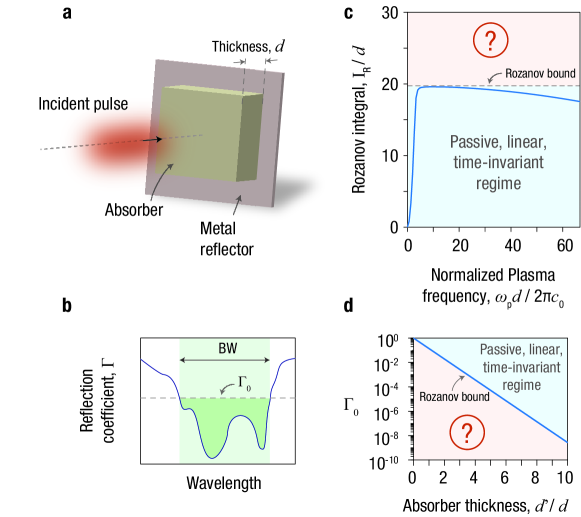
Incorporating time-varying elements into electromagnetic systems has shown to be a powerful approach to challenge well-established performance limits, for example bounds on absorption and impedance matching. So far, the majority of these studies have concentrated on time-switched systems, where the material undergoes instantaneous modulation in time while the input field is entirely contained within it. This approach, however, necessitates accurate timing of the switching event and limits how thin the system can ultimately be due to the spatial width of the impinging pulse. To address these challenges, here we investigate the periodic temporal modulation of highly lossy materials, focusing on their relatively unexplored parametric absorption aspects. Our results reveal that, by appropriately selecting the modulation parameters, the absorption performance of a periodically modulated absorber can be greatly improved compared to its time-invariant counterpart, and can even exceed the theoretical bound for conventional electromagnetic absorbers, namely, the "Rozanov bound". Our findings thus demonstrate the potential of periodic temporal modulations to enable significant improvements in absorber performance while circumventing the limitations imposed by precise timing and material thickness in time-switched schemes, opening up new opportunities for the design and optimization of advanced electromagnetic absorber systems for various applications.
Motivation & Objective
- To overcome the fundamental limitations imposed by the Rozanov bound on electromagnetic absorption in linear time-invariant (LTI) systems.
- To investigate the potential of periodic temporal modulation in lossy materials to enhance absorption performance beyond what is possible with static or time-switched absorbers.
- To address practical challenges in time-switched systems, such as strict timing requirements and minimum thickness constraints due to pulse width.
- To demonstrate that continuous periodic modulation can achieve impedance matching and high absorption without relying on precise synchronization or thick structures.
- To establish a framework for designing high-performance, thin, and broadband electromagnetic absorbers using time-modulated materials.
Proposed method
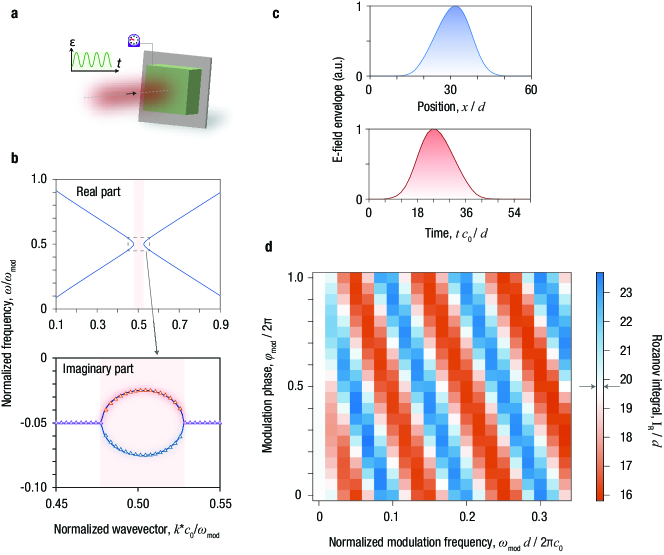
- The study employs a theoretical and numerical analysis of a non-magnetic, lossy slab with Drude-type dispersion, periodically modulated in time via a harmonic variation of its plasma frequency.
- The system is modeled using time-dependent Maxwell's equations with a periodic modulation envelope, where the modulation frequency and amplitude are key control parameters.
- The reflection coefficient spectrum is computed using a transfer matrix method adapted for time-varying media, accounting for harmonic generation and coupling across multiple frequency bands.
- Two figures of merit are used: the Rozanov Integral (I_R), which quantifies the total logarithmic reflection suppression over the spectrum, and absorption efficiency (AE), defined as the ratio of absorbed to incident power.
- The analysis compares the performance of time-modulated systems against the time-invariant baseline, with the Rozanov bound serving as the theoretical upper limit for LTI systems.
- The incident pulse is modeled with a well-defined bandwidth to ensure accurate comparison with the bound, and the reflection response is evaluated across the full spectrum, including harmonic components.
Experimental results
Research questions
- RQ1Can periodic temporal modulation of a lossy material surpass the Rozanov bound on electromagnetic absorption, which is a theoretical limit for passive, time-invariant systems?
- RQ2How does the absorption performance of a periodically modulated absorber compare to that of its time-invariant counterpart in terms of bandwidth and efficiency?
- RQ3To what extent can modulation parameters (amplitude, frequency, phase) be tuned to maximize absorption while remaining within physical constraints?
- RQ4Does periodic modulation eliminate the need for precise timing of pulse entry, as required in time-switched absorber schemes?
- RQ5Can the system maintain stability and avoid unbounded oscillations despite strong temporal modulation and high intrinsic losses?
Key findings
- The absorption efficiency of the periodically modulated absorber exceeds the Rozanov bound by a significant margin, demonstrating a fundamental break from the limits of passive LTI systems.
- For a given thickness and bandwidth, the system achieves a higher absorption efficiency than the time-invariant case, with improvements observed across a range of modulation amplitudes.
- The reflection spectrum shows a strong reduction in-band due to coherent interference and harmonic suppression, while out-of-band harmonics are generated but do not compromise overall absorption.
- The system is stable and free from unbounded temporal oscillations because both eigenmodes in the momentum bandgap exhibit decaying behavior due to high intrinsic losses.
- The absorber thickness is no longer constrained by the spatial width of the incident pulse, unlike in time-switched systems, enabling thinner and more compact designs.
- The method is robust to timing misalignment, as the continuous modulation ensures effective absorption regardless of when the pulse enters the medium, eliminating the need for precise synchronization.
Read this paper
Open the full text in the Nubint reader and ask about any passage as you read.
Read this paper on NubintThis review was generated by AI from the original paper. Please check the paper before citing it.