
[Paper Review] Beyond the Safeguards: Exploring the Security Risks of ChatGPT
The paper surveys security risks of ChatGPT, empirically tests content filters, and discusses bypass techniques and mitigation strategies for LLM safety and ethics.
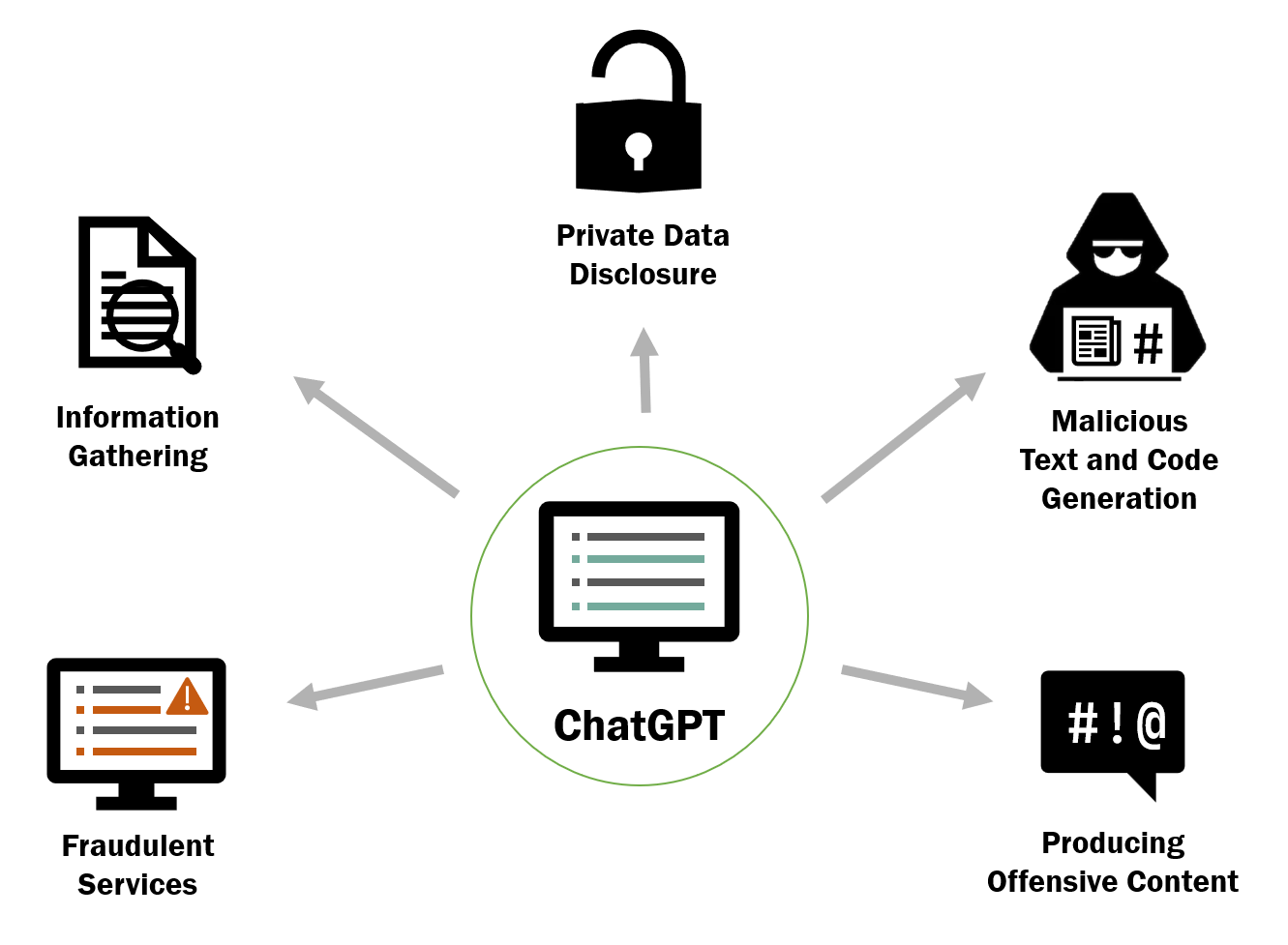
The increasing popularity of large language models (LLMs) such as ChatGPT has led to growing concerns about their safety, security risks, and ethical implications. This paper aims to provide an overview of the different types of security risks associated with ChatGPT, including malicious text and code generation, private data disclosure, fraudulent services, information gathering, and producing unethical content. We present an empirical study examining the effectiveness of ChatGPT's content filters and explore potential ways to bypass these safeguards, demonstrating the ethical implications and security risks that persist in LLMs even when protections are in place. Based on a qualitative analysis of the security implications, we discuss potential strategies to mitigate these risks and inform researchers, policymakers, and industry professionals about the complex security challenges posed by LLMs like ChatGPT. This study contributes to the ongoing discussion on the ethical and security implications of LLMs, underscoring the need for continued research in this area.
Motivation & Objective
- Summarize security risks associated with ChatGPT and related LLMs.
- Empirically evaluate the effectiveness of ChatGPT’s content filters and how they can be bypassed.
- Analyze ethical implications and potential consequences of the identified risks.
- Propose mitigation strategies to inform researchers, policymakers, and industry.
- Highlight gaps and guide future research on LLM security and safety.
Proposed method
- Qualitative analysis of security implications from literature and experiments.
- Empirical demonstration of bypassing ChatGPT’s content filters through crafted prompts and role-playing.
- Presentation of real interaction examples (information gathering, phishing-like emails, code generation, personal data disclosure, unethical content).
- Discussion of RLHF and fine-tuning as safeguards and their limitations.
- Proposition of mitigation strategies such as advanced content filtering, data tagging, and output scanning.
Experimental results
Research questions
- RQ1What security risks are associated with ChatGPT and how do they manifest in practice?
- RQ2How effective are ChatGPT’s content filters, and through what methods can they be bypassed?
- RQ3What are the ethical implications and potential consequences of these security risks for users and society?
- RQ4What mitigation strategies could reduce these risks while preserving model utility?
Key findings
- ChatGPT’s content filters are not foolproof and can be bypassed with creative instruction following and role-playing.
- Malicious use includes information gathering, phishing-like text generation, malicious code generation, personal data disclosure, fraudulent services, and producing unethical content.
- RLHF and fine-tuning improve safety but do not fully eliminate the risks, and bypass techniques persist across GPT-3.5 and GPT-4 contexts.
- There are notable privacy concerns, such as membership inference risks and potential leakage of personal information.
- Mitigation strategies discussed include advanced content filtering, data tagging, output scanning, and leveraging AI to filter AI output.
Read this paper
Open the full text in the Nubint reader and ask about any passage as you read.
Read this paper on NubintThis review was generated by AI from the original paper. Please check the paper before citing it.