
[Paper Review] Bi-Bimodal Modality Fusion for Correlation-Controlled Multimodal Sentiment Analysis
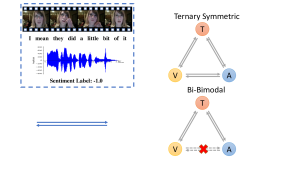
This paper proposes the Bi-Bimodal Fusion Network (BBFN), an end-to-end multimodal sentiment analysis model that uses two separate Transformer-based bimodal fusion modules (TV and TA) to jointly perform fusion and separation of modality representations, mitigating feature space collapse via a layer-wise feature space separator and enabling fine-grained control through a gated mechanism. BBFN achieves state-of-the-art performance on CMU-MOSI, CMU-MOSEI, and UR-FUNNY datasets, outperforming prior methods in sentiment intensity prediction and humor recognition.
Multimodal sentiment analysis aims to extract and integrate semantic information collected from multiple modalities to recognize the expressed emotions and sentiment in multimodal data. This research area's major concern lies in developing an extraordinary fusion scheme that can extract and integrate key information from various modalities. However, one issue that may restrict previous work to achieve a higher level is the lack of proper modeling for the dynamics of the competition between the independence and relevance among modalities, which could deteriorate fusion outcomes by causing the collapse of modality-specific feature space or introducing extra noise. To mitigate this, we propose the Bi-Bimodal Fusion Network (BBFN), a novel end-to-end network that performs fusion (relevance increment) and separation (difference increment) on pairwise modality representations. The two parts are trained simultaneously such that the combat between them is simulated. The model takes two bimodal pairs as input due to the known information imbalance among modalities. In addition, we leverage a gated control mechanism in the Transformer architecture to further improve the final output. Experimental results on three datasets (CMU-MOSI, CMU-MOSEI, and UR-FUNNY) verifies that our model significantly outperforms the SOTA. The implementation of this work is available at https://github.com/declare-lab/multimodal-deep-learning.
Motivation & Objective
- To address the limitation of existing multimodal fusion methods in handling imbalanced modality contributions and lack of control over modality correlation and independence.
- To mitigate feature space collapse in stacked Transformer architectures, which undermines modality independence and degrades fusion performance.
- To develop a fusion scheme that enables progressive, bidirectional complementation between modality pairs while preserving their unique representations.
- To improve sentiment analysis performance by introducing a gated control mechanism that dynamically adjusts information flow between modalities.
Proposed method
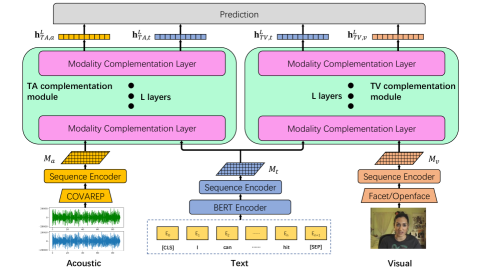
- The model employs two parallel bimodal fusion modules: one for text-visual (TV) and another for text-acoustic (TA) pairs, enabling focused, pairwise fusion.
- Each module uses stacked Transformer layers with modality-specific feature space separators to prevent representation collapse and maintain modality independence.
- A gated control mechanism is introduced at each fusion layer, using separate gates for retention and compound (cross-modality) attention, allowing dynamic control over information flow.
- The compound gate weights are used to determine modality dependency, with higher weights indicating greater reliance on the other modality’s representation.
- The two fusion modules are trained jointly, simulating a competitive yet cooperative dynamic between fusion and separation to enhance representation quality.
- The architecture is end-to-end trainable and leverages self-attention with residual connections to preserve long-range dependencies across modalities.
Experimental results
Research questions
- RQ1How can a fusion mechanism better balance the contributions of different modalities in multimodal sentiment analysis, especially when one modality (e.g., text) dominates?
- RQ2To what extent can a dedicated feature space separator mitigate representation collapse in stacked Transformer-based multimodal models?
- RQ3Can a gated control mechanism improve fusion performance by dynamically regulating modality interaction and dependency?
- RQ4How does the proposed bimodal fusion architecture compare to symmetric ternary fusion in terms of performance and robustness across diverse datasets?
- RQ5What is the impact of modality-specific attention control on the interpretability and accuracy of sentiment predictions?
Key findings
- BBFN achieves state-of-the-art performance on CMU-MOSI, CMU-MOSEI, and UR-FUNNY, with a mean absolute error (MAE) of 0.529 on CMU-MOSEI, outperforming previous SOTA methods.
- The ablation study shows that removing the feature space separator increases MAE to 0.533, confirming its role in mitigating representation collapse.
- Removing the gated control mechanism leads to a drop in performance, with MAE rising to 0.531, indicating its importance in dynamic modality interaction.
- The model achieves a correlation score of 0.775 on CMU-MOSEI, the highest among all compared methods, demonstrating improved alignment with ground truth.
- Visualization of gate weights confirms that the model learns modality dependency patterns consistent with human interpretation, such as higher compound gate weights for less informative modalities.
- BBFN’s predictions are closer to the ground truth than MISA’s, especially in case A where the model correctly identifies text as dominant, avoiding over-reliance on noisy visual or acoustic cues.
Read this paper
Open the full text in the Nubint reader and ask about any passage as you read.
Read this paper on NubintThis review was generated by AI from the original paper. Please check the paper before citing it.