
[Paper Review] Bi-level Contrastive Learning for Knowledge-Enhanced Molecule Representations
This paper proposes Gode, a bi-level contrastive learning framework that enhances molecule representation by jointly pre-training on molecular graphs and knowledge graph substructures. By aligning embeddings from both levels via contrastive learning, Gode achieves state-of-the-art performance, improving average ROC-AUC by 12.7% and RMSE/MAE by 34.4% across 11 molecular property prediction tasks.
Molecular representation learning is vital for various downstream applications, including the analysis and prediction of molecular properties and side effects. While Graph Neural Networks (GNNs) have been a popular framework for modeling molecular data, they often struggle to capture the full complexity of molecular representations. In this paper, we introduce a novel method called GODE, which accounts for the dual-level structure inherent in molecules. Molecules possess an intrinsic graph structure and simultaneously function as nodes within a broader molecular knowledge graph. GODE integrates individual molecular graph representations with multi-domain biochemical data from knowledge graphs. By pre-training two GNNs on different graph structures and employing contrastive learning, GODE effectively fuses molecular structures with their corresponding knowledge graph substructures. This fusion yields a more robust and informative representation, enhancing molecular property predictions by leveraging both chemical and biological information. When fine-tuned across 11 chemical property tasks, our model significantly outperforms existing benchmarks, achieving an average ROC-AUC improvement of 12.7% for classification tasks and an average RMSE/MAE improvement of 34.4% for regression tasks. Notably, GODE surpasses the current leading model in property prediction, with advancements of 2.2% in classification and 7.2% in regression tasks.
Motivation & Objective
- To address the limitation of standard molecular graph representations that fail to capture rich contextual knowledge from biochemical knowledge graphs.
- To improve molecular property prediction by integrating structural information from molecular graphs with relational knowledge from knowledge graphs.
- To develop a robust, self-supervised pre-training paradigm that aligns representations across two distinct graph levels—molecular and knowledge graph substructures.
- To construct a comprehensive molecular knowledge graph (MolKG) to support knowledge-driven molecular representation learning.
- To demonstrate that bi-level contrastive learning enhances representation robustness and generalization across diverse molecular property prediction tasks.
Proposed method
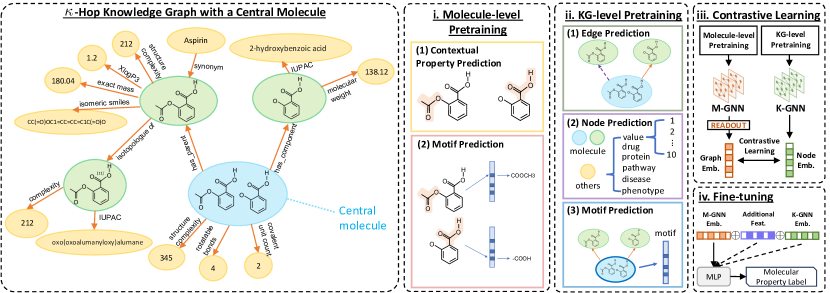
- Gode employs two dedicated graph neural networks: M-GNN for learning molecular graph representations and K-GNN for learning knowledge graph substructure representations centered on the target molecule.
- The method performs bi-level self-supervised pre-training: M-GNN is pre-trained on the molecular graph, while K-GNN is pre-trained on a subgraph of the knowledge graph (MolKG) centered on the molecule.
- Contrastive learning is applied between the M-GNN and K-GNN embeddings of the same molecule to align their representations, ensuring knowledge transfer across modalities.
- Functional group features are extracted using RDKit and concatenated with the final embeddings to enrich molecular representation.
- During fine-tuning, the model supports two inference modes: using only M-GNN embeddings or concatenating M-GNN and K-GNN outputs for improved performance.
- The MolKG knowledge graph is constructed from multi-domain biochemical data, including PubChemRDF, UMLS, and PrimeKG, to support comprehensive molecular knowledge integration.
Experimental results
Research questions
- RQ1Can joint pre-training on molecular graphs and knowledge graph substructures improve molecular representation learning for property prediction?
- RQ2How does bi-level contrastive learning between molecular and knowledge graph representations enhance embedding robustness and generalization?
- RQ3What is the impact of integrating functional group features on downstream molecular property prediction performance?
- RQ4How does Gode compare to state-of-the-art models like GROVER, MolCLR, and KANO across diverse molecular property prediction benchmarks?
- RQ5To what extent does pre-training on both molecular and knowledge graph structures reduce performance degradation on out-of-distribution molecular datasets?
Key findings
- Gode achieves an average ROC-AUC improvement of 12.7% over baselines across 11 classification tasks, significantly outperforming existing methods.
- For regression tasks, Gode reduces average RMSE/MAE by 34.4%, demonstrating superior predictive accuracy on continuous molecular property prediction.
- Gode surpasses the current leading model by 2.1% in average classification performance and 6.4% in average regression performance.
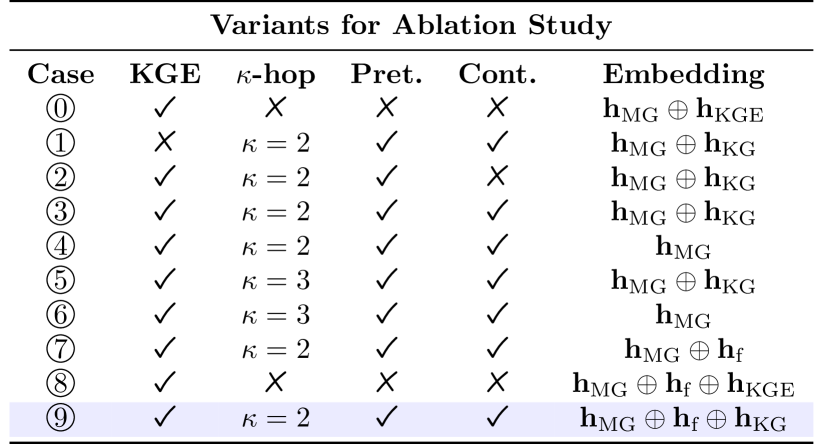
- Ablation studies show that pre-training both M-GNN and K-GNN yields the highest performance gain, with a 5.6% drop in ROC-AUC when both are randomly initialized.
- The inclusion of functional group features and contrastive alignment between M-GNN and K-GNN embeddings contributes significantly to performance gains, especially in regression tasks.
- The model maintains strong performance even when only M-GNN embeddings are used in fine-tuning, indicating the robustness and flexibility of the learned representations.
Read this paper
Open the full text in the Nubint reader and ask about any passage as you read.
Read this paper on NubintThis review was generated by AI from the original paper. Please check the paper before citing it.