
[Paper Review] BIDER: Bridging Knowledge Inconsistency for Efficient Retrieval-Augmented LLMs via Key Supporting Evidence
BIDER proposes a method to refine retrieval documents into Key Supporting Evidence (KSE) by synthesizing knowledge, fine-tuning via supervised learning, and aligning outputs with LLM preferences using reinforcement learning. It improves answer quality by 7% while reducing input length by 80%, outperforming existing retrieval-augmented LLMs across five datasets.
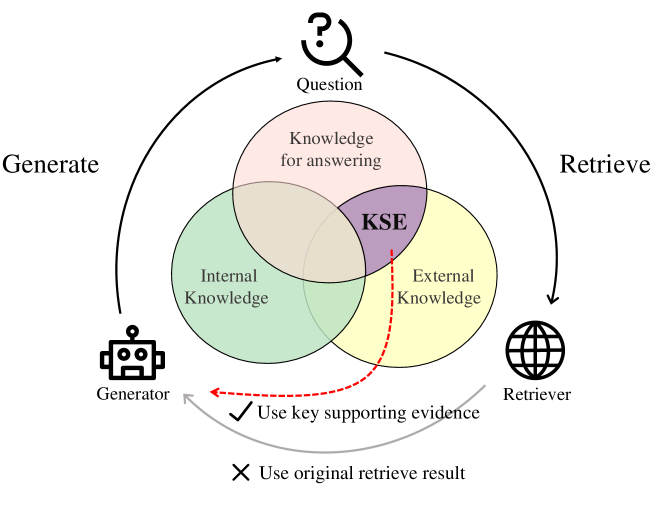
Retrieval-augmented large language models (LLMs) have demonstrated efficacy in knowledge-intensive tasks such as open-domain QA, addressing inherent challenges in knowledge update and factual inadequacy. However, inconsistencies between retrieval knowledge and the necessary knowledge for LLMs, leading to a decline in LLM's answer quality. This paper introduces BIDER, an approach that refines retrieval documents into Key Supporting Evidence (KSE) through knowledge synthesis, supervised fine-tuning (SFT), and preference alignment. We train BIDER by learning from crafting KSE, while maximizing its output to align with LLM's information acquisition preferences through reinforcement learning. Evaluations across five datasets show BIDER boosts LLMs' answer quality by 7% while reducing input content length in retrieval documents by 80%, outperforming existing methods. The proposed KSE simulation effectively equips LLMs with essential information for accurate question answering.
Motivation & Objective
- To address knowledge inconsistency between retrieved documents and the knowledge required by LLMs for accurate question answering.
- To reduce input length in retrieval-augmented generation (RAG) without sacrificing answer quality.
- To improve answer quality by refining retrieval outputs into concise, coherent, and essential Key Supporting Evidence (KSE).
- To develop a training pipeline that combines knowledge synthesis, supervised fine-tuning, and preference alignment for robust KSE generation.
- To validate the method’s effectiveness across diverse knowledge-intensive tasks and varying retrieval quality.
Proposed method
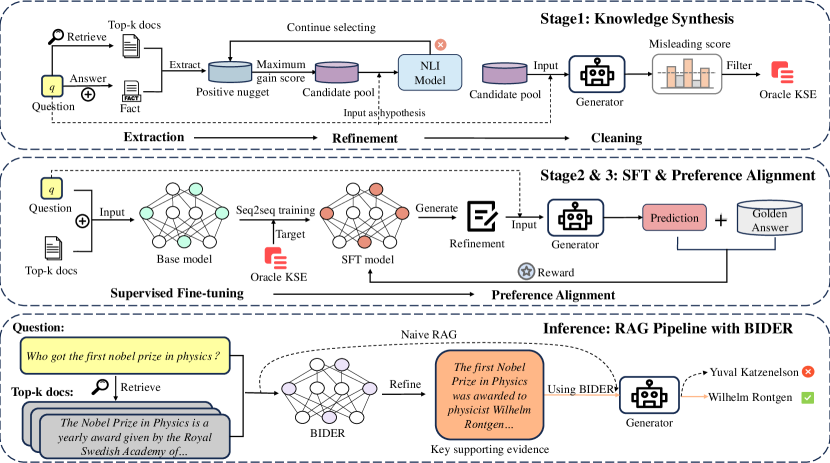
- A three-step knowledge synthesis process generates oracle-quality Key Supporting Evidence (KSE) by identifying, extracting, and refining essential information from retrieved documents.
- A sequence-to-sequence model is trained via supervised fine-tuning (SFT) to map raw retrieval documents to KSE, learning the mapping from noisy input to concise, factual output.
- Preference alignment is applied using reinforcement learning to align the model’s output with the information acquisition preferences of downstream LLMs.
- The refinement process ensures KSE is coherent, information-rich, and positioned for optimal model utilization during generation.
- The method is trained end-to-end with a focus on high-quality training data construction before leveraging LLM feedback.
- The approach is evaluated in a RAG framework, where refined KSE is used as input to the generator, reducing input length while improving answer quality.
Experimental results
Research questions
- RQ1How can retrieval-augmented LLMs be improved when retrieved documents contain noise and inconsistencies with required knowledge?
- RQ2What is the impact of constructing high-quality training targets (KSE) on the performance of retrieval refinement models?
- RQ3To what extent does preference alignment with LLM feedback enhance the quality and structure of refined retrieval outputs?
- RQ4How does the method perform under varying retrieval quality, especially with weak or noisy retrievers?
- RQ5Can the refinement process reduce input length significantly while maintaining or improving answer accuracy?
Key findings
- BIDER improves answer quality by 7% on average across five datasets, with gains of 3.0% on NQ, 0.5% on TQA, and 0.5% on HotpotQA.
- Input retrieval length is reduced by 80% on average, significantly improving inference efficiency and reducing token consumption.
- Preference alignment increases the proportion of golden answers in model outputs by 3-4% and moves their average position closer to the beginning of the output.
- The method outperforms existing baselines, especially when retrieval quality is low, indicating strong robustness to noisy retrievers.
- Ablation studies confirm that knowledge synthesis is more critical than preference alignment, as removing it causes a larger performance drop than removing the latter.
- Inference latency is reduced by 10% end-to-end, with BIDER’s refinement step taking only 0.10 seconds per query on a V100-32G GPU.
Read this paper
Open the full text in the Nubint reader and ask about any passage as you read.
Read this paper on NubintThis review was generated by AI from the original paper. Please check the paper before citing it.