
[Paper Review] BigDatasetGAN: Synthesizing ImageNet with Pixel-wise Annotations
This paper proposes BigDatasetGAN, a method to synthesize a large-scale, pixel-wise annotated ImageNet dataset using only 5 manually annotated images per class from BigGAN. By training a segmentation head on these few labeled GAN samples, the model generates high-quality synthetic images with accurate masks, enabling state-of-the-art performance on downstream segmentation and detection tasks when used for pre-training.
Annotating images with pixel-wise labels is a time-consuming and costly process. Recently, DatasetGAN showcased a promising alternative - to synthesize a large labeled dataset via a generative adversarial network (GAN) by exploiting a small set of manually labeled, GAN-generated images. Here, we scale DatasetGAN to ImageNet scale of class diversity. We take image samples from the class-conditional generative model BigGAN trained on ImageNet, and manually annotate 5 images per class, for all 1k classes. By training an effective feature segmentation architecture on top of BigGAN, we turn BigGAN into a labeled dataset generator. We further show that VQGAN can similarly serve as a dataset generator, leveraging the already annotated data. We create a new ImageNet benchmark by labeling an additional set of 8k real images and evaluate segmentation performance in a variety of settings. Through an extensive ablation study we show big gains in leveraging a large generated dataset to train different supervised and self-supervised backbone models on pixel-wise tasks. Furthermore, we demonstrate that using our synthesized datasets for pre-training leads to improvements over standard ImageNet pre-training on several downstream datasets, such as PASCAL-VOC, MS-COCO, Cityscapes and chest X-ray, as well as tasks (detection, segmentation). Our benchmark will be made public and maintain a leaderboard for this challenging task. Project Page: https://nv-tlabs.github.io/big-datasetgan/
Motivation & Objective
- To address the high cost and effort of manual pixel-wise annotation for large-scale datasets like ImageNet.
- To scale the DatasetGAN framework from class-conditional GANs to the full ImageNet with 1,000 classes.
- To create a new benchmark for semantic segmentation using both synthetic and real-annotated images.
- To evaluate the effectiveness of synthetic datasets for pre-training backbone models in dense prediction tasks.
- To demonstrate that synthetic data from BigGAN and VQGAN can outperform standard ImageNet pre-training on downstream benchmarks.
Proposed method
- Sample 5 images per class from BigGAN, manually annotate them with pixel-wise masks using a single expert.
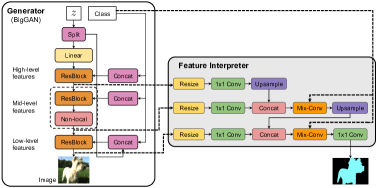
- Train a segmentation head (feature interpreter branch) on the GAN’s feature maps using the small annotated set.
- Use the trained model to generate large-scale synthetic datasets with both images and corresponding masks.
- Extend the method to VQGAN, showing it can also serve as a labeled data generator without additional annotation.
- Leverage the synthetic datasets for pre-training segmentation and detection models on downstream tasks.
- Host a public benchmark with a leaderboard to evaluate segmentation performance on real and synthetic data.

Experimental results
Research questions
- RQ1Can a small set of manually annotated GAN-generated images be used to train a segmentation head that generalizes to high-quality synthetic data generation at ImageNet scale?
- RQ2How does pre-training on synthetic, pixel-wise labeled data from BigGAN compare to standard ImageNet pre-training on downstream segmentation and detection tasks?
- RQ3To what extent can VQGAN be used as a data generator for pixel-wise segmentation without additional annotation?
- RQ4How does the quality of synthetic masks from BigGAN and VQGAN compare to real-annotated masks in terms of shape diversity and accuracy?
- RQ5What is the impact of synthetic data on self-supervised and supervised pre-training in dense prediction tasks?
Key findings
- Pre-training on BigDatasetGAN-generated synthetic data leads to significant performance gains over standard ImageNet pre-training on PASCAL-VOC, MS-COCO, Cityscapes, and chest X-ray datasets.
- The synthetic dataset from BigGAN achieves state-of-the-art performance on semantic segmentation benchmarks, outperforming models pre-trained on real ImageNet when fine-tuned on downstream tasks.
- VQGAN-sim generates more diverse images in terms of object scale, pose, and background compared to BigGAN-sim, though with slightly lower mask quality.
- The shape diversity metric shows that BigGAN-sim captures meaningful shape variations across classes, especially for animals, with k-means clustering revealing distinct object modes.
- Transfer learning experiments demonstrate that synthetic data improves performance across multiple backbone architectures and learning paradigms, including self-supervised and supervised pre-training.
- The benchmark with real-annotated images confirms the utility of the synthetic data, and the public leaderboard enables ongoing evaluation and progress tracking.
Read this paper
Open the full text in the Nubint reader and ask about any passage as you read.
Read this paper on NubintThis review was generated by AI from the original paper. Please check the paper before citing it.