
[Paper Review] Binarizing Split Learning for Data Privacy Enhancement and Computation Reduction
This paper proposes Binarized Split Learning (B-SL), a method that binarizes local layers in split learning to drastically reduce computation and memory usage—up to 17.5× faster inference and 32× less bandwidth—while enhancing data privacy. B-SL reduces leakage from smashed feature maps and integrates leakage loss and differential privacy for stronger privacy guarantees, achieving up to 50% lower SSIM leakage and effective defense against feature-space hijacking attacks.
Split learning (SL) enables data privacy preservation by allowing clients to collaboratively train a deep learning model with the server without sharing raw data. However, SL still has limitations such as potential data privacy leakage and high computation at clients. In this study, we propose to binarize the SL local layers for faster computation (up to 17.5 times less forward-propagation time in both training and inference phases on mobile devices) and reduced memory usage (up to 32 times less memory and bandwidth requirements). More importantly, the binarized SL (B-SL) model can reduce privacy leakage from SL smashed data with merely a small degradation in model accuracy. To further enhance the privacy preservation, we also propose two novel approaches: 1) training with additional local leak loss and 2) applying differential privacy, which could be integrated separately or concurrently into the B-SL model. Experimental results with different datasets have affirmed the advantages of the B-SL models compared with several benchmark models. The effectiveness of B-SL models against feature-space hijacking attack (FSHA) is also illustrated. Our results have demonstrated B-SL models are promising for lightweight IoT/mobile applications with high privacy-preservation requirements such as mobile healthcare applications.
Motivation & Objective
- Address high computational and memory overhead in split learning for resource-constrained mobile and IoT devices.
- Reduce data privacy leakage from shared smashed feature maps in split learning, especially for time-series and sensitive data like ECG.
- Enhance privacy preservation without significant accuracy degradation by combining binarization with novel leakage-reduction techniques.
- Integrate differential privacy into binarized models to provide provable privacy guarantees with minimal accuracy trade-off.
- Evaluate B-SL’s robustness against feature-space hijacking attacks (FSHA) and demonstrate its effectiveness in real-world scenarios.
Proposed method
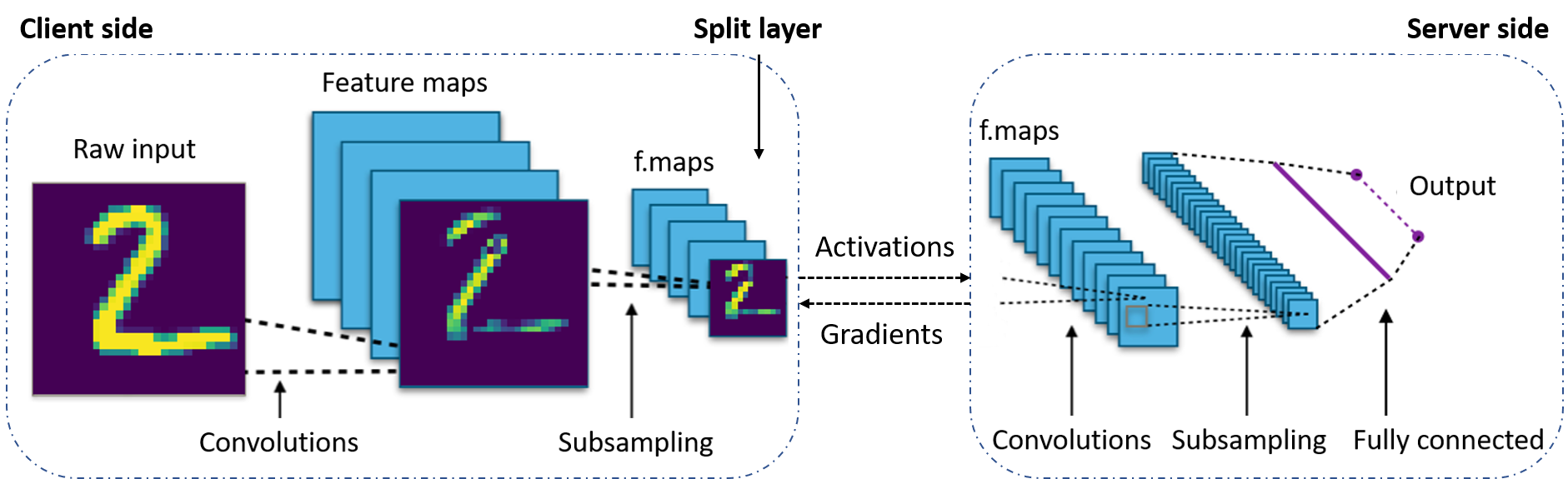
- Binarize only the local client-side layers in split learning, keeping the server-side full-precision, to accelerate forward and backward passes.
- Apply a hybrid training strategy where local binarized layers are trained with a novel local leak loss to minimize information leakage from feature maps.
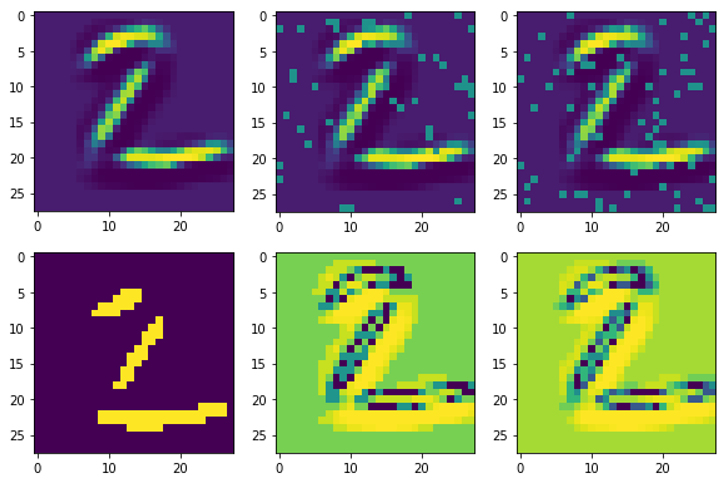
- Integrate differential privacy via a randomizing response mechanism to inject controlled noise into binarized activations, ensuring ε-differential privacy.
- Use a two-part model architecture: client handles first few layers (binarized), server processes remaining layers (full-precision), enabling privacy-preserving collaboration.
- Leverage SSIM and KL-Divergence metrics to quantitatively evaluate privacy leakage, comparing B-SL against standard SL and other baselines.
- Conduct end-to-end evaluation on MNIST, CIFAR-10, and other datasets under FSHA to test reconstruction resistance and model robustness.
Experimental results
Research questions
- RQ1Can binarizing local layers in split learning significantly reduce computation and memory usage on mobile and IoT devices without sacrificing model accuracy?
- RQ2To what extent does binarization reduce privacy leakage from shared smashed feature maps in split learning, especially under feature-space hijacking attacks?
- RQ3How effective is the proposed local leak loss in further minimizing information leakage beyond binarization alone?
- RQ4Can differential privacy be effectively integrated into binarized split learning to provide provable privacy guarantees with minimal accuracy degradation?
- RQ5How does B-SL compare to standard split learning in resisting data reconstruction attacks like FSHA in terms of reconstruction quality and classification accuracy?
Key findings
- B-SL achieves up to 17.5× faster forward-propagation time on mobile devices during both training and inference compared to standard split learning.
- Memory and bandwidth usage are reduced by up to 32× due to binarization of local activations and model weights.
- B-SL reduces privacy leakage by up to 50% in SSIM metric compared to standard split learning, especially when combined with local leak loss.
- Under feature-space hijacking attacks (FSHA), B-SL achieves only 10% reconstruction accuracy on split 1 and 64% on split 2, compared to 71% and 96% for standard SL, indicating stronger resistance.
- The model maintains high classification accuracy (94–95%) on MNIST even under FSHA, while SL drops to 97–98%, showing B-SL’s resilience despite higher accuracy drop.
- The integration of differential privacy via randomizing response achieves ε-differential privacy with minimal accuracy trade-off, enabling provable privacy guarantees.
Read this paper
Open the full text in the Nubint reader and ask about any passage as you read.
Read this paper on NubintThis review was generated by AI from the original paper. Please check the paper before citing it.