
[Paper Review] BinsFormer: Revisiting Adaptive Bins for Monocular Depth Estimation
BinsFormer introduces a Transformer-based adaptive bin generation for monocular depth estimation in a classification-regression framework, with a multi-scale refinement and an auxiliary scene understanding task, achieving state-of-the-art results on KITTI, NYU, and SUN RGB-D.
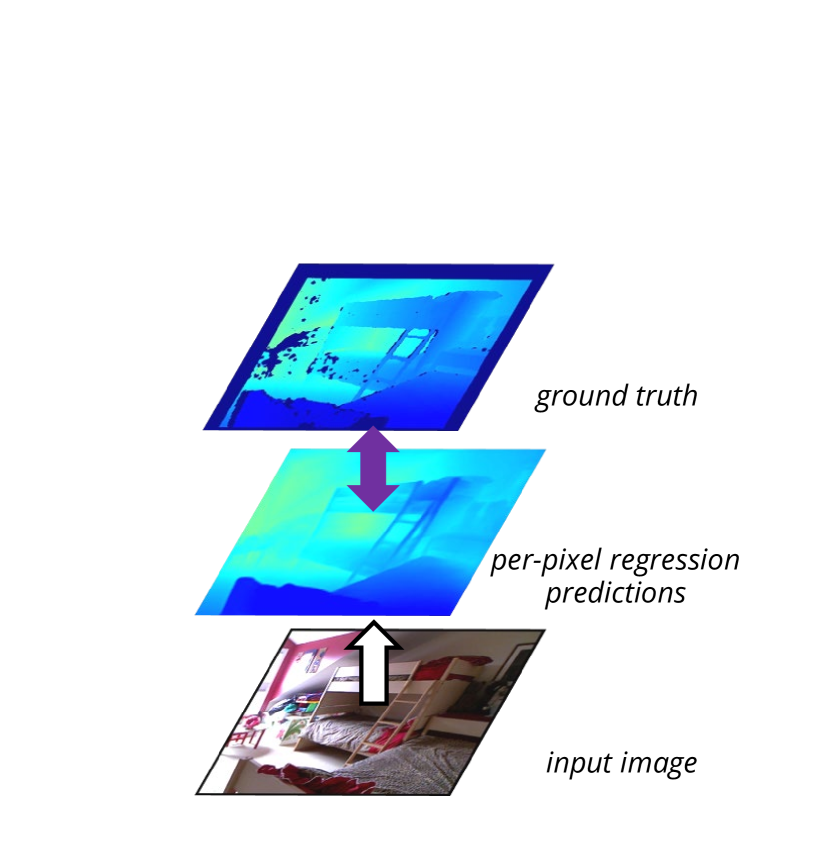
Monocular depth estimation is a fundamental task in computer vision and has drawn increasing attention. Recently, some methods reformulate it as a classification-regression task to boost the model performance, where continuous depth is estimated via a linear combination of predicted probability distributions and discrete bins. In this paper, we present a novel framework called BinsFormer, tailored for the classification-regression-based depth estimation. It mainly focuses on two crucial components in the specific task: 1) proper generation of adaptive bins and 2) sufficient interaction between probability distribution and bins predictions. To specify, we employ the Transformer decoder to generate bins, novelly viewing it as a direct set-to-set prediction problem. We further integrate a multi-scale decoder structure to achieve a comprehensive understanding of spatial geometry information and estimate depth maps in a coarse-to-fine manner. Moreover, an extra scene understanding query is proposed to improve the estimation accuracy, which turns out that models can implicitly learn useful information from an auxiliary environment classification task. Extensive experiments on the KITTI, NYU, and SUN RGB-D datasets demonstrate that BinsFormer surpasses state-of-the-art monocular depth estimation methods with prominent margins. Code and pretrained models will be made publicly available at \url{https://github.com/zhyever/Monocular-Depth-Estimation-Toolbox}.
Motivation & Objective
- Motivate and improve monocular depth estimation when formulating it as classification-regression with adaptive bins.
- Generate adaptive bin centers via a separate Transformer decoder treated as a set-to-set prediction problem.
- Enable strong global-local feature interactions through a multi-scale decoder for coarse-to-fine depth maps.
- Incorporate an auxiliary scene understanding task to guide bin generation and improve depth accuracy.
- Demonstrate state-of-the-art performance on KITTI, NYU-Depth-v2, and SUN RGB-D datasets and show good cross-dataset generalization.
Proposed method
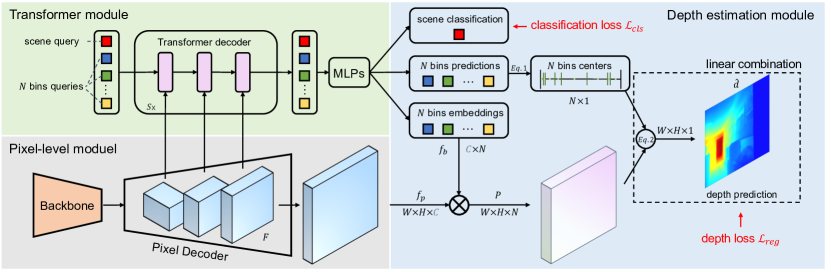
- Use a pixel-level module to extract multi-scale image features and per-pixel representations.
- Employ a Transformer decoder as a set-to-set predictor to output N bins lengths and N bins embeddings independently of the per-pixel features.
- Compute a per-pixel probability distribution over bins by dot-product matching between pixel embeddings and bins embeddings, then predict depth as a linear combination of bin centers with these probabilities.
- Generate bin centers from predicted bin lengths via a simple post-processing function to map lengths to depth values.
- Introduce an auxiliary scene understanding query in the Transformer to implicitly supervise bins generation through scene classification loss.
- Incorporate a multi-scale prediction refinement strategy where each scale feeds into the Transformer, enabling coarse-to-fine depth refinement with scale-weighted losses.
Experimental results
Research questions
- RQ1Can adaptive bins generated by a Transformer decoder improve monocular depth estimation in a classification-regression framework?
- RQ2Does separating bins generation from per-pixel representations and employing multi-scale refinement enhance depth accuracy and global-local consistency?
- RQ3Does an auxiliary scene understanding task provide beneficial supervision for bin generation and depth predictions?
- RQ4How does BinsFormer perform against state-of-the-art methods on KITTI, NYU-Depth-v2, and SUN RGB-D, and how well does it generalize cross-dataset?
Key findings
- BinsFormer achieves state-of-the-art or competitive performance on KITTI, NYU-Depth-v2, and SUN RGB-D datasets across multiple backbones (e.g., Swin variants, ResNet backbones).
- The separate Transformer-based bins generator and per-pixel module enable effective global and local information interaction, reducing large-area depth errors.
- Multi-scale refinement improves depth estimation when incorporating features from up to three scales, with diminishing gains beyond that.
- An auxiliary scene classification task aids bin generation, yielding measurable improvements with negligible training overhead.
- Across evaluation, BinsFormer demonstrates strong cross-dataset generalization, notably enhancing SUN RGB-D results when trained on NYU-Depth-v2.
Read this paper
Open the full text in the Nubint reader and ask about any passage as you read.
Read this paper on NubintThis review was generated by AI from the original paper. Please check the paper before citing it.