
[Paper Review] Blind Image Quality Assessment via Vision-Language Correspondence: A Multitask Learning Perspective
This paper proposes LIQE, a multitask learning framework for blind image quality assessment (BIQA) that leverages vision-language correspondence via CLIP embeddings to jointly optimize BIQA, scene classification, and distortion type identification. By modeling joint probability from visual-textual embeddings and using dynamic loss weighting, LIQE improves BIQA performance, enhances robustness, and enables perceptually meaningful realignment of quality scores across datasets.
We aim at advancing blind image quality assessment (BIQA), which predicts the human perception of image quality without any reference information. We develop a general and automated multitask learning scheme for BIQA to exploit auxiliary knowledge from other tasks, in a way that the model parameter sharing and the loss weighting are determined automatically. Specifically, we first describe all candidate label combinations (from multiple tasks) using a textual template, and compute the joint probability from the cosine similarities of the visual-textual embeddings. Predictions of each task can be inferred from the joint distribution, and optimized by carefully designed loss functions. Through comprehensive experiments on learning three tasks - BIQA, scene classification, and distortion type identification, we verify that the proposed BIQA method 1) benefits from the scene classification and distortion type identification tasks and outperforms the state-of-the-art on multiple IQA datasets, 2) is more robust in the group maximum differentiation competition, and 3) realigns the quality annotations from different IQA datasets more effectively. The source code is available at https://github.com/zwx8981/LIQE.
Motivation & Objective
- Address the data scarcity challenge in blind image quality assessment (BIQA) by leveraging auxiliary tasks with easier-to-annotate labels.
- Overcome the conceptual conflict between BIQA (distortion-sensitive) and high-level vision tasks (distortion-insensitive) like scene classification.
- Develop an automated multitask learning framework that dynamically shares parameters and weights losses without manual tuning.
- Improve the consistency and perceptual meaningfulness of quality annotations across diverse IQA datasets through realignment.
- Demonstrate that auxiliary tasks such as distortion type identification can enhance BIQA performance despite conceptual differences.
Proposed method
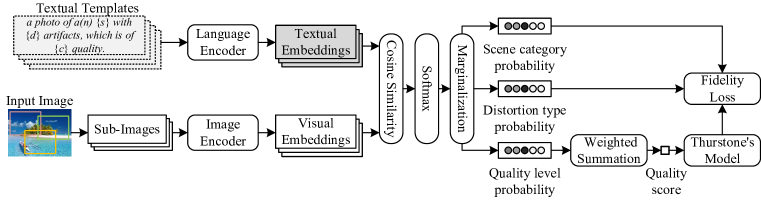
- Represent each image’s scene category, distortion type, and quality level using a unified textual template (e.g., 'a photo of a cityscape with Gaussian blur, which is of bad quality').
- Use CLIP to encode images and textual descriptions into shared visual and textual embeddings for joint representation learning.
- Compute the joint probability distribution over the three tasks using cosine similarity between image and textual embeddings.
- Derive marginal probabilities for each task from the joint distribution, with quality scores inferred as a weighted average using the marginal distribution.
- Optimize the model using a weighted sum of three fidelity losses (for BIQA, scene classification, and distortion type identification), with dynamic loss weighting to automate trade-offs.
- Train the model end-to-end on combined IQA datasets with added scene and distortion labels, enabling parameter sharing and joint optimization.
Experimental results
Research questions
- RQ1Can BIQA benefit from auxiliary tasks such as scene classification and distortion type identification in a multitask learning framework?
- RQ2How can vision-language correspondence be leveraged to automatically learn parameter sharing and loss weighting in multitask BIQA?
- RQ3Does joint optimization with conceptually conflicting tasks (e.g., scene classification) improve BIQA performance and robustness?
- RQ4Can the proposed method realign quality scores from disparate IQA datasets into a more perceptually consistent scale?
- RQ5What is the relative contribution of each auxiliary task to the final BIQA performance?
Key findings
- LIQE outperforms state-of-the-art methods on multiple BIQA datasets, achieving higher median SRCC (spearman rank correlation coefficient) in both standard and group maximum differentiation benchmarks.
- The inclusion of distortion type identification significantly improves BIQA performance, indicating a cooperative relationship between the tasks.
- The model with dynamic loss weighting achieves superior results compared to equal weighting, eliminating the need for manual hyperparameter tuning.
- Freezing the language encoder during training degrades performance, indicating that quality-related concepts require fine-tuning beyond pre-training.
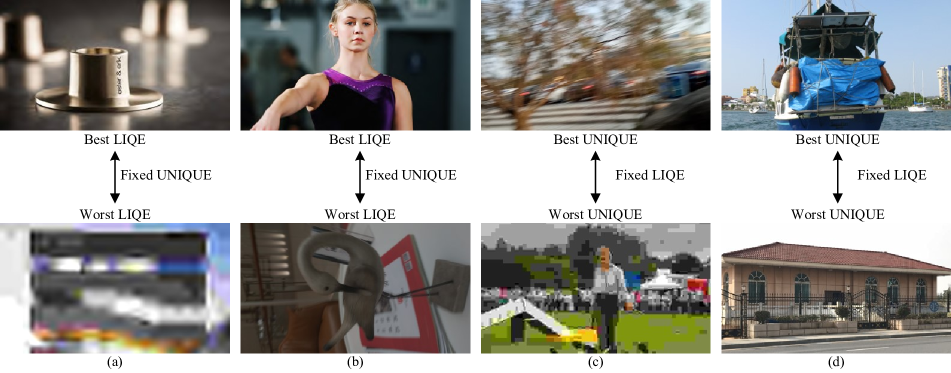
- LIQE successfully realigns mean opinion scores (MOS) from six different IQA datasets into a more perceptually consistent scale, outperforming prior methods like UNIQUE.
- The visual encoder representation optimized for BIQA diverges from the pre-trained CLIP, indicating that BIQA-specific optimization moves away from general transferability to other tasks.
Read this paper
Open the full text in the Nubint reader and ask about any passage as you read.
Read this paper on NubintThis review was generated by AI from the original paper. Please check the paper before citing it.