
[Paper Review] Blockchain-Empowered Trustworthy Data Sharing: Fundamentals, Applications, and Challenges
This paper surveys blockchain-enabled data sharing, proposes BlockDaSh architecture, and analyzes applications, lessons, and open challenges.
Various data-sharing platforms have emerged with the growing public demand for open data and legislation mandating certain data to remain open. Most of these platforms remain opaque, leading to many questions about data accuracy, provenance and lineage, privacy implications, consent management, and the lack of fair incentives for data providers. With their transparency, immutability, non-repudiation, and decentralization properties, blockchains could not be more apt to answer these questions and enhance trust in a data-sharing platform. However, blockchains are not good at handling the four Vs of big data (i.e., volume, variety, velocity, and veracity) due to their limited performance, scalability, and high cost. Given many related works proposes blockchain-based trustworthy data-sharing solutions, there is increasing confusion and difficulties in understanding and selecting these technologies and platforms in terms of their sharing mechanisms, sharing services, quality of services, and applications. In this paper, we conduct a comprehensive survey on blockchain-based data-sharing architectures and applications to fill the gap. First, we present the foundations of blockchains and discuss the challenges of current data-sharing techniques. Second, we focus on the convergence of blockchain and data sharing to give a clear picture of this landscape and propose a reference architecture for blockchain-based data sharing. Third, we discuss the industrial applications of blockchain-based data sharing, ranging from healthcare and smart grid to transportation and decarbonization. For each application, we provide lessons learned for the deployment of Blockchain-based data sharing. Finally, we discuss research challenges and open research directions.
Motivation & Objective
- Provide an overview of data sharing concepts, types, limitations, and motivation for blockchain-based solutions.
- Present a reference architecture for blockchain-based data sharing (BlockDaSh) and describe its building blocks and layers.
- Offer an in-depth taxonomy of blockchain-based data-sharing applications across multiple domains.
- Extract lessons learned from deployments to guide real-world implementations and identify open research directions.
Proposed method
- Survey existing data-sharing approaches and their limitations (centralized vs. decentralized).
- Analyze blockchain, DLTs, and privacy-preserving techniques relevant to data sharing.
- Introduce BlockDaSh, a reference architecture for blockchain-based data sharing and its adaptions to different scenarios.
- Develop a taxonomy of use cases (healthcare, supply chain, transportation, smart grid, data markets, etc.).
- Provide deployment lessons learned and outline research challenges and future directions.
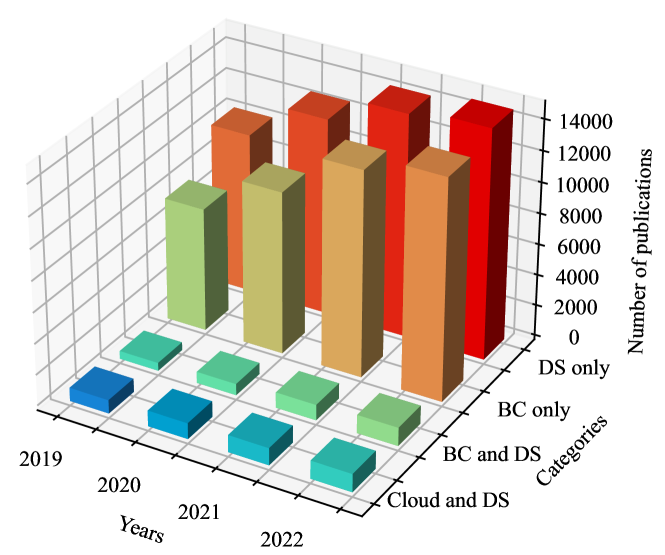
Experimental results
Research questions
- RQ1How can blockchain and related technologies address core data-sharing challenges such as centralization, interoperability, privacy, and trust?
- RQ2What is the BlockDaSh reference architecture for blockchain-based data sharing and how can it be adapted to various domains?
- RQ3What lessons can be drawn from real-world deployments across healthcare, supply chain, transportation, and decarbonization to guide future implementations?
Key findings
- Blockchain-based data sharing can mitigate centralization, privacy, and trust issues in traditional platforms.
- A reference architecture (BlockDaSh) is proposed to structure data processing, sharing, and storage in blockchain-based solutions.
- The paper provides a taxonomy of blockchain-based data-sharing applications across healthcare, supply chains, transportation, smart grids, data markets, and decarbonization.
- Lessons learned from deployments are discussed to guide future designs and deployments.
- Open research challenges and directions are identified, focusing on connectivity, security, privacy, incentives, scalability, and editability.
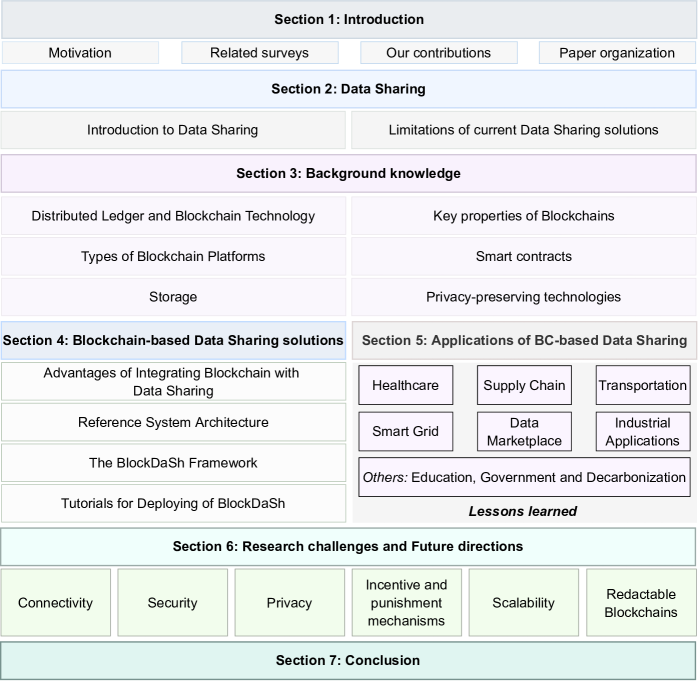
Read this paper
Open the full text in the Nubint reader and ask about any passage as you read.
Read this paper on NubintThis review was generated by AI from the original paper. Please check the paper before citing it.