
[Paper Review] Blockchain for Data Sharing at the Network Edge: Trade-Off Between Capability and Security
This paper models blockchain block propagation at the network edge using a Markov chain to analyze the trade-off between transaction throughput (capability) and security metrics like fault tolerance and malicious modification probability. It shows that increasing block generation speed or size boosts throughput up to thousands of TPS at the cost of reduced fault tolerance, while raising the confirmation threshold can restore security at the expense of higher confirmation delay.
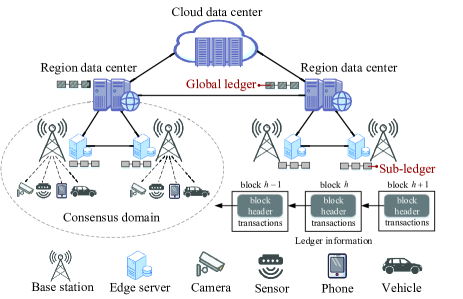
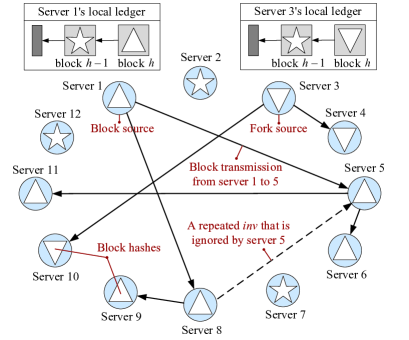
Blokchain is a promising technology to enable distributed and reliable data sharing at the network edge. The high security in blockchain is undoubtedly a critical factor for the network to handle important data item. On the other hand, according to the dilemma in blockchain, an overemphasis on distributed security will lead to poor transaction-processing capability, which limits the application of blockchain in data sharing scenarios with high-throughput and low-latency requirements. To enable demand-oriented distributed services, this paper investigates the relationship between capability and security in blockchain from the perspective of block propagation and forking problem. First, a Markov chain is introduced to analyze the gossiping-based block propagation among edge servers, which aims to derive block propagation delay and forking probability. Then, we study the impact of forking on blockchain capability and security metrics, in terms of transaction throughput, confirmation delay, fault tolerance, and the probability of malicious modification. The analytical results show that with the adjustment of block generation time or block size, transaction throughput improves at the sacrifice of fault tolerance, and vice versa. Meanwhile, the decline in security can be offset by adjusting confirmation threshold, at the cost of increasing confirmation delay. The analysis of capability-security trade-off can provide a theoretical guideline to manage blockchain performance based on the requirements of data sharing scenarios.
Motivation & Objective
- To analyze the capability-security trade-off in blockchain-based data sharing at the network edge.
- To model block propagation among edge servers using a Markov chain to quantify propagation delay and forking probability.
- To derive closed-form expressions for key performance metrics: transaction throughput, confirmation delay, fault tolerance, and modification probability.
- To provide theoretical bounds and design guidelines for tuning blockchain parameters based on application-specific needs in edge computing.
Proposed method
- A continuous-time Markov chain is constructed to model the dynamic spread of new blocks across edge servers, tracking the number of informed servers over time.
- The model incorporates asynchronous block transmission and accounts for network parameters such as total servers, selected servers, and data rate.
- Block propagation delay and failure state transition probabilities are derived using the Markov chain, enabling analysis of propagation reliability.
- Forking probability is calculated based on incomplete propagation, which directly affects blockchain security and capability metrics.
- Mathematical expressions for transaction throughput, confirmation delay, fault tolerance, and malicious modification probability are derived from the propagation model.
- The impact of adjustable parameters—block generation time, block size, and confirmation threshold—is analyzed to reveal trade-offs.
Experimental results
Research questions
- RQ1How does block propagation delay and forking probability vary with network parameters such as server count and transmission rate in edge blockchain systems?
- RQ2What is the theoretical upper bound of transaction throughput in edge blockchain, and how is it constrained by network and system parameters?
- RQ3How does forking affect fault tolerance and the probability of malicious data modification in blockchain-based data sharing?
- RQ4To what extent can increasing the confirmation threshold compensate for reduced security due to high forking probability?
- RQ5What is the trade-off between confirmation delay and security level when forking is present?
Key findings
- Transaction throughput can increase from 7 TPS to over 1,000 TPS by reducing block generation time or increasing block size, but this reduces fault tolerance by 10% to 40% depending on forking probability.
- The upper bound of transaction throughput is highly sensitive to network parameters, including the total number of edge servers, number of selected servers per transmission, and network data rate.
- When forking probability is high, the probability of malicious data modification increases, but this can be mitigated by increasing the confirmation threshold $ m $, which logarithmically reduces the risk.
- To achieve Bitcoin’s security level 1 (10% attacker hashrate), the confirmation threshold must be increased from $ m=6 $ to $ m=16 $; for security level 2 (20% hashrate), $ m=28 $ is required.
- Confirmation delay increases exponentially with block size due to forking, and higher security levels (via larger $ m $) incur additional delay, demonstrating a clear trade-off between security and latency.
- The expected time to exit a failure state (e.g., incomplete propagation) depends heavily on the selection parameter $ k $, with smaller $ k $ enabling faster recovery due to higher probability of selecting uninformed servers.
Read this paper
Open the full text in the Nubint reader and ask about any passage as you read.
Read this paper on NubintThis review was generated by AI from the original paper. Please check the paper before citing it.