
[Paper Review] BOLAA: Benchmarking and Orchestrating LLM-augmented Autonomous Agents
BOLAA benchmarks various LAA architectures with different LLM backbones and introduces a multi-agent controller to orchestrate specialized LAAs, evaluating on decision-making and knowledge reasoning tasks.
The massive successes of large language models (LLMs) encourage the emerging exploration of LLM-augmented Autonomous Agents (LAAs). An LAA is able to generate actions with its core LLM and interact with environments, which facilitates the ability to resolve complex tasks by conditioning on past interactions such as observations and actions. Since the investigation of LAA is still very recent, limited explorations are available. Therefore, we provide a comprehensive comparison of LAA in terms of both agent architectures and LLM backbones. Additionally, we propose a new strategy to orchestrate multiple LAAs such that each labor LAA focuses on one type of action, extit{i.e.} BOLAA, where a controller manages the communication among multiple agents. We conduct simulations on both decision-making and multi-step reasoning environments, which comprehensively justify the capacity of LAAs. Our performance results provide quantitative suggestions for designing LAA architectures and the optimal choice of LLMs, as well as the compatibility of both. We release our implementation code of LAAs to the public at \url{https://github.com/salesforce/BOLAA}.
Motivation & Objective
- Assess how LAA architectures perform across a range of LLM backbones.
- Identify which combinations of architecture and LLM yield best task performance.
- Investigate the benefits of orchestrating multiple specialized LAAs via a controller.
- Provide guidance on architecture design choices for scalable LAA systems.
- Release open-source implementation to foster reproducibility.
Proposed method
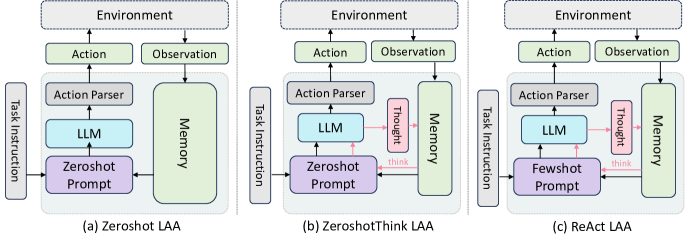
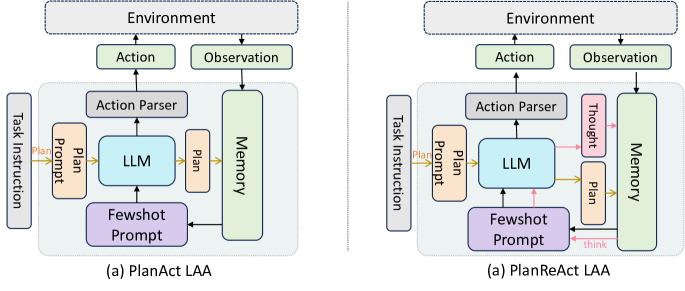
- Construct a suite of 6 solo LAA architectures spanning prompting, self-thinking, and planning variants.
- Pair architectures with multiple backbone LLMs to create a broad evaluation matrix.
- Propose BOLAA: a controller-based architecture that routes actions to specialized labor LAAs (e.g., separate click and search agents).
- Evaluate on WebShop (web navigation) and HotPotQA (multi-hop knowledge reasoning) environments.
- Report final rewards and intermediate recalls to assess efficacy and communication quality.
Experimental results
Research questions
- RQ1How do different LAA architectures perform with diverse LLM backbones on web navigation and reasoning tasks?
- RQ2Does orchestrating multiple specialized LAAs via a controller (BOLAA) improve performance relative to solo agents?
- RQ3What is the impact of context length and model size on LAA effectiveness across architectures?
- RQ4Which LLM backbones and architectures best generalize to open-domain tasks and planning scenarios?
Key findings
- BOLAA generally achieves the highest rewards across tested LLMs, indicating the benefit of specialized, orchestrated agents.
- The optimal pairing of LLM and architecture is task- and model-dependent (e.g., PlanAct, PlanReAct, or BOLAA perform differently across models).
- Larger, more capable LLMs often outperform smaller ones, but extremely long context can lead to more hallucinations and do not always improve results.
- Plan flows tend to help open-source LLMs, whereas planning can hinder some knowledge-reasoning tasks due to misaligned prior plans.
- In WebShop, BOLAA with specialized labor LAAs (search and click) consistently yields strong performance and recall; in HotPotQA, ReAct-based architectures excel with few-shot prompts.
Read this paper
Open the full text in the Nubint reader and ask about any passage as you read.
Read this paper on NubintThis review was generated by AI from the original paper. Please check the paper before citing it.