
[Paper Review] Boosting Adversarial Attacks by Leveraging Decision Boundary Information
This paper proposes Boundary Fitting Attack (BFA), a novel transfer-based adversarial attack that enhances transferability by leveraging gradient information from boundary points near the decision boundary of a substitute model. By averaging gradients from multiple boundary points, BFA generates a more effective adversarial direction that crosses the victim model's decision boundary more efficiently, achieving state-of-the-art attack success rates—5.6% higher on normal CNNs and 14.9% on defense CNNs, with 58.2% success rate against transformers when using CNNs as substitutes.
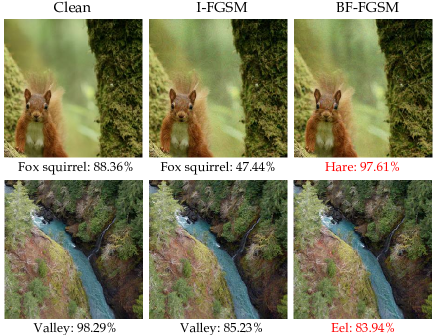
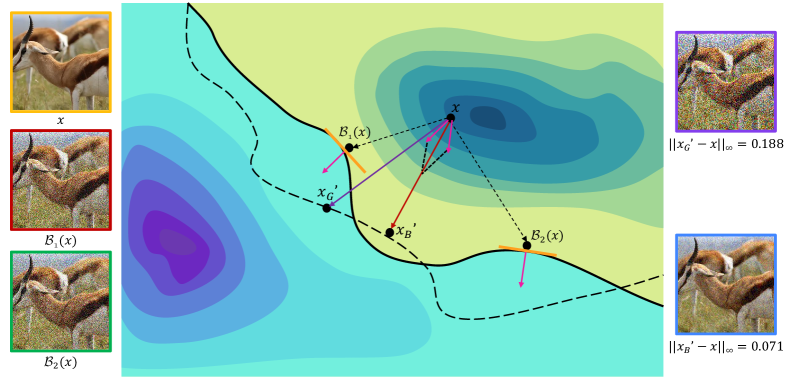
Due to the gap between a substitute model and a victim model, the gradient-based noise generated from a substitute model may have low transferability for a victim model since their gradients are different. Inspired by the fact that the decision boundaries of different models do not differ much, we conduct experiments and discover that the gradients of different models are more similar on the decision boundary than in the original position. Moreover, since the decision boundary in the vicinity of an input image is flat along most directions, we conjecture that the boundary gradients can help find an effective direction to cross the decision boundary of the victim models. Based on it, we propose a Boundary Fitting Attack to improve transferability. Specifically, we introduce a method to obtain a set of boundary points and leverage the gradient information of these points to update the adversarial examples. Notably, our method can be combined with existing gradient-based methods. Extensive experiments prove the effectiveness of our method, i.e., improving the success rate by 5.6% against normally trained CNNs and 14.9% against defense CNNs on average compared to state-of-the-art transfer-based attacks. Further we compare transformers with CNNs, the results indicate that transformers are more robust than CNNs. However, our method still outperforms existing methods when attacking transformers. Specifically, when using CNNs as substitute models, our method obtains an average attack success rate of 58.2%, which is 10.8% higher than other state-of-the-art transfer-based attacks.
Motivation & Objective
- To address the limited transferability of adversarial examples generated from substitute models due to differences in model gradients.
- To investigate whether decision boundary gradients are more similar across models than original input gradients, thereby improving transferability.
- To develop a method that enhances adversarial attack success rates by exploiting the flatness and geometric properties of decision boundaries.
- To evaluate the robustness of transformers versus CNNs under transfer-based attacks and improve attack effectiveness on both architectures.
- To provide theoretical and empirical justification for using boundary gradient averaging as a strategy to find more transferable adversarial directions.
Proposed method
- The method samples multiple boundary points by perturbing the input image along random directions until the model's prediction changes, indicating proximity to the decision boundary.
- It computes gradients at these boundary points and averages them to generate a refined adversarial update direction that is more aligned with the victim model's decision boundary.
- The approach is compatible with existing gradient-based attacks (e.g., FGSM, MI-FGSM), allowing integration into standard attack pipelines.
- A shrinkage factor γ controls the step size during boundary search to balance proximity to the boundary and computational efficiency.
- The number of sampled boundary points N is tuned to optimize transferability, with N=20 found to offer the best trade-off between performance and cost.
- The method introduces the concept of 'decision boundary distance' as a proxy for model robustness, with larger distances indicating higher robustness along natural directions.
Experimental results
Research questions
- RQ1Are the gradients of different models more similar on the decision boundary than at the original input location?
- RQ2Can leveraging boundary gradient information improve the transferability of adversarial examples across models?
- RQ3Does the flatness of decision boundaries enable more effective adversarial directions when derived from boundary gradients?
- RQ4How does the performance of transfer-based attacks compare between CNNs and transformers, and can our method improve attack success on both?
- RQ5What is the optimal configuration of hyperparameters (e.g., shrinkage factor γ, number of boundary points N) for maximizing transferability?
Key findings
- The proposed Boundary Fitting Attack improves the average attack success rate by 5.6% on normally trained CNNs and 14.9% on defense CNNs compared to state-of-the-art transfer-based attacks.
- When using CNNs as substitute models, the method achieves a 58.2% average attack success rate against transformers—10.8% higher than other state-of-the-art methods.
- The attack achieves a 78.1% average success rate on CNNs when transferring from transformers, outperforming other methods by 13.6%.
- With the addition of SIM, the method reaches 82.6% average success rate when attacking CNNs from transformers, demonstrating strong transferability.
- Experiments confirm that boundary gradients are more similar across models than original gradients, supporting the method’s core hypothesis.
- The ablation study shows that γ=0.6 and N=20 provide the optimal balance between performance and computational cost.
Read this paper
Open the full text in the Nubint reader and ask about any passage as you read.
Read this paper on NubintThis review was generated by AI from the original paper. Please check the paper before citing it.