
[Paper Review] Boosting Consistency in Story Visualization with Rich-Contextual Conditional Diffusion Models
RCDMs introduce a two-stage framework that uses a frame-prior transformer diffusion model plus a frame-contextual 3D diffusion model to achieve semantic and temporal consistency in story visualization, enabling single-forward-inference generation.
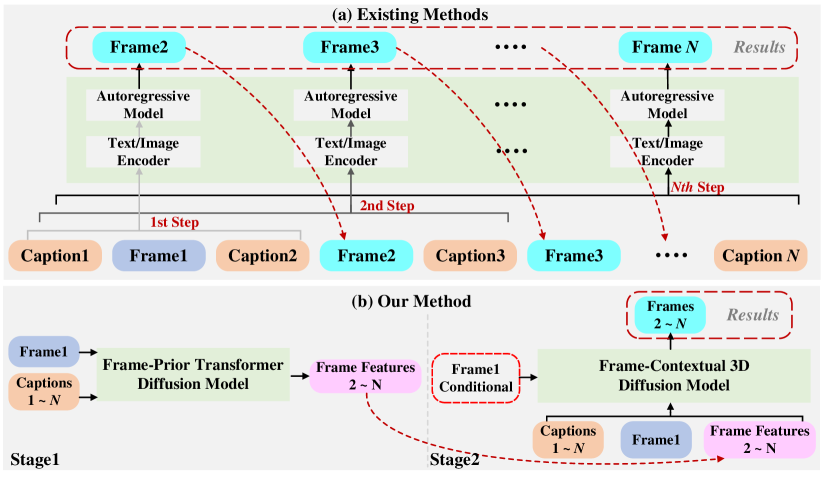
Recent research showcases the considerable potential of conditional diffusion models for generating consistent stories. However, current methods, which predominantly generate stories in an autoregressive and excessively caption-dependent manner, often underrate the contextual consistency and relevance of frames during sequential generation. To address this, we propose a novel Rich-contextual Conditional Diffusion Models (RCDMs), a two-stage approach designed to enhance story generation's semantic consistency and temporal consistency. Specifically, in the first stage, the frame-prior transformer diffusion model is presented to predict the frame semantic embedding of the unknown clip by aligning the semantic correlations between the captions and frames of the known clip. The second stage establishes a robust model with rich contextual conditions, including reference images of the known clip, the predicted frame semantic embedding of the unknown clip, and text embeddings of all captions. By jointly injecting these rich contextual conditions at the image and feature levels, RCDMs can generate semantic and temporal consistency stories. Moreover, RCDMs can generate consistent stories with a single forward inference compared to autoregressive models. Our qualitative and quantitative results demonstrate that our proposed RCDMs outperform in challenging scenarios. The code and model will be available at https://github.com/muzishen/RCDMs.
Motivation & Objective
- Address weak contextual and temporal consistency in autoregressive story visualization methods.
- Propose a frame-prior transformer diffusion model to predict unknown clip frame embeddings from known frames and captions.
- Develop a frame-contextual 3D diffusion model that jointly uses image-level and feature-level rich contextual conditions to generate coherent stories.
- Show quantitative and qualitative improvements over state-of-the-art on FlintstonesSV and PororoSV datasets.
Proposed method
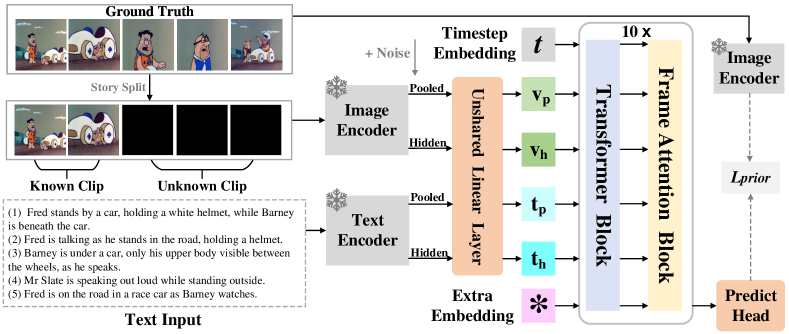
- Stage 1: Frame-prior transformer diffusion model predicts unknown frameSemantic embeddings using known clip frames and all captions.
- Stage 2: Frame-contextual 3D diffusion model generates frames with image-level (known clip images) and feature-level (frame embedding, all captions) conditions.
- Use a frozen CLIP-based image encoder and a frozen text encoder; employ frame attention blocks to capture temporal dynamics.
- Inject image-level and feature-level conditions via a multimodal interaction module and a semantic stacking module.
- Train with a two-stage objective and apply classifier-free guidance during sampling.
Experimental results
Research questions
- RQ1How can frame-level semantic priors improve cross-frame consistency in story visualization?
- RQ2Can rich contextual conditioning at both image and feature levels yield better semantic and temporal coherence than caption-only or autoregressive methods?
- RQ3Does the two-stage RCDM enable faster or comparable inference compared to autoregressive diffusion approaches?
- RQ4What is the contribution of each module (IC, MIM, SSM, stage1 prior) to overall performance?
Key findings
- RCDMs achieve the best FID, Char-Acc, and Char-F1 across FlintstonesSV and PororoSV versus SOTA methods.
- Frame-prior stage improves frame semantic consistency and boosts downstream character and scene consistency.
- Image-level conditioning and multimodal interaction modules substantially improve results over caption-only approaches.
- RCDMs generate consistent stories in a single forward inference, outperforming autoregressive baselines in speed.
- User studies show higher perceived visual quality, text-image relevance, and temporal consistency for RCDMs.
Read this paper
Open the full text in the Nubint reader and ask about any passage as you read.
Read this paper on NubintThis review was generated by AI from the original paper. Please check the paper before citing it.