
[Paper Review] Boosting Learning for LDPC Codes to Improve the Error-Floor Performance
This paper proposes a novel training framework for neural min-sum (NMS) decoders that eliminates the error-floor in LDPC codes by using boosting learning to specialize a post-decoder on uncorrected words from the first decoder. By introducing a block-wise retraining schedule and dynamic weight sharing, the method achieves near-error-floor-free performance down to FER = 10⁻⁷ across WiMAX, IEEE 802.11n, and 5G LDPC codes without hardware overhead.
Low-density parity-check (LDPC) codes have been successfully commercialized in communication systems due to their strong error correction capabilities and simple decoding process. However, the error-floor phenomenon of LDPC codes, in which the error rate stops decreasing rapidly at a certain level, presents challenges for achieving extremely low error rates and deploying LDPC codes in scenarios demanding ultra-high reliability. In this work, we propose training methods for neural min-sum (NMS) decoders to eliminate the error-floor effect. First, by leveraging the boosting learning technique of ensemble networks, we divide the decoding network into two neural decoders and train the post decoder to be specialized for uncorrected words that the first decoder fails to correct. Secondly, to address the vanishing gradient issue in training, we introduce a block-wise training schedule that locally trains a block of weights while retraining the preceding block. Lastly, we show that assigning different weights to unsatisfied check nodes effectively lowers the error-floor with a minimal number of weights. By applying these training methods to standard LDPC codes, we achieve the best error-floor performance compared to other decoding methods. The proposed NMS decoder, optimized solely through novel training methods without additional modules, can be integrated into existing LDPC decoders without incurring extra hardware costs. The source code is available at https://github.com/ghy1228/LDPC_Error_Floor .
Motivation & Objective
- Address the persistent error-floor phenomenon in LDPC codes, especially critical for ultra-reliable 6G and xURLLC systems.
- Improve error-floor performance of low-complexity neural min-sum (NMS) decoders without adding hardware complexity.
- Overcome training challenges such as vanishing gradients and local minima in deep iterative NMS decoders.
- Minimize the number of trainable weights while maintaining high error-floor suppression performance.
- Enable direct hardware integration of the proposed NMS decoder into existing LDPC systems with no additional area or latency cost.
Proposed method
- Apply boosting learning by cascading two neural decoders: the first focuses on waterfall performance, while the second is trained exclusively on uncorrected codewords from the first decoder.
- Implement a block-wise training schedule that divides decoding iterations into sub-blocks and re-trains previous blocks during each stage to avoid vanishing gradients and escape local minima.
- Introduce dynamic weight allocation by grouping weights across iterations, reducing parameter count while preserving diversity needed to correct trapping set-related error patterns.
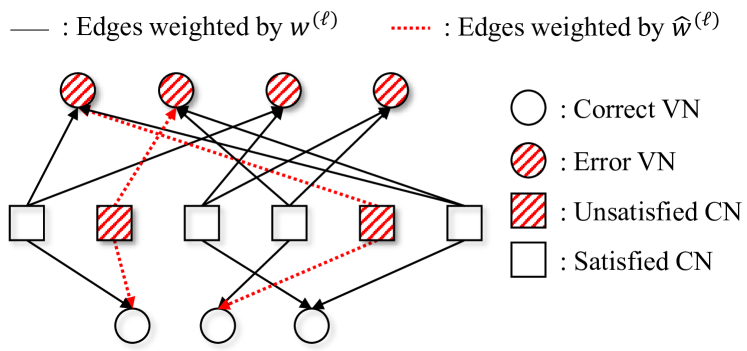
- Use unsatisfied check nodes as key training signals, assigning them higher weights to enhance correction of error-floor-inducing patterns.
- Train the NMS decoder using received words with bit error rate of 10⁻³ at Eb/N0 = 2–4 dB as training samples, employing an iter-by-iter training schedule.
- Optimize the decoder using a loss function that emphasizes correction of uncorrected words, enabling the post-decoder to specialize in error-floor patterns.
Experimental results
Research questions
- RQ1Can a two-stage neural decoder architecture effectively suppress the error-floor in LDPC codes by specializing the second decoder on uncorrected words?
- RQ2Does a block-wise retraining schedule mitigate the vanishing gradient problem in deep NMS decoders with over 50 iterations?
- RQ3Can dynamic weight sharing with minimal distinct weights maintain high error-floor suppression performance?
- RQ4How does the proposed training method compare in performance and complexity to existing post-processing and multi-loss training schemes?
- RQ5To what extent can the proposed NMS decoder achieve near-error-floor-free performance across diverse standard LDPC codes (e.g., WiMAX, 5G, IEEE 802.11n) without hardware modifications?
Key findings
- The proposed NMS decoder achieves a frame error rate (FER) of 10⁻⁷ with no noticeable error-floor across WiMAX, IEEE 802.11n, and 5G LDPC codes, outperforming conventional NMS and post-processing schemes.
- The error-floor is effectively eliminated by training the post-decoder on uncorrected words, reducing FER by multiple orders of magnitude in the error-floor region compared to baseline NMS decoders.
- The block-wise retraining schedule successfully trains 50 iterations of the NMS decoder, avoiding vanishing gradients and outperforming both multi-loss and standard iter-by-iter training methods.
- The proposed method uses only 3×ℓ weights (130 for ℓ=50), significantly reducing memory overhead compared to full weight diversity schemes (e.g., 676,800 operations in ABC 2018), while maintaining superior performance.
- Despite higher per-iteration complexity than the MS decoder, the total complexity is lower than the state-of-the-art post-processing scheme (which uses 150 iterations), due to fewer total iterations and efficient weight sharing.
- The method is hardware-compatible and can be directly integrated into existing LDPC decoder architectures without additional area or latency, as confirmed by complexity analysis in Table 2.
Read this paper
Open the full text in the Nubint reader and ask about any passage as you read.
Read this paper on NubintThis review was generated by AI from the original paper. Please check the paper before citing it.