
[Paper Review] Bootstrapping LLM-based Task-Oriented Dialogue Agents via Self-Talk
This paper proposes a self-talk framework where two LLMs simulate a client and agent in task-oriented dialogues to generate high-quality training data, using automated metrics to filter successful conversations. The method significantly improves dialogue policy learning with minimal human data, achieving superior performance in both automated and human evaluations compared to baseline fine-tuning.
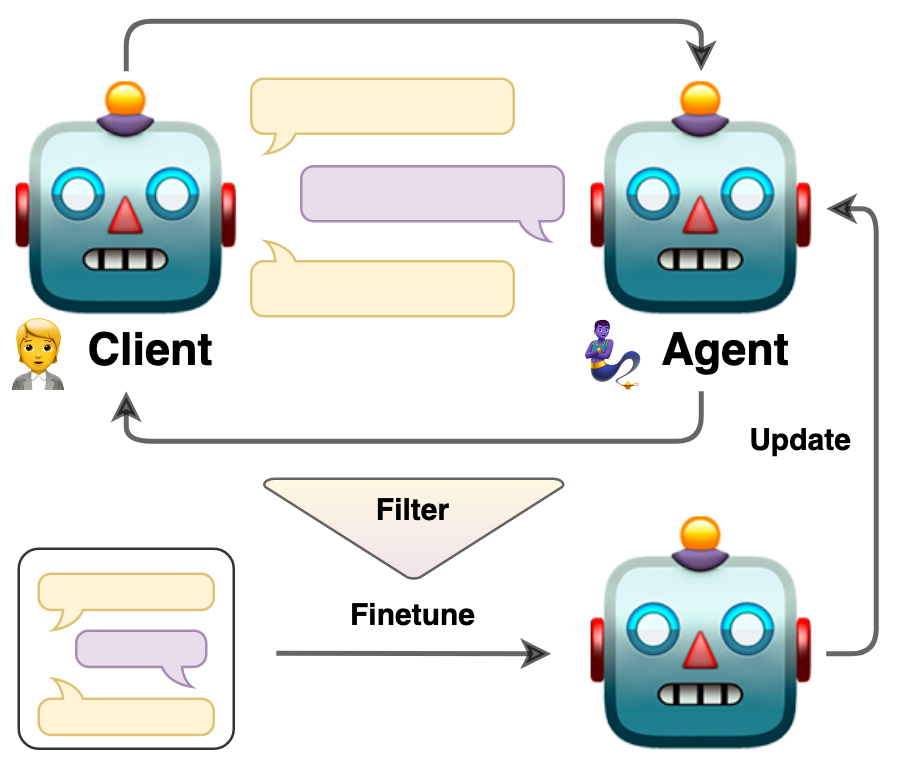
Large language models (LLMs) are powerful dialogue agents, but specializing them towards fulfilling a specific function can be challenging. Instructing tuning, i.e. tuning models on instruction and sample responses generated by humans (Ouyang et al., 2022), has proven as an effective method to do so, yet requires a number of data samples that a) might not be available or b) costly to generate. Furthermore, this cost increases when the goal is to make the LLM follow a specific workflow within a dialogue instead of single instructions. Inspired by the self-play technique in reinforcement learning and the use of LLMs to simulate human agents, we propose a more effective method for data collection through LLMs engaging in a conversation in various roles. This approach generates a training data via "self-talk" of LLMs that can be refined and utilized for supervised fine-tuning. We introduce an automated way to measure the (partial) success of a dialogue. This metric is used to filter the generated conversational data that is fed back in LLM for training. Based on our automated and human evaluations of conversation quality, we demonstrate that such self-talk data improves results. In addition, we examine the various characteristics that showcase the quality of generated dialogues and how they can be connected to their potential utility as training data.
Motivation & Objective
- To address the challenge of acquiring high-quality, task-specific dialogue data for fine-tuning LLMs, especially when human-annotated data is scarce or expensive.
- To explore whether LLMs can autonomously generate useful, structured dialogue data through role-playing conversations between a client and agent.
- To develop automated metrics for evaluating dialogue success and consistency to filter low-quality or off-topic conversations.
- To assess the effectiveness of self-talk generated data in improving the performance of task-oriented dialogue agents via supervised fine-tuning.
- To evaluate the utility of different filtering strategies based on subgoal adherence and dialogue structure for training data curation.
Proposed method
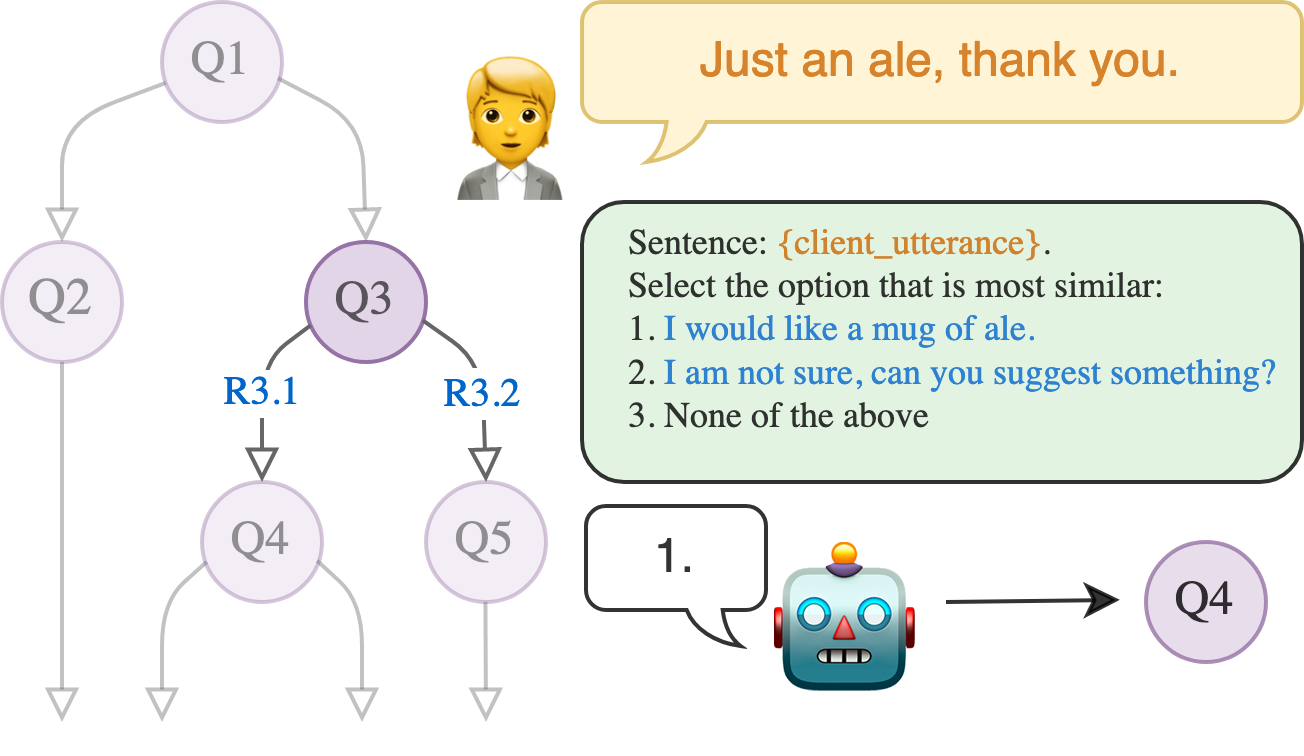
- Two LLMs are prompted to role-play as a client (with a persona and goal) and an agent (with a fixed dialogue policy), engaging in simulated task-oriented dialogues.
- Each conversation is automatically evaluated using a success metric based on subgoal completion and dialogue consistency, enabling filtering of high-quality samples.
- The filtered dialogues are used to fine-tune the agent model via supervised fine-tuning, improving its adherence to intended dialogue workflows.
- Multiple filtering strategies are explored, including percentage of subgoals completed and absolute subgoal counts, to assess their impact on model performance.
- The method is evaluated using both automated metrics and human evaluation to compare model behavior against baseline fine-tuning with human data.
- The approach is applied to diverse task scenarios such as granting wishes, casting curses, selling items, and granting wealth, demonstrating generalizability.
Experimental results
Research questions
- RQ1Can LLMs generate high-quality, task-specific dialogue data through self-talk between role-playing agents, reducing reliance on costly human-annotated data?
- RQ2How effective are automated metrics in identifying successful and consistent dialogues from LLM-generated conversations?
- RQ3Does filtering self-talk data based on subgoal completion improve the performance of fine-tuned dialogue agents?
- RQ4How does the performance of agents fine-tuned on self-talk data compare to those fine-tuned on human-annotated data in both automated and human evaluations?
- RQ5What characteristics of generated dialogues correlate with their utility as training data for task-oriented dialogue agents?
Key findings
- The self-talk method successfully generates diverse, structured dialogues that align with intended task workflows, even without human-annotated data.
- Filtering conversations using automated success metrics significantly improves the quality of training data, leading to better generalization and reduced hallucination.
- Agents fine-tuned on self-talk data outperform baseline models fine-tuned on human data in terms of dialogue success and consistency, particularly when using subgoal-based filtering.
- Human evaluations confirm that models trained on filtered self-talk data produce more natural, goal-oriented, and coherent dialogues than those trained on unfiltered or human-annotated data alone.
- The percentage of subgoals completed during a dialogue is a strong predictor of training data quality, with higher subgoal completion rates correlating with better downstream performance.
- The method demonstrates robustness across multiple task types, including wish-granting, curse-casting, item-selling, and wealth-granting scenarios, showing broad applicability.
Read this paper
Open the full text in the Nubint reader and ask about any passage as you read.
Read this paper on NubintThis review was generated by AI from the original paper. Please check the paper before citing it.